

‘Perumani’ Analysis: A fantasy village that feels uncomfortably real

Mail This Article


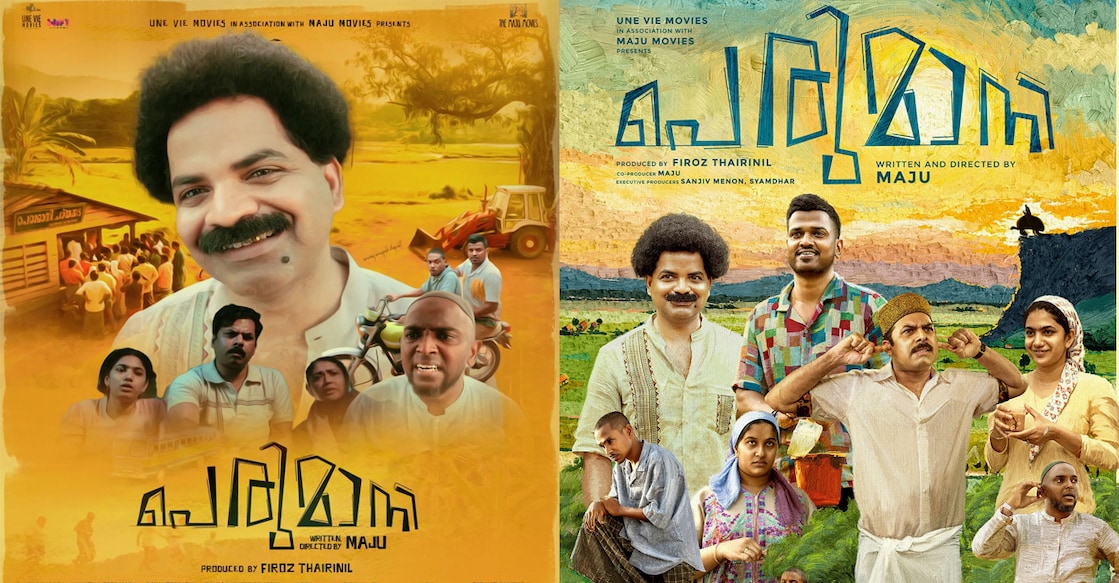
‘Perumani’, written and directed by Maju, is not a faraway place. We live there pretty much right now. While watching this fantasy village Maju has created as the backdrop of his third film (after ‘French Viplavam’ and ‘Appan’), one can’t miss its resemblance to present-day India. It is perhaps the closest a filmmaker can get to ‘Panchavadi Palam’ (K. G. George’s 1984 political satire), which could never be made in today’s political climate.
If in one frame ‘Perumani’ is stuck in the 1980s with two-stroke bikes and clay-tiled houses, in another it is in the 2000s with QWERTY Nokia handsets, and in the next it shifts into real time with touchscreen mobiles and dual-tone Vespa scooters. These are not prop goof-ups by the art department, nor are they tricks to prevent viewers from carbon-dating the story. This is how the storyteller displays the depth of class discrimination in our society. It’s not the frames but the people in them who are trapped in different eras.

The same goes for transportation. In Perumani village, there are those on foot or bicycles (the commoners), those on two-wheelers (the middle class, including Sunny Wayne’s Muji and Lukman Avaran’s Abi), and those with cars. Among them, Vinay Forrt’s Nassar stands out with multiple four-wheelers, including a truck and an excavator, clear markers of his position in Perumani. The filmmaker seems to underline that privilege lets the haves enjoy the finest in life without much effort.
Maju, however, takes extra care to delete all geo-identifiers from each frame. Still, being someone from Malabar, or perhaps because of my cliched bias that any Muslim-majority village must be in Malappuram, I can’t help but place Perumani somewhere in its interiors. Yet not all characters speak in the Eranadan slang, which lends the film a touch of universality. Rather than seeing the film, now streaming on Prime Video, as a writer-director from another community turning the lens on a minority to demean it, it is better read as a clever way of smuggling ideas at a time when cinema or art that reflects harsh realities is either banned or censored beyond recognition. One shudders to think of the fate this story might have faced had it been told from any other cultural backdrop.
The opening sequence of ‘Perumani’ shows two crooked businessmen, eyeing war profiteering, instigating conflict by spreading false information through the media (here, a notice board). A realistic narration with direct references would never have survived the cut. The Mappila backdrop also gives Maju the licence to poke fun at religion and superstition. Yet, the absence of reference to other faiths makes it appear as though these issues exist only within the Muslim community, when the reality is far more universal.
A striking sequence shows science (the doctor), pseudoscience (the Hindu astrologer), and religion (the ustad and mosque office-bearers) colluding to stop people from following the mysterious Bhai, whom a group projects as a saint in order to profit from public fear. The scene lands differently in today’s context, when even scientists are seen fretting about 'rahu kaalam', the inauspicious 90-minute window of the day, to launch rockets that could take humans to the Moon.
Maju layers ‘Perumani’ further with magical realism by portraying Bhai (a migrant worker from Bengal) as a mystic. The filmmaker also seems to suggest that migrant workers are no less significant than the revered Perumani Thangal, who once appeared in a time of crisis and vowed to watch over the land from a hilltop. After helping two women, Fathima and Ramlu, Bhai disappears along with Thangal’s holy pitcher. The next thing we hear is his mysterious late-night azaan echoing through a north Indian village. No comments! Bhai, perched on rooftops and Thangal para, recalls Sreenath Bhasi’s Djinn from Muhsin Parari’s ‘KL10 Patthu’ (2015).
Another strong element in ‘Perumani’ is the cinematography. To give the film its caricaturish tone, cinematographer Manesh Mahadevan often uses wide lenses angled on his characters from above or below. At times, though, the effect is weakened by short shot lengths. The colour grading of the warm earth-green palette does justice to his beautiful frames by adding a freshness to it. Watch out for the moment when a red flag goes up in Fathima’s mind against Nassar. As she walks in, unsure whether marrying him is the right decision, Manesh uses a shaft of light falling through a glass tile amidst the clay roof to create a lens flare over her head. It becomes a moment of realisation, where practical light turns magical.
The acting, too, holds the film together. Vinay Forrt shines as Nassar, capturing the character’s eccentricity in every frame. His consistency never slips from caricature to vulgarity, reminding one of another timeless delusional figure from Malayalam cinema, Thalathil Dineshan from ‘Vadakkunokkiyantram’ (1989), immortalised by Sreenivasan.
As the credits roll, one wonders if ‘Perumani’ ever needed a pin on the map. It plays like a breezy weekend comedy, yet carries a weightier idea beneath the laughs.
 Add as a preferred source on Google