

Defamation case: The courtroom drama that unfolded during SC hearing on Rahul's conviction
Mail This Article
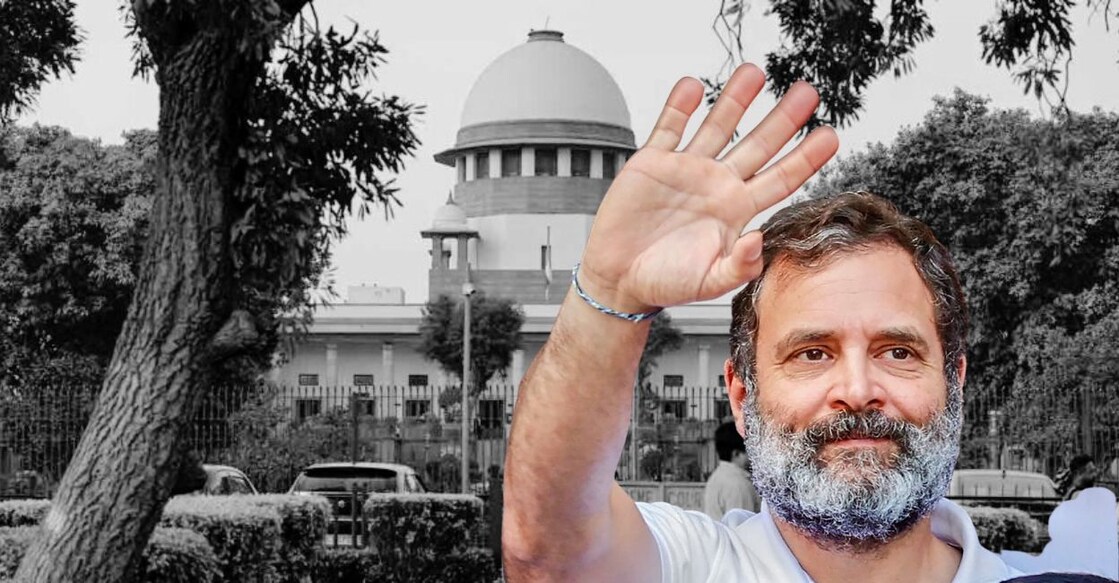
New Delhi: The Supreme Court on Friday issued an order staying the conviction of Congress leader Rahul Gandhi in the defamation case against him over his controversial Modi surname remark.
The Lok Sabha speaker can now restore his membership in Parliament on his own. Gandhi, armed with the apex court order, can also seek restoration of his status as an MP.
A three-judge bench of justices B R Gavai, P S Narasimha and Sanjay Kumar said no reason was given by the trial court judge while awarding Gandhi the maximum sentence except that he was admonished by the apex court in a contempt case.
Justice BR Gavai observed during the hearing that he has recently come across ‘interesting’ judgements from the Gujarat High Court, which ran into hundreds of pages. Here are a few arguments raised during the hearing that lasted for one hour and 15 minutes
NO REASON CITED FOR MAXIMUM PUNISHMENT: SC
Justice Gavai: The trial judge has granted a maximum sentence of two years. The sentence is two years or fine or both. So, when the maximum sentence is granted, there has to be some reasoning given. Not a whisper by the trial judge. Not only the right of one individual, but that of the entire electorate was affected by this judgment. The high court judge has widely discussed that Parliament members are not entitled to a special treatment. But he has not touched the other aspect of the matter. He said that being a Member of Parliament was not a ground for granting special concessions.
Senior Advocate Mahesh Jethmalani chimed in by saying that people’s representatives ought to be held to a higher standard of conduct.
Justice Gavai: That is what the high court judge says. He elaborates on what should be expected of a Member of Parliament. This 125-page-long judgment makes a very interesting reading. Some of the judgments coming from the solicitor-general’s state make a very interesting reading.
Particularly when the offence was non-cognizable, bailable, and compoundable, the least that was expected from the learned trial judge was to give reasons for imposing the maximum punishment. Though the learned appellate court and the high court have spent voluminous pages in rejecting the applications, these aspects are not seen considered.
ARGUMENTS OF GANDHI
Senior Advocate Abhishek Manu Singhvi, appearing for Gandhi, at the outset submitted that the complainant Bharatiya Janata Party MLA Purnesh Modi belonged to the Modh Vanika Samaj which includes other communities as well. The records indicate that the Modi surname falls under many other castes.
He pointed out that of the 13 crore members said to be in the Modi community, only a handful of BJP members have filed complaints alleging criminal defamation. He argued that the class of persons sharing Modi surname is not an identifiable class within the meaning of Section 499/500 IPC who can file a defamation complaint.
Singhvi then highlighted that the Court awarding the maximum sentence of two years for criminal defamation is an extreme rarity.
1. WHY MAXIMUM SENTENCE?
Advocate Abhishek Manu Singhvi: I am yet to see a non-cognizable, bailable and compoundable offence, which is not against society, which is not kidnapping, rape and murder, in which the maximum sentence is given. How can this become an offence involving moral turpitude?
The maximum sentence has the effect of silencing Gandhi for eight years, as it will disqualify him from elections as per the Representation of the People Act.
Justice Gavai: The learned judge also talks about your criminal antecedents
Adv Singhvi: There is no prior conviction for Gandhi. There was one contempt case in Supreme Court in which he tendered an apology. Other cases are pending complaints filed by BJP workers.
He is not a hardened criminal. There is no conviction in any case. There has to be some mutual respect in politics. The High Court passed the order 66 days after reserving the judgment.
2. BYE-ELECTION A CONSEQUENCE
Adv Singhvi: The consequence of the conviction is that a bye-election will have to be notified for the Wayanad constituency. He has already lost two sessions (of Lok Sabha). If the Supreme Court says no, he will lose the entire term. What is the complainant's interest in ensuring his disqualification as his concern ought to be only the conviction.
3. WHERE'S THE EVIDENCE?
Adv Singhvi: The complainant has not heard the speech first hand and his source of information is a WhatsApp message and a newspaper article. The complainant has not proved the speech. He pointed out that the complainant himself had approached the High Court to stay the trial saying that he wanted to get evidence. One year later, he himself gets the stay vacated and a month later, the conviction comes.
Adv Singhvi placed reliance on the 2018 judgment in the Lok Prahari case which held that stay of conviction by the appellate court will stay the disqualification too. Reference was also made to the Supreme Court's order staying the conviction of former Congress and present BJP member Hardik Patel in a criminal case.
ARGUMENTS OF THE COMPLAINANT
1. VIDEOS SUBMITTED AS EVIDENCE
Senior Advocate Mahesh Jethmalani: Videos of the speech were produced as evidence before the court. A person who heard Gandhi's speech in the meeting was produced as a witness who corroborated the videos. Also, the speech was never denied.
The senior counsel quoted Gandhi's speech as "Achchha ek chhota sa sawal, inn sab choron ka naam, Modi, Modi, Modi kaise hain...Lalit Modi, Nirav Modi...Aur thoda dhundoge toh aur saare Modi nikal aayega"
Gandhi's intention was to defame the entire Modi community just because it was the surname of the Prime Minister. In his Section 313 statement before the trial court, Gandhi said that he does not remember the speech.

Justice Gavai: Politicians, who address several public meetings a day, may not remember their speeches.
Jethmalani pointed out that he was an accused who was facing trial against a wealth of evidence.
Advocate Jethmalani: 'Modi' was an identifiable class and every person having the 'Modi' surname has the locus standi to file the complaint.
The Representation of Peoples Act does not refer to the concept of "moral turpitude" and merely says that a sentence of two years or more will attract disqualification. In the 2013 Lily Thomas case, the Supreme Court struck down Section 8(4), which provided for keeping the disqualification in abeyance during the pendency of the appeal. The present attempt to seek a stay on the conviction was an attempt to "bring through the backdoor" a provision which was struck down by the Supreme Court.
Justice Gavai: Whether the fact that a constituency which elects a person goes unrepresented is a relevant factor? Also, when you impose the maximum sentence, there have to be reasons. But there is no whisper on this by the trial court.
You are not only affecting the right of one individual but rights of the entire constituency. So while the learned single judge says merely because one is a Member of Parliament is not a ground to give a concession, the other aspect is not touched upon. 125 pages the learned single judge has written. It makes an interesting reading.
The judgments coming from "the Learned Solicitor General's state" make interesting reading.
Solicitor General Tushar Mehta requested the bench to not make "off-the-cuff remarks" on the High Court. SG said that sometimes, the Supreme Court criticises High Courts for not giving adequate reasons and hence, High Court judges pass detailed orders. Justice Gavai said that they have come across two recent orders by the High Court.
2. SC WARNING TO RAHUL GANDHI
Advocate Jethmalani: The Supreme Court had admonished Rahul Gandhi in the contempt case after he tendered an apology and said that it amounts to a prior conviction.
He referred to the previous contempt case against Gandhi for wrongfully saying that Supreme Court indicted Prime Minister in the Rafale case. While dismissing the Rafale review petitions, the Supreme Court had a word of warning for Gandhi by saying, "Certainly Mr. Gandhi needs to be more careful in future".
Adv Singhvi: Supreme Court's order came on November 14, 2019, after the date of the impugned speech.
Justice Gavai: Had the judgment come earlier, your client would have been more careful.
Adv Jethmalani: A person who has a history of making rash speeches has no right to seek concessions. He has not shown any contrition in the present matter too.
(With LiveLaw inputs.)
 Add as a preferred source on Google