

Indian Navy was prepared to strike Karachi and other targets: AN Pramod
Mail This Article


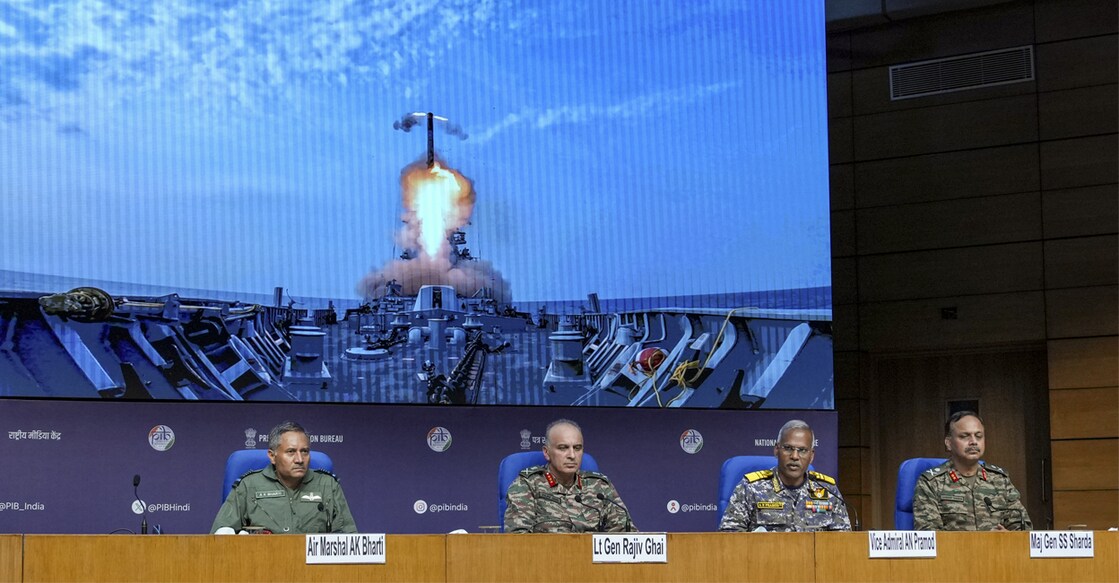
New Delhi: Vice Admiral A N Pramod on Sunday, said the Indian Navy responded to the Pahalgam terror attack by swiftly deploying its carrier battle group, submarines, and aviation assets in the Arabian Sea with full combat preparedness.
Speaking at a joint press conference with senior officials from the Army and Air Force, Vice Admiral Pramod, the Director General of Naval Operations, explained that naval forces were positioned in a forward deployment in the northern Arabian Sea with a “dissuasive and deterrent” posture, ready to engage targets on land and sea, including Karachi, at India’s discretion.
The Navy began conducting a series of weapon firings within 96 hours of the April 22 terror incident that claimed the lives of 26 civilians. The operations were part of India's large-scale response under ‘Operation Sindoor’.
“The aim was to revalidate our crew, armament, equipment and platform readiness to deliver various ordnance on selected targets precisely,” Vice Admiral Pramod stated, highlighting the objective of refining tactics and operational procedures at sea.
He noted that the presence of India’s carrier battle group following the terror attack significantly influenced Pakistan’s naval and aerial deployments, forcing them to retreat into a defensive stance, mostly within their harbours or near their coastline.
“The Indian Navy maintained seamless maritime domain awareness throughout the duration and was entirely aware of the location and movement of Pakistani units,” he added. “In effect, we had, and continue to have, good battlespace transparency, using our maritime domain awareness grid.”
Vice Admiral Pramod emphasised that the Indian Navy’s readiness included offensive capabilities, and all possible responses were evaluated as part of India’s strategic plan. “Under India's calibrated approach, we considered all options, including the ability of the Indian Navy for offensive action from and at sea,” he said.
The Navy’s involvement was closely coordinated with the Army and Air Force. “As part of the escalation control mechanism, the application of force by the Navy was planned in a synchronised manner in concert with the Army and the Air Force, the highlight being teams from the three services working closely in an integrated manner,” he added.
He also attributed Pakistan’s request for a ceasefire to the combined might of the Indian forces, including the Navy’s overwhelming dominance at sea. “Along with kinetic actions by the Indian Army and Indian Air Force, the overwhelming operational edge of the Indian Navy at sea contributed towards Pakistan's urgent request for a ceasefire yesterday,” he said.
Vice Admiral Pramod reiterated that the Indian Navy continues to stay positioned at sea with strong deterrence, prepared to respond decisively to any threat posed by Pakistan or terror outfits based there.
India had launched precision strikes on terrorist targets on May 7.
In retaliation, Pakistan attempted attacks on Indian military posts over the following three days—May 8, 9, and 10. These were met with a strong Indian counterstrike that caused severe damage to several Pakistani military facilities, including radar stations, air bases, command centres, and air defence installations. On Saturday evening, Foreign Secretary Vikram Misri confirmed that both India and Pakistan agreed to an immediate halt to all military actions across land, air, and sea.
(With PTI Inputs)
 Add as a preferred source on Google