

Inside Haryana’s ‘stolen votes’ village: Missing names and non-responsive BLOs
Mail This Article


Rohtak: When Rahul Gandhi dropped his H-Bomb, the latest round of allegations of voter list rigging, at a press conference on Wednesday, one of his starkest examples came from Malikpur, a village in Haryana’s Rai Assembly segment.
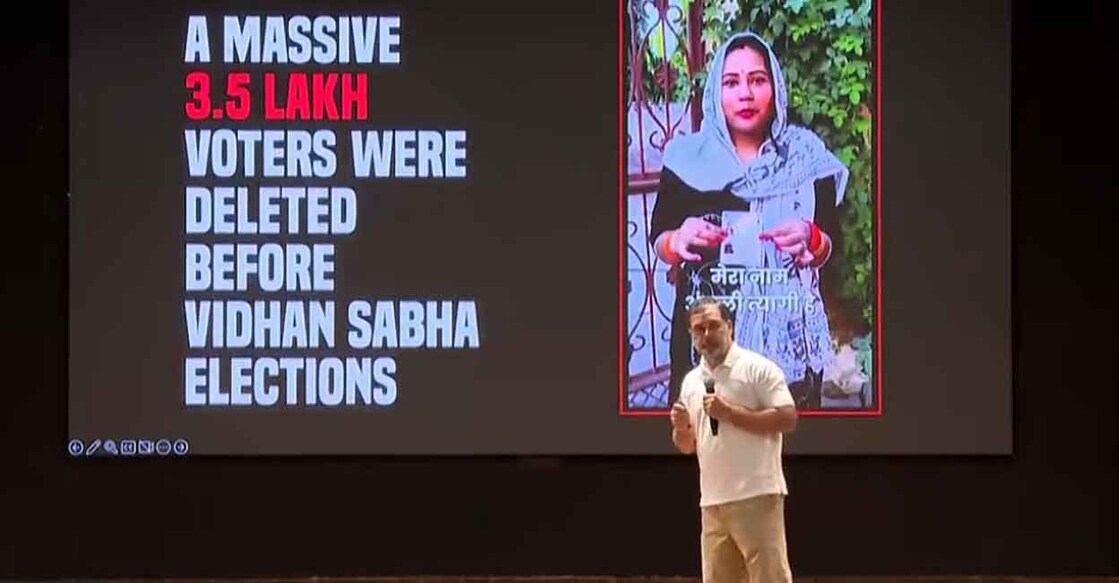
During the expose, the Congress MP and Leader of Opposition showed videos of four families who, he said, voted in the April 2024 Lok Sabha election but found their names missing from the rolls during the Assembly polls six months later. Their votes, he alleged, were “stolen” because they backed the Congress.
A visit to Malikpur confirms that these families did vote once and could not vote the second time – but also reveals a more layered story of politics and procedure.
‘Voted once, then names disappeared’
Saddam Hussain, who moved to Malikpur from nearby Tajpur 15 years ago, said he and his wife Yasmin both voted in the Lok Sabha polls. “In April we voted, but by the Assembly election our names had vanished,” he said. He feels he was a political target. “Many of those who went against the BJP had their votes removed.”
He said his family once backed the Chautalas but has voted for the Congress for nearly three decades. Hussain claimed that around 250 names were removed from the voter list in the village “In Malikpur and nearby villages, vote chori is real," he asserted.
Consent, politics and a viral clip
At the Tyagi household, Anjali recalls casting her first vote in the Lok Sabha election on the basis of a slip, without a voter ID. In 2024, she turned out to vote in the Assembly polls only to find she was no longer on the voter list.
“Two months ago, a team from Congress came and recorded a video about my name missing from the voters' list and took my Aadhaar and PAN details,” she said. However, she did not realise at the time that the clip would be used in a press conference against the alleged EC-BJP collusion.
She admitted that her husband's family is long-time Congress loyalists, but she was cagey about being cast as a party foot soldier. “My family may be with Congress, but the vote is personal,” she said. “Voting is an individual right.”
Her discomfort underlines a key tension: Not everyone wants to be part of the political theatre around 'vote chori' allegations.
'Old Congress house, new missing vote’
Farmer Krishan Kumar, a proud supporter of the grand old party, offered a more explicitly political reading of the vote chori allegation. “We are old Congress people. We openly campaign for them. The BJP agent in the village got my son’s vote cut,” he alleged.
He said his son, Ajay Tyagi, now in Delhi, preparing for the UPSC exam, voted at booth number 3 in the Lok Sabha polls. Six months later, the family reached the booth to find that everyone else in the household remained on the list but Ajay's name had been deleted. Kumar said he informed Congress candidate Jai Bhagwan Antil, whose team later recorded his statement. He also alleged that local BJP men “captured” booths while the police “stood as silent spectators”.
A wedding and four missing votes
In another lane in the same locality, at the home of Mahender Tyagi, wedding preparations were underway. The family lists four members who, they say, could not vote in the Assembly election: brothers Anuj and Rahul, and their wives Sakshi and Sonia.
Anuj works in Dharuhera in Rewari district; Rahul and his wife live in nearby Gannaur in Sonipat. The family had a total of nine votes. “We all voted in the Lok Sabha election,” Anuj said. “By the time of the Assembly polls, four names were gone.” Those four could not vote; fresh voter cards have since been issued.
This household does not talk of conspiracy as Hussain r Kumar do, but its experience reinforces the pattern of voters who were on the roll in April being removed by October.
The BLO who shut the door
Rajwanti, Malikpur Ward 1 Booth Level Officer (BLO), shut the door on this reporter and refused to speak. An anganwadi worker spoke on the phone later. “Nobody’s vote is cut deliberately,” she maintained, before disconnecting.
Congress ‘survey’ vs village arithmetic
Congress youth leader Anant Dahiya and former Rai candidate Jai Bhagwan Antil said they have surveyed the entire Assembly segment. They claim that more than 150 “fake votes” were cast in Malikpur alone, while hundreds of “genuine” votes were struck off across Rai.
The panchayat’s figures tell a different story. Village sarpanch Vicky says Malikpur has about 4,600 registered voters across four booths, of whom nearly 3,500 cast their ballot in the Assembly polls. He acknowledged complaints over missing names but rejected the idea of a one-sided attack. According to him, some deletions hit families seen as close to the BJP as well. “Some names are missing, that is true,” he says. “But this is not a village where only Congress supporters faced it. Calling it ‘vote chori’ is an exaggeration.”
When the tide turned
In the 2024 Lok Sabha election, locals say, Congress candidate Satpal Brahmachari led both in Rai and in Malikpur. Six months later, in the Assembly race, the tables turned: BJP’s Krishna Gehlawat defeated Congress’s Jai Bhagwan Antil in Rai by 4,673 votes, polling 64,614 votes to Antil’s 59,941.
Brahmachari, now the MP from Sonipat, alleges that both in the parliamentary and Assembly polls, the industrial belts of Ganaur and Rai saw the highest levels of “vote theft”. In at least one ward, he claims, up to 20 votes were fabricated in the name of a single individual, with the same photograph and father’s name repeated. Across Rai, he says, 2,000–3,000 such entries have already been flagged.
Single address in Hodal
Rahul Gandhi’s presentation also cited two addresses in Hodal where 66 and 501 voters were clustered. A subsequent spot-check by local media there, however, found those numbers mapped to large extended families living on subdivided plots but sharing one house number. Most said they had voted without difficulty.
 Add as a preferred source on Google