

VB-G RAM G Bill introduced in Lok Sabha; Opposition calls it 'insult' to Mahatma Gandhi
Mail This Article


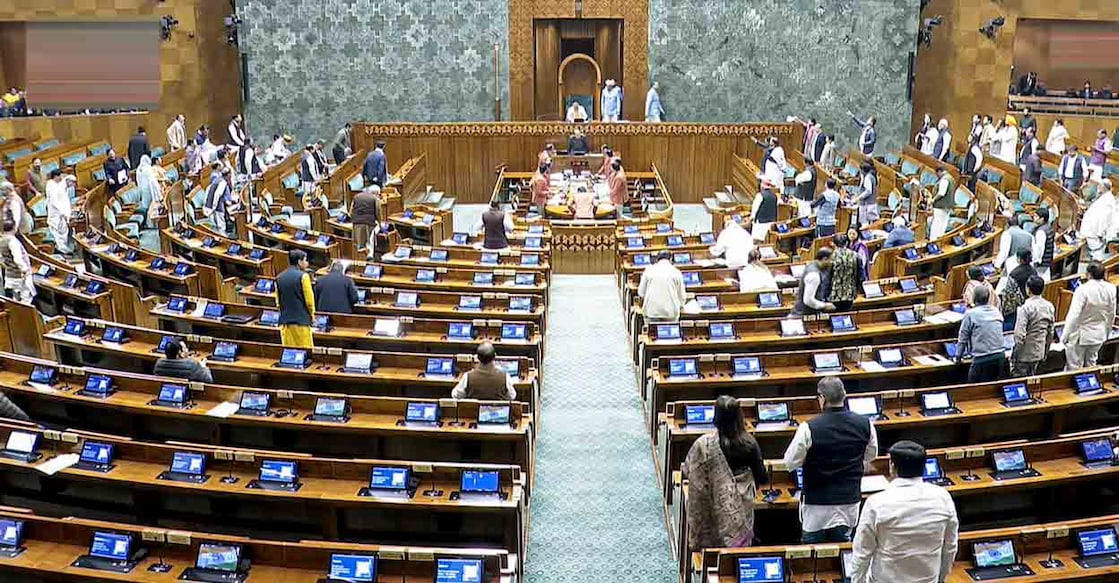
New Delhi: Union Rural Development Minister Shivraj Singh Chouhan on Tuesday introduced a Bill in the Lok Sabha seeking to replace the 20-year-old Mahatma Gandhi National Rural Employment Guarantee Act (MGNREGA) with a new framework guaranteeing 125 days of rural employment annually, triggering strong opposition protests over the removal of Mahatma Gandhi’s name.
Chouhan introduced the Viksit Bharat Guarantee for Rozgar and Ajeevika Mission (Gramin) (VB-G RAM G) Bill, 2025, asserting that the Narendra Modi-led government not only believes in Mahatma Gandhi’s ideals but has done more for rural development than previous administrations.
Opposition members objected at the introduction stage itself, demanding that the Bill be referred to a parliamentary standing committee for detailed scrutiny. Several MPs, including Congress leader Priyanka Gandhi Vadra, DMK’s T R Baalu and RSP’s N K Premchandran, accused the government of undermining Gandhi’s legacy by repealing MGNREGA.
Participating in the debate, T R Baalu recalled that Mahatma Gandhi lived among villagers and worked for the upliftment of the rural poor. He said the landmark MGNREGA, introduced by the Manmohan Singh-led UPA government, had ensured 100 days of guaranteed employment for the poorest households. “The Father of the Nation is being ridiculed by the present government,” he charged.
Priyanka Gandhi described MGNREGA as a “revolutionary Act” passed with the support of all parties and said the new Bill weakened the employment rights of the rural poor. She alleged that the Centre’s funding share would be reduced from 90 per cent to 60 per cent, placing an additional burden on state governments, particularly those already struggling financially.
“Under this Bill, the Centre’s control increases while its responsibility decreases,” she said, adding that Mahatma Gandhi did not belong to any one family but to every Indian household. She also demanded that the Bill be sent to a parliamentary panel.
Congress MP Shashi Tharoor took a swipe at the government, arguing that the proposed legislation was not a mere administrative change but an assault on the spirit and philosophical foundation of the rural employment guarantee programme.
As protests intensified, opposition MPs entered the Well of the House holding photographs of Mahatma Gandhi to register their disapproval.
According to the Bill, every rural household whose adult members volunteer for unskilled manual work will be entitled to a statutory guarantee of 125 days of wage employment in a financial year. States will be required to frame their own schemes in line with the new law within six months of its commencement.
In a separate statement, the Rural Development Ministry said the Bill was aligned with the vision of ‘Viksit Bharat 2047’ and aimed to generate employment while creating durable rural infrastructure. It identified four priority areas — water security, core rural infrastructure, livelihood-linked infrastructure, and works to mitigate extreme weather events.
The ministry described the Bill as a significant upgrade over MGNREGA, claiming it addressed structural shortcomings while improving transparency, planning and accountability.
Later in the day, several opposition MPs staged a protest at the Mahatma Gandhi statue in the Parliament House complex, accusing the BJP-led NDA government of “insulting” the Father of the Nation and demanding the withdrawal of the Bill. Holding placards and photographs of Gandhi, leaders, including Priyanka Gandhi, Samajwadi Party chief Akhilesh Yadav and T R Baalu, raised slogans against the proposed law.
Akhilesh Yadav said the government was changing names because it had “nothing new to offer.” At the same time, Priyanka Gandhi alleged that the Bill would effectively dismantle the legal guarantee of employment for millions of rural labourers and weaken the role of gram panchayats by centralising decision-making powers.
Responding to the criticism, Chouhan reiterated that the government remained committed to Gandhian principles and rural welfare, dismissing the opposition’s charges as politically motivated.
(With PTI inputs)
 Add as a preferred source on Google