

Hindutva is colonial invention, Indian or western philosophies can’t understand Guru’s language: Rajeevan at Hortus
Mail This Article


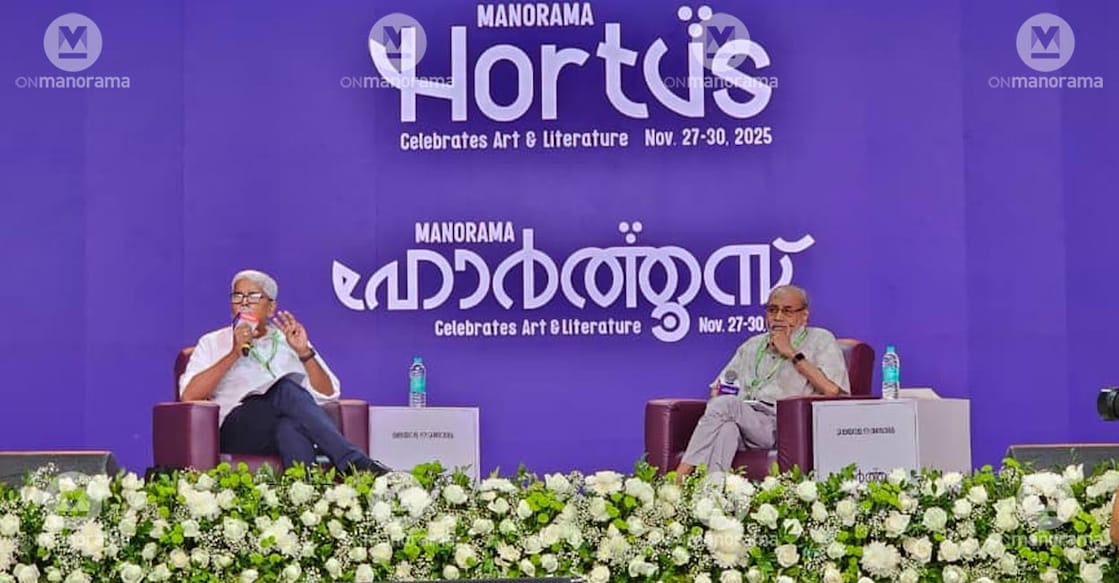
Speaking at the session ‘Gurudarshanam Kaavikkum Chuvappinum Idayil’ at Manorama Hortus 2025 in Kochi, writer and critic B Rajeevan reframed the debate around India’s current ideological landscape. He asserted that Hindutva is neither indigenous nor ancient, but a colonial invention shaped by the British and Orientalist scholars, and its true origins need to be laid bare.
Before a packed audience, Rajeevan argued that the idea of a monolithic Hindu religion and the Hindutva ideology built upon it was crafted by British Orientalist scholars in order to consolidate and control the subcontinent, which was full of diversities. “Hindu religion itself is a very recent creation. It is a colonial construction, a tool the British used to culturally unify and conquer diverse India,” he said. What is today called Hindutva is the political afterlife of that colonial project, he said.
According to Rajeevan, colonial Indology and Orientalism homogenised India’s innumerable cultures, languages and traditions under the invented category of “Hindu religion.”
“India was an unconquerable phenomenon of diversities. The British needed a unified Hindu religion to rule this India. Max Muller and others assumed such a religion into existence. It was never a monolithic religion in this land,” he said.
He added that a political movement is reviving that colonial conception. “Hindutva was the fascist ideology created by the British. It is today being followed by a political party. We must expose it,” Rajeevan said.
Rajeevan’s critique extended to how the teachings of Sree Narayana Guru, Mahatma Gandhi and Vaikunta Swamikal are being misread through Western frameworks, whether Marxist, liberal or Hindutva.
“No Western interpretation can decode Narayana Guru. Liberal democracy, the French Revolution’s ideas of liberty and equality, none of these can interpret Guru’s teachings,” he said.
According to him, Guru, Gandhi and Swamikal created a radically different political and moral language, one born out of the lives of the downtrodden and the oppressed.
“They created a new language, a new politics, deeply rooted in the marginalised. Western or Indian philosophies influenced by the West cannot understand that language,” he said.
Rajeevan warned that today, both the Left and the Right are distorting that indigenous humanism. “The Saffron and the Red are both suppressing the real power of India, the power that Guru and Gandhi tried to awaken. Both camps are trying to appropriate these men for their own politics,” he said.
He argued that neither Marxism nor Hindutva, which are of Western origin, can grasp the spiritual and social revolution Guru envisioned. “Both are Western products. Both obscure the truth we need to reclaim. We must fight this obscuration with light,” he said.
Rajeevan described this indigenous ethic as “New Humanism”, a philosophy cultivated by Guru and Vaikunta Swamikal that is distinct from Western humanism and deeply rooted in the experiences of the oppressed. Its presence becomes visible in moments of crisis.
“When Kerala faced the 2018 floods, we saw that New Humanism rise. People forgot caste and creed and saved each other. That showed that Guru’s vision still survives among ordinary people,” he said.
However, he said that the political handling of the Sabarimala issue, unfortunately, once again fractured society. Yet Rajeevan remains hopeful “the New Humanism will rise again. And when it does, Narayana Guru and his teachings will lead it,” he said.

 Add as a preferred source on Google