

NH-66 wall collapse in Kollam due to bearing capacity failure, soil quality: NHAI
Mail This Article


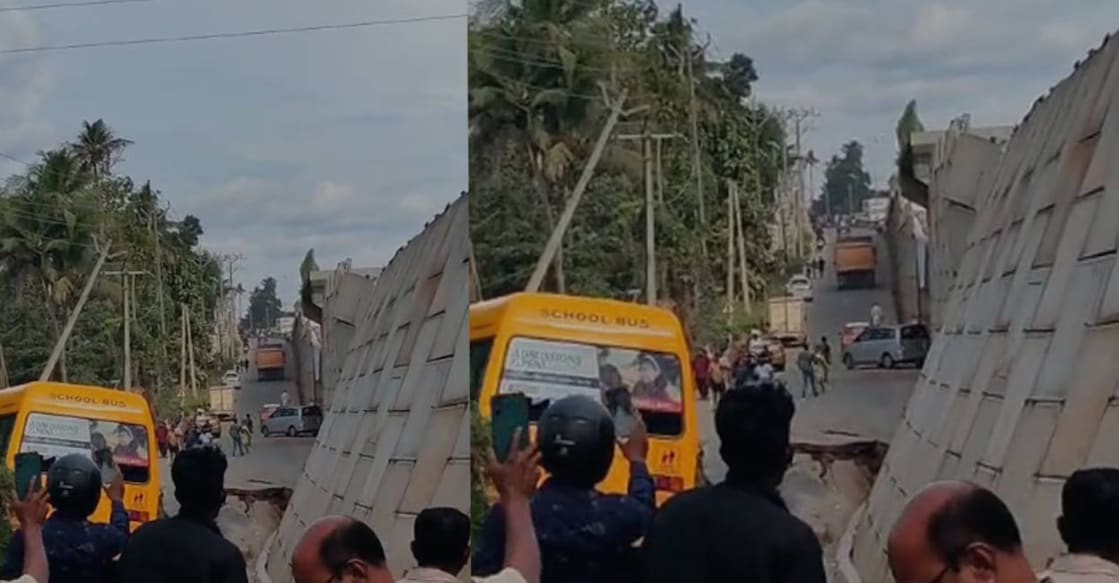
Kollam: NHAI has issued a statement suggesting that the collapse of the Reinforced Soil wall at Mylakkadu was due to poor bearing capacity and quality of the soil used, stating that they have initiated action against the contractor and the engineering firm.
The 9.4-metre-high reinforced soil wall under construction, part of the NH-66 development work, was intended to serve as an approach to a vehicular underpass at Mylakkadu on the Kollam-Kadambattukonam route, but collapsed on December 5.
In the statement, the NHAI said the preliminary assessment indicated a deep-seated shear or bearing-capacity failure, suggesting the soil beneath the foundation was too weak to support the fill.
"Concessionaire and its promoters (M/s Shivalaya) and the Independent Engineer (M/s Feedback - Satra JV) have been temporarily suspended from bidding for future projects. They have also been issued show cause notices for potential debarment (up to 3 years for the concessionaire and up to 2 years for the IE), along with monetary penalties," the statement said.
Additionally, the NHAI said the project manager of the concessionaire and the resident engineer have also been removed from the project site.
The agency said that although the RS wall technology is proven, failures raise questions about the bearing capacity and quality of the soil used in the design and construction of these structures along NH-66.
This has led to a series of initiatives by the NHAI to resolve the issue. A high-level expert committee comprising Jimmy Thomas (IIT-Kanpur) and TK Sudheesh (IIT-Palakkad) visited the site on December 6 to investigate the failure and recommend corrective measures.
Similarly, the NHAI is also implementing the findings of an earlier expert committee, which was constituted after the Kooriyad NH collapse.
Additionally, the authority has also appointed 18 geotechnical agencies to conduct soil sampling and testing at 378 structures and RS wall locations across 18 projects on NH-66 in Kerala. This would cover the sites already built, under construction, or yet to start, officials said.
Agencies are also expected to complete tests across 100 locations within one month, and within three months in the remaining locations, with several rigs to be deployed within 7 to 10 days to aid the same.
There would also be a reassessment of the design and construction of all RS walls based on the field and laboratory reports.
"Remedial actions, including dismantling and reconstruction of walls, will be taken where necessary. RS walls will only be accepted after this process is complete and quality is confirmed. Accountability will be fixed for all lapses found during this review," the statement said.
Following a separate incident involving the falling of girders on the Aroor-Thuravoor Elevated Road Project in November, NHAI has already engaged RITES to conduct a safety audit. This audit will now be expanded to other NH-66 projects to identify and rectify safety concerns proactively, the agency added.
 Add as a preferred source on Google