

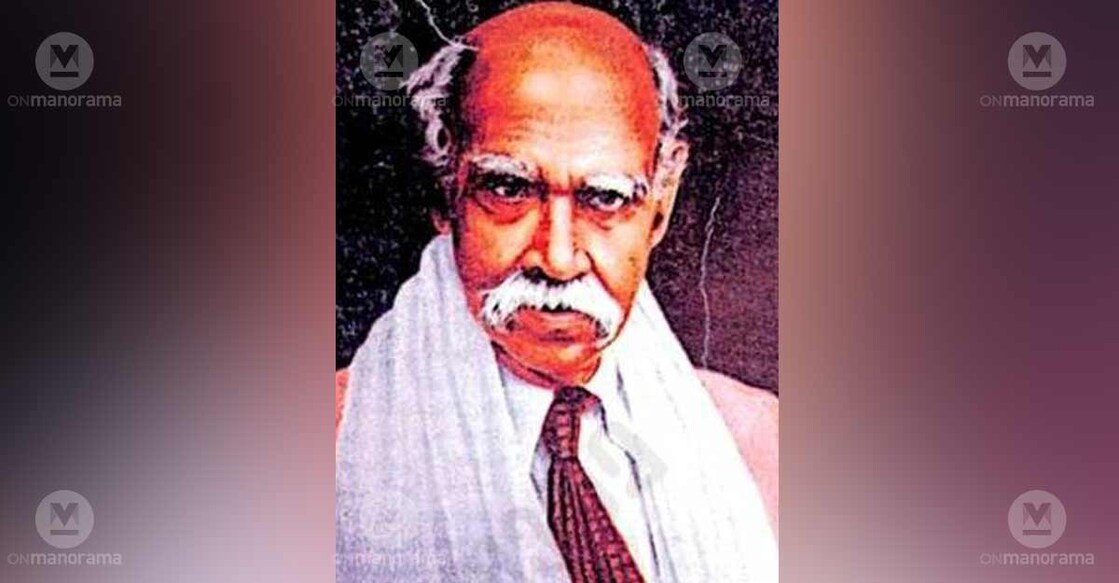
This Christmas marked the 150th birth anniversary of IC Chacko, the writer of Christu Sahasra Namam
Mail This Article


Alappuzha: IC Chacko, who wrote the Christu Sahasranama Sthothram, an iconic Malayalam hymn that praises Jesus Christ in 1000 holy names, was not only a linguistic expert and poet but also a well-known research scholar, scientist and critic. Interestingly, Chacko was born on Christmas Day, an amazing coincidence that many may not know. This year marks the 150th birth anniversary of IC Chacko, who contributed significantly to the great literary tradition of Kerala.
IC Chacko was born on December 25, 1875 into the famed Illiparambu family in Punnakunnathussery, Kuttanad. A polyglot, Chacko had excellent command over English, Malayalam, Sanskrit, Tamil, Greek, Latin, Syriac, French and German. He was a linguistic master who penned several amazing literary works in Sanskrit and Malayalam. He wrote the notable thesis Paniniya Pradyotham that explains the complex grammatical structures and rules of Panini, cementing his position in Sanskrit grammar and literature.
IC Chacko started learning Sanskrit from childhood itself. After completing his education from Alappuzha government high school, Kottayam CMS College and Thiruvananthapuram University College, he worked as a teacher for two years. In 1901, he acquired a government scholarship to study at the famous Imperial College of Science and Technology in London. He graduated in BSc Honours in Physics, ARSM in mining engineering and ARCS before returning to Kerala in 1905. Chacko soon joined the geological department of the Travancore government as a geologist. He then worked as the director of commerce for some time. Travancore Minerals and Kundara Ceramics were started in the Travancore province when he was the director of commerce.
Chacko penned the Christu Sahasra Namam between May 31 - June 26, 1914. It is a rare literary creation that combines Sanskrit and the Bible. IC Chacko was conferred with the prestigious Chevelier award in 1960 for his contributions to literature and culture.
Besides science and literature, Chacko was quite active in politics too. Moreover, he was a notable freedom fighter and one of the founders of the Travancore State Congress. He later became a member of the Travancore Legislature. It was IC Chacko who called the struggle of the backward communities the ‘Nivarthana Prakshobam’. Many popular Malayalam words that are still in currency like rashtreeyam (politics) and madyapani (drunkard) were the contributions of Chacko. An avid lover of regional boat races, Chacko played a crucial role in reviving the famous Champakulam Moolam boat race.
Although he began his stint in literature, writing poetry, he was keen to experiment with genres and themes. Meanwhile, Chacko had written prose in various magazines on a variety of subjects including religion, community, history, diplomacy, agriculture, education, linguistics, literature and grammar even when he was a student. His agriculture songs and folk songs celebrated the unique art and culture of Kuttanad. Moreover, he even recommended scientific agriculture methods to develop the farming sector of Kuttanad.
Paniniya Pradyotham, a thesis on grammar based on the grammatical text called Ashtadyayi written by sage Panini is Chacko’s most important work in Sanskrit. This work received the first award given by the Kendra Sahitya Academy for Malayalam. Chila Shabdangalum Avayude Roodarthangalum, Catholica Parishramam (translation), Prakriti Kathakal (children’s literature), Krishivishayangal, Jeevithasmaranakal, Vithandavadadwansanam, Thomas More, Mar Luis and Valmikiyude Lokathil are some of his notable works. Some of these works have been adopted into textbooks in various academic courses. IC Chacko has also written an elegy in Sanskrit about the death of a dog called Hector. He died on May 27, 1966.
 Add as a preferred source on Google