

Looking at Ahmedabad through a 'water lens’

Mail This Article


Each Indian city reveals itself in countless ways, depending on the lens through which a traveller looks. For an aspiring Gujarati metropolis like Ahmedabad, there will never be a shortage of lenses.
Ahmedabad carries the deep imprints of a historic city founded by Sultan Ahmed Shah in the early 15th century. A walk through the crowded Lal Darwaja market, with its glimpses of iconic architecture such as the Sidi Saiyyed Mosque and Bhadra Fort, feels like a journey back to its medieval glory. Exploring Ahmedabad also reveals the story of legendary institutions and iconic figures that shaped modern India – from the Sabarmati Ashram to the Sardar Patel Memorial.
One of India’s most vibrant economic centres, the Ahmedabad metropolitan region is home to the Gujarat International Finance Tec-City (GIFT City) and India’s first Greenfield Smart City, Dholera. Another landmark infrastructure project taking shape is the country’s first bullet train, which is set to link Mumbai with Gujarat.
While travelling through Ahmedabad this time, neither its historic charm nor its present-day development marvels stirred much attention. Rather, the focus was on something that appears trivial but is crucial in understanding any city – water.
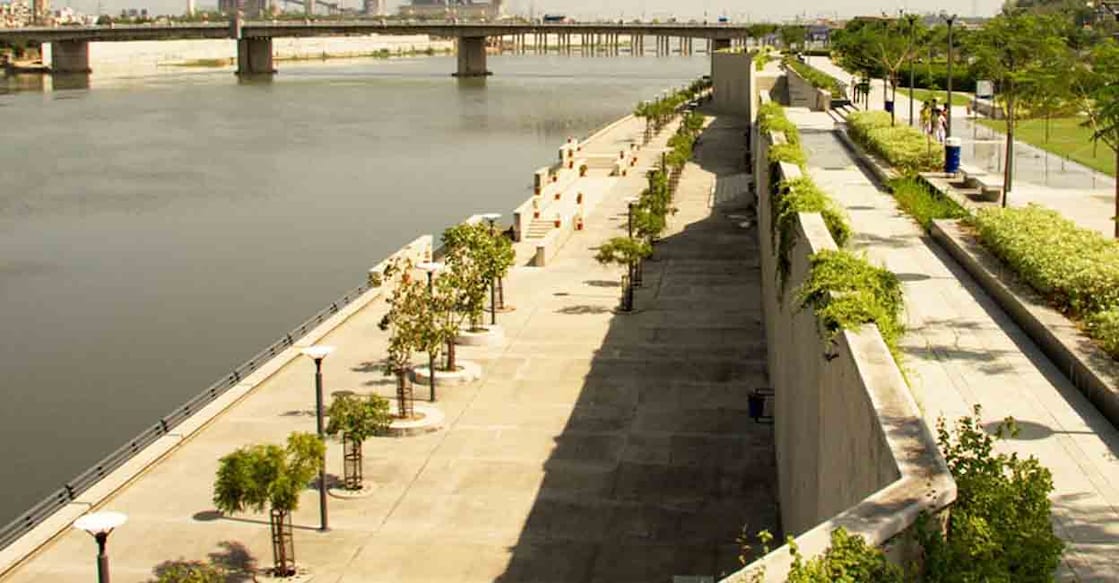
Sabarmati river front
Nothing short of the word ‘lifeline’ seems adequate to describe the bond between the Sabarmati and Ahmedabad. Despite being a seasonal river, the Sabarmati has shaped the city’s livelihoods and culture for centuries.

When a plague broke out in Kochrab in 1917, Mahatma Gandhi relocated his ashram to the banks of the Sabarmati River – a place he considered ideal for his experiments in farming, animal husbandry, and the promotion of khadi.
However, in the decades that followed, this historic river met an unfortunate fate. Industrial contamination, untreated sewage, and the rapid growth of slums along the Sabarmati have collectively polluted the river and degraded its banks.
Although the idea of reviving the Sabarmati dates back to the 1960s, construction for an extensive riverfront project began in 2005, and the first phase was opened to the public in 2012.
With the ambitious tagline of “reconnecting Ahmedabad to its river,” the project, when fully completed, will stretch 38 km – making the Sabarmati one of the world’s longest riverfronts.
Walking across the pedestrian Atal Bridge one night – a striking triangular truss structure inspired by the city’s kite festival – you are surrounded by colourful lights that feel truly magical. A series of illuminated bridges spanning the Sabarmati, together with the reflections of buildings on the water and the crisp riverfront air, creates unforgettable moments.
For someone who saw the ailing Sabarmati and its banks in the early part of this century, the transformation into a riverfront with a series of parks, jogging tracks, and cycling paths is a major facelift. A crucial component of this transformation is modern water management interventions that have turned Sabarmati into a perennial river through a network of dams and barrages, supplemented by water from the Narmada canal.
Aquatic escapes
A Sabarmati-like revival project has upgraded Kankaria, Ahmedabad’s largest polygonal artificial lake, which features an island summer palace built by Sultan Qutb-ud-Din Ahmad Shah II in 1451. Once a neglected historical site, Kankaria was transformed in 2008 into a vibrant lakefront featuring various recreational facilities and a week-long carnival each December.
Ahmedabad’s passion for water-based tourism finds its most impressive expression in the Aquatic Gallery at Gujarat Science City, home to the largest public aquarium in India.
With a large variety of marine species housed in ultra-large tanks set in colourful environments – including a penguin enclave and a massive underwater tunnel with gigantic sharks – one might wonder whether they are exploring one of the world’s leading aquariums in Dubai or Singapore.
Another attraction is the Vedic Water Show at Swaminarayan Akshardham temple near Gandhinagar, a spectacular multimedia performance produced by renowned French multimedia creator Yves Pépin.
Vanishing lakes
Ahmedabad has been fortunate to inherit several natural lakes, along with a few man-made ones, such as Kankaria, constructed in the 15th century.
However, Ahmedabad’s recent efforts to revive its major water bodies and promote blue tourism are not reflected in the preservation of its smaller lakes and ponds. Most of the lakes within the Ahmedabad Municipal Corporation limits are now struggling to survive due to unchecked urban expansion.
On July 9, the National Green Tribunal directed the district collector to submit a report in response to an Indian Express article that exposed the disappearance of 37 out of 172 lakes.
While travelling through Ahmedabad, one can observe how various water bodies are under severe pressure due to the city’s rapid infrastructural development.
Various aerial images and committee reports since 2000 point to a significant decline in Ahmedabad’s blue cover. While the exact figures may be debated, it is undeniable that the first two decades of this century saw a drastic reduction in the number of lakes.
Typically, construction activities and the resulting encroachments block the natural course of lakes and obstruct the inflow of rainwater. A researcher from CEPT University has identified several key issues, including the loss of interconnectedness among lakes, declining water levels that are causing them to dry upgradually, and increasing pollution along their peripheries.
A recent report indicates that the total area of water bodies surrounding the city’s four major lakes has shrunk to nearly half, primarily due to the ‘lack of water sensitivity in statutory plans’.
Beyond the big
Geographically situated in a hot, dry region with erratic rainfall, Ahmedabad has long witnessed localised efforts to preserve its water resources, making the city more livable. Built during the Gujarat Sultanate, the stepwells (vavs) stand as remarkable examples of water conservation and as architecturally stunning structures that once brought communities together.
A visit to the 500-year-old, five-storey Adalaj Vav near Gandhinagar reveals an architectural marvel -- a blend of Hindu and Islamic styles -- that once supplied water to the locality and served as a vibrant public space.
Even days after the Gujarat visit, one question continues to resonate: while Ahmedabad bets big on water-based tourism like many world-class cities, why does it not pay enough attention to its smaller yet vital water bodies?
While pursuing global ambitions, has Ahmedabad forgotten the message of its greatest son, who once lived on the banks of the Sabarmati – that small things matter most when aiming high?
(Social anthropologist and novelist Thomas Sajan and US-trained neurologist Titto Idicula, based in Norway, write on politics, culture, economy, and medicine)
 Add as a preferred source on Google