

Love anything local, anywhere

Mail This Article


A dear aunt of mine, who used to go to Coimbatore from Kochi to visit her sister-in-law used to come back with her Ambassador car dicky loaded with sacks of vegetables. Fresh tapering carrots with peppery leaves with brown mud still on them, red and yellow bell peppers shining in their colour and light, turnips and radishes. Then there were spinach leaves, celery sticks and chives-- all fished out with a child-like glee by her from wet jute sacks and distributed like prasad after a pilgrimage to those who believed in fresh local produce.
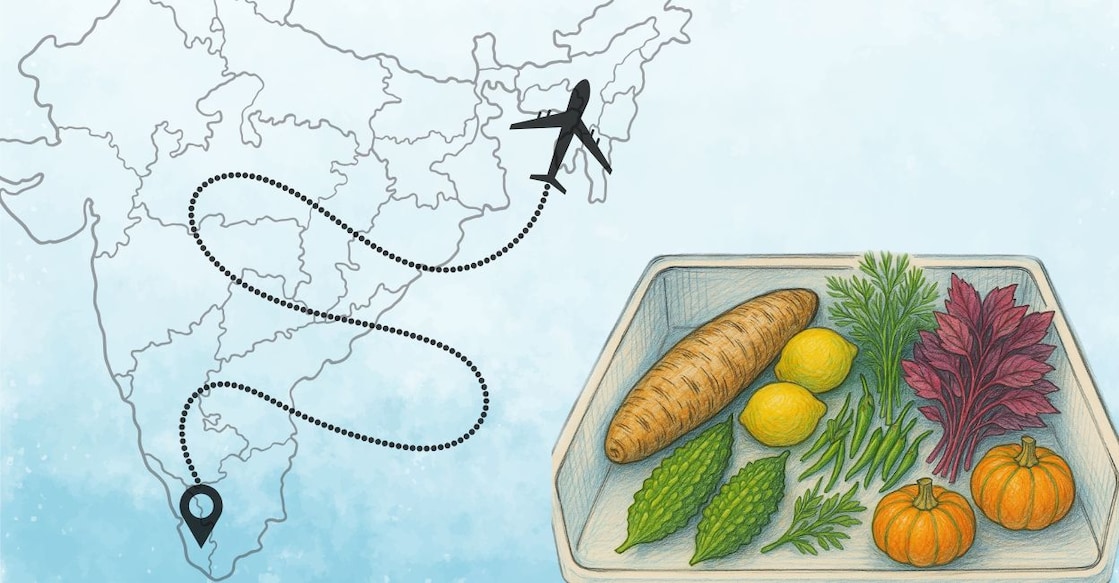
After my recent trip to Garhwal Hills, I came back home to Delhi with Ram Karela, small pumpkins, Banda (footlong yam), Limbu (pahadi lemon) and dill leaves. I stopped at three local shops to pick these, much to the chagrin of my car mates. I had also bought Munsiyari Rajma, hemp seeds and white navy beans. I picked Old Hill Gouda cheese and seed bread of Mukteshwar bakery. As I arranged them in my refrigerator, there was also red cheera (amaranth leaves) and kanthari (birds eye chillies) from home in Kerala from two weeks back. Knowing my fetish for local veggies, a friend who went to Bengaluru (which was once home) had got me three or four chow chow (chayote squash). In one glance, that vegetable case was me and the many geographies which define me. I could pull it out, glance at my roots and branches, and tuck it back in. It is the map of my wanderings.
I do not know how to cook ram karela or Banda. I never knew hemp seeds were edible even. Yet the lure of local produce is real. I was told by the vegetable seller that Lord Ram ate the spiky gourds during his exile and hence the name Ram Karela. I liked the etymology, which is eminently relatable. We, civil servants are in a different type of executive exile-- away from our home states and home towns, reconciling janmabhoomi and karmabhoomi, redrawing the never intersecting lines with the call of duty ringing in our ears.
My cabin baggage is always an ice breaker with the CISF jawans at the airport security in Kochi. A speckled Madras cucumber in the corner, long drum sticks and snake gourds halved and cling filmed right on top of the trolley bag. “You are going to the North with all these vegetables from the South and we come with our mustard oil from our farm to your state”. We lock our eyes in sadness, bartering our predicament. The boarding pass is an unnecessary distraction in between. For every Madras cucumber that has crossed the Vindhyas, there is a canister of mustard oil that has made the reverse travel. No tariffs, no BoP issues.
My refrigerator is a museum of my travels; my grocery cupboard an album of places I have set up home in or travelled to. If flipping through albums fills you with nostalgia and bitter sweet memories, then that is what I feel when I see the dried fish and prawns I picked in Thiruvananthapuram or Monoprix cherry jam from an official tour to Paris last year. Edible lavender flowers from Istanbul announce a trip many years ago. Wadi from Amritsar carry the fragrance of Waheguru. Eating the local food and carrying a handful back is my way of prolonging the travel and processing my multiple identities. I am this and also that. While fridge magnets and souvenirs stay external to you, consuming the local food and taking them to your cells is the best way to permanently stamp the place in your body passport. You align with the soil and water and it is irreversible.
Modern living is a valiant attempt to make sense of migration and the consequent fragmentation of identity. Our hometowns are different from ancestral towns. On our dining tables sit the predicament of global taste and local food. On our tables sit children and people, equally displaced but not necessarily dispossessed. We have been served chemicals, pollutants, microplastics, allergies and gut issues which are illegible to our parents who grew on well water and local produce.
Our meals at home in a day range from pasta to Cilbir to paratha, with flax seed energy balls and air fried sweet potato sticks, all of which are alien to the state I belong. Yet every time I open the fridge or the cupboard, the sight of red matta rice or a glass dish full of red and green kanthari is enough to centre me. It reminds you of a childhood spent wandering around the house, discovering a plant full of red chillies, that had been growing away from the glare. A Christmas tree with baubles! It reminds you of the lessons you learnt from the elders as they navigated you through the sharpness of kanthari against the creamy starch of steamed tapioca and white yam. Green chillies won’t work here, my father’s words ring in my ears, it has to be stone ground kanthari cut with the fat of coconut oil and acid in shallots. The discerning will add a crystal or two of sugar to balance it all.
My friend who grew up in Delhi swear by the falsa berries he grew up with. He goes to great lengths in summer to get a handful, just for the wistfulness and centering. This, when imported Kiwis smile at him from every nook and cranny.
As I type this, a bottle of gulkand is on its way from Pushkar, which was home for more than two years. It will sit on my countertop for many months now, reminding me how it was my staple during a tough pregnancy. We are all nowhere and everywhere, but a fistful of the local produce invariably reminds you where home is, or where all homes were. I am this and that; all of it and none of it.
(The writer is a career civil servant and a creator on Instagram.)
 Add as a preferred source on Google