

One-sided Dubai clash failed to live up to famed India-Pakistan cricket rivalry

Mail This Article


An India-Pakistan clash on the cricket field always tops the list when it comes to organising international tournaments. Hence, irrespective of the name of the championship, the International Cricket Council (ICC) ensures that these two teams play each other in the league phase, keeping open the possibility of the two sides meeting again in the knockout stage.
It is also mandated that this game takes place on a holiday when the television viewership is the highest. It is estimated that close to 80 per cent of the revenue of a tournament such as the Asia Cup comes from the match between these neighbouring countries. Hence, it was not surprising that this pattern did not change during the latest edition of the championship, currently underway in the United Arab Emirates.
A match between India and Pakistan is not just a game of cricket played on the field. It is a high-octane contest between two countries separated from each other at birth, and who have fought numerous wars against each other in their 78-year history. It is only logical that the rivalry on the battlefield extends to the cricket field when the national sides take on each other in the most popular sport in both countries. Hence, there is always an extra element of stress for the team management and the players in the run-up to this game.

Sunday's (Sept 14, 2025) assumed added significance as this was the first time that the two teams were meeting after the Pahalgam massacre and post-Operation Sindoor armed conflict between the two states. Many in India opined that the country should boycott playing against Pakistan, even when the game is held at a neutral venue. For the record, in the ICC Women’s World Cup, which India is hosting in the next couple of months, the matches involving Pakistan will be held in Sri Lanka through a special arrangement with the island nation. The top honchos of the Board of Control for Cricket in India (BCCI) too were conspicuous by their absence at the venue of the Asia Cup match.
Leaving aside the incidents and observations outside the field of play, the India-Pakistan contest is unique in that it has produced some of the most memorable matches in the history of limited-overs cricket. The final of the Australasia Cup in 1986, where Javed Miandad took Pakistan singlehandedly to victory by hitting a sixer off the last ball of the match, remains etched in the minds of all those who watched that game.
The genius of Sachin Tendulkar was never seen in greater brilliance than during the knock of 98 he played against Pakistan in the ICC World Cup of 2003, when he took an attack comprising Wasim Akram, Shoaib Akhtar, Waqar Younis and Shahid Afridi to the cleaners.

It took the adrenaline rush of an India-Pakistan match for Virat Kohli to demonstrate to the world that one could achieve a target of 28 runs off 8 balls by playing conventional cricketing shots, as he did during the 2022 ICC T20 World Cup in Melbourne. Hence, the fans of the sport look at these clashes as occasions when the greats of the game bring out their best to perform superhuman feats.
Against this background, how did the India-Pakistan match on Sunday fare? For starters, reports from Dubai indicated that the mood in this port city was sombre, rather than festive, as used to be the case on the previous occasions when the two sides met. The criticism on social media in India against the national side taking on Pakistan, even in a multi-lateral fixture played on neutral territory, appeared to have taken a toll, both on the players and the spectators.
The adverse comments that the simple gesture of shaking hands by the Indian skipper with an office bearer of the organisers elicited showed the unreasonableness that the fervour and emotions triggered on the eve of the match. The words of skipper Suryakumar Yadav (SKY) during the prize distribution ceremony about standing with the families of the victims of the Pahalgam terror attack and dedicating the win to the armed forces of the nation stand as evidence for the fact that the feelings in this regard are very raw and not far beneath the surface.
As a game of cricket, the match proved to be a “no contest”. Both India and Pakistan are in the process of rebuilding their T20 national sides, but the former is much better placed and appears to be streets ahead of the latter in this regard. The absence of a formal structure for domestic first-class cricket in their country and the lack of a top-quality franchise league place Pakistan at a huge disadvantage vis-à-vis their opponents.
The team in the Asia Cup that lost to India is a far cry from the outfit moulded by Imran Khan in the 1980s. There does not appear to be even one world-class performer in their ranks. One wonders what happened to the seemingly inexhaustible supply lines of incredibly talented willow wielders, capable of exciting stroke play, and outstanding bowlers, both pace and spin, who could make the cricket ball behave in a manner no one deemed possible.
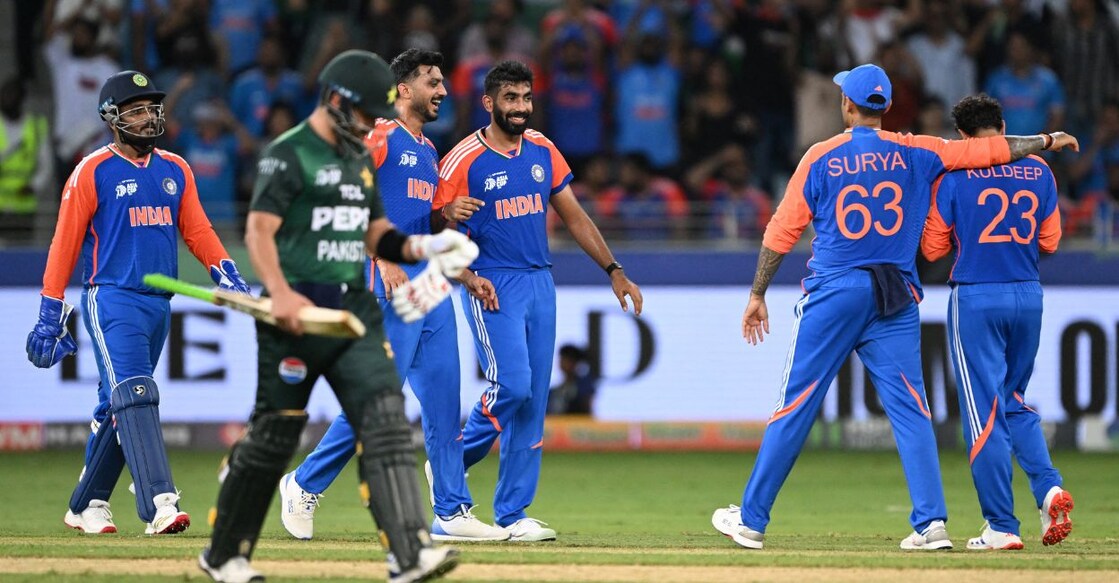
The pitch at Dubai stayed true to its reputation of being a “slow” one, where the ball does not come onto the bat. Indian team management had planned for this by selecting three high-quality white ball spin bowlers in the playing XI. Kuldeep Yadav, Axar Patel and Varun Chakravarthy used the conditions very well, while bowling within their limitations, without attempting to be too ambitious. The variations they employed in the pace of the delivery, especially the clever use of the slower ball, kept the Pakistani batsmen guessing. After Hardik Pandya and Jasprit Bumrah provided the initial breakthroughs, the three spinners dominated the proceedings through the middle overs, picking up wickets at regular intervals besides keeping the batsmen under check.
The total score of 128 was too low to stretch the Indian batsmen and they reached the target in style with 7 wickets in hand and 25 balls to spare. Fittingly, the winning hit was struck by SKY, who sent the ball soaring to the stands for a huge sixer to wrap up the proceedings.
Kuldeep Yadav won the Player of the Match for the second match in succession for his brilliant spell with the ball that saw him return with figures of 3 for 18 off his full quota of 4 overs. He was ably supported by Axar and Varun, who kept things tight and were unlucky not to return with better pickings. One gets the feeling that SKY would have been a very close second to Kuldeep in the race for Player of the Match award, both for his unbeaten innings of 47 as well as the calm and poise with which he led the side in a tense game.
Well played, India! Best wishes to SKY and team in the matches ahead and for winning the championship.
 Add as a preferred source on Google