

Up close to a money-borrowing ex-president
Mail This Article


When I went to meet Ketumile Quett Joni Masire, former President of Botswana, he had been retired for about two years and living as a farmer on the outskirts of Lobatse, a prosperous town on the South African border. Ramachandran Ottappath, a chartered accountant (from Trichur, Kerala) whom I had met in Lobatse and became friends with, had made it possible for me to meet Masire. Ramachandran worked for the supermarket which purchased Masire’s farm produces and knew Masire well. He confided in me that there were occasions when Masire called the supermarket from afar and requested them to send some cash across to his home to meet some urgent need. Masire would promise to repay the loan when, say, the corn harvest came up – and he always did.
Masire had two farms where he cultivated cabbage, spinach and corn and other crops. He also farmed ostrich. Ramachandran had warned me to expect complaints about the weather, low prices and all the typical hassles that worry a farmer and I was pleased to hear exactly that. It was as if I was sitting with a farmer in my own village.
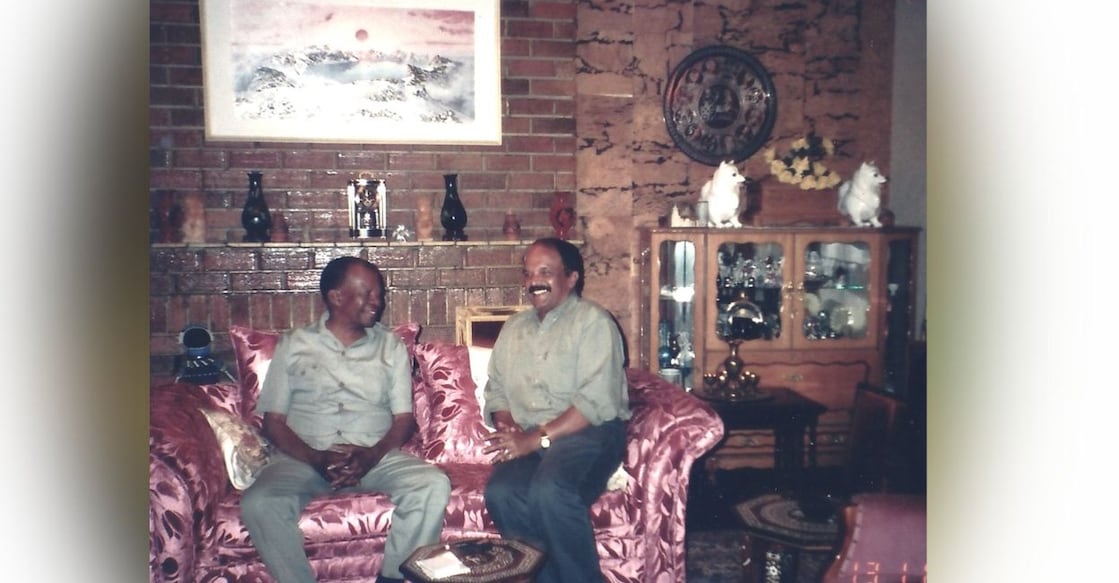
It is a drive of about an hour through mud-roads to reach Masire’s farm. The gate is open. A tractor stands in the yard and agricultural implements lie scattered. As we get down from the car, a man – obviously a security man in civilian clothes, unarmed – escorts us inside the house. It is a well-to-do farmer’s home, the only sign of luxury being the colourful sofas in the living room. Masire’s wife, a tall, hefty, friendly woman, receives us and makes small talk.

Masire enters. He’s a trim, energetic person of around 65 but looks hardly fifty. He heartily welcomes us, and his laughter is loud. He is informal and easy, but the composure and self-assurance of a person who’s been holding power over a nation for 33 years as vice-president and president, is unmistakeable. His simplicity is transparent, but it’s that of a statesman who has walked global corridors of power for decades.
Masire is a family man with six children, three girls and three boys. At the time of my visit one son was helping him in the farm; another ran a motor garage and the other worked at a conference centre, both in Gaborone, the capital city.
Masire was the only African politician I had the opportunity to meet during my five-month-long travel in Africa. Post-colonial African politics is, if I may borrow a word from the vocabulary of that master of the art of the novel, Milan Kundera, a ‘problematique’ – a complex, interconnected, contradictory, confusing, bundle of issues that eludes easy understanding. Not many politicians have come out of the jungle of African politics with reputation untarnished. Very many have been felled by corruption, avarice and greed for power. Even Nelson Mandela had family issues that turned politically embarrassing. Quett Masire was different.
I had wandered into Botswana by road from Cape Town, South Africa – a distance of 1400 kms. Botswana is home to the famed Kalahari Desert which also houses the equally famous Okavango Delta. It is also the world’s number one producer of diamonds in monetary value; and second only to Russia in carat volume. Thereby hangs a tale of destiny. It was in 1966 that the British colonial rule in Botswana ended. And in 1967, three diamond fields, considered among the world’s largest, were discovered there. And Botswana, a poor post-colonial nation of Africa, had discovered a new destiny.
The first president, Seretse Khama, led the team that put the country on a democratic path and ensured scientific and efficient management of the extraordinary diamond hoard. Quett Masire was his vice president and also minister of finance and development planning, who firmly put Botswana on a path of growth and prosperity.
Masire became president in 1980 and continued till 1998, voluntarily retiring when he had two more years to go. (He had announced his decision to quit as president at a state reception for president Clinton in 1998.) His presidency witnessed a miracle: Botswana became the only country in Africa that boasted a surplus budget. (Today there are around five more.) Masire’s presidency was marked by its strong democratic spirit, firm commitment to the people and a surging economy. He was a peoples’ president.
In the dark times we live in, it is a tiresome exercise – perhaps fruitless – to even try to point out that Masire belonged to a vanishing tribe of political leadership – one that took democracy and people seriously. Personal probity was the foundation of political authority. All this may sound strange today. Yet it is a joy to know that such a president did exist. Perhaps his life says that there’s hope yet.
Here are a few excerpts from my interview with him:
PZ: ‘Why did you decide to retire when you had two more years of assured power?’
QM: ‘I was vice president for 15 years and president for 18 years. I felt it was time to hand over the reins to younger people and let them prove their worth.’
PZ: ‘The word ‘politician’ has some unfortunate connotations in India.’
QM: (Laughs loudly). ‘Yes, people think we’re all thieves! I told you that I had faith in my juniors and felt it was time to let them take charge. There was another challenge. Africans never let go of power. I had prayed that I should never die as president. I wanted to retire and prove that at least one African can do that.’
PZ: ‘Did you have an ideological position in building up Botswana in the early stages? Communism? Socialism?
QM: ‘We’re a very practical people. We respect capitalism for what it can do. But we do not want heartless capitalism. What we want is capitalism in the shape of investment that brings goods and services to people and generate employment. We do not need ‘highway robbery’ variety of capitalism. The ‘iron rule of wages’ states that people will work for any wage as long as they are assured of food. But as human beings we need to respect other human beings. They are the same as us and what is good for us is good for them too. In capitalism it is necessary to make profits to enable growth. But that should not be at the cost of the people. That kind of growth is meaningless.’
PZ: ‘For many countries in Asia and Africa war is a great attraction. Have you ever viewed war as a solution for domestic issues?’
QM: ‘Never. May be, we were lucky to recognize we are a small nation! (laughs). It would be foolish for a country like ours to go to war with neighbours. There were several attempts to drag us into war. But we didn’t give in. We didn’t have an army, only paramilitary police. But when (apartheid) South Africa began sending guerilla fighters against us we had to create an army.’
PZ: Were you able to check corruption? Did you resort to moral pressure or legal?
QM: Both. First of all, because we had started out as a poor country, there wasn’t enough money around to fuel corruption. But as our economic situation improved, we started having difficulties. Government officials in lower rungs started asking citizens for ‘special pay’ to do their jobs. Also, many started stealing from the exchequer. We looked around for a country that had successfully tackled corruption to seek help. It was from Hongkong’s anti-corruption directorate that we received the guidance to create our own system. It worked.’
PZ: ‘Would you say that your personal example played a part in eradicating corruption? What would’ve happened to the nation if you were corrupt?’
QM: (laughs loudly) ‘Who knows! I do not wish to beat my own drum. But I think all of us were very conscious of the dangers of corruption and therefore carefully kept it away.’
PZ: ‘Was it an act of patriotism or result of a personal value system?’
QM: ‘It’s difficult to separate the two. All I can say is that all of us understood that we were working for the nation and that the nation had bestowed on us the honour of serving it and that we should do nothing that would make us undeserving of that honour.’
***
(Quett Masire died in 2017, aged 91 years. I dedicate this small note to his memory – a great African, a great statesman, a great human being and the rarest of them all: an honourable politician)
 Add as a preferred source on Google