

My days in Zimbabwe with a lovable investor in death

Mail This Article


‘Even a baby can do what I’m doing here,’ Guni Ramji told me. ‘You buy something from somebody and sell it to somebody else. The goods come to you, and the customers come to you. It’s so boring!’ He was sitting in his office at the back of his shop in Bulawayo, Zimbabwe, along with his Man Friday, Minhas, a young, amiable Pakistani. Guni had just entered my life, or rather, I had just walked into his.
The late Mr V Damodar, a businessman in Bulawayo with whom I was staying and whose guidance helped me shape my first African travel, had told me, ‘My friend Guni has agreed to show you around.’ I didn’t know I was going meet one of the most interesting people I’ve ever come across. Thus, one afternoon, I had stepped into Guni’s readymade clothes store on Herbert Chitepo Street, Bulawayo. Like many Gujarati retail establishments in Africa (of course, twenty-five years back), it was a plain, no-nonsense shop. Guni welcomed me, pipe in mouth and full of good cheer.
He was a man in his late forties with a foodie’s paunch, talking simultaneously into two mobile phones, exploding with laughter, cuss-words and delectable obscenities, and in between, with the phone pressed between his shoulder and ear, freeing his hands to pull out a document on the desk or make entries in his laptop or go to a shelf and search for something. When the phones were quiet, he continued to attend to work even as he kept talking to you. He was multitasking many times personified.

In the middle of it all, he also listened keenly, full of curiosity about the world, about India, about my being a writer and why I was a traveller. He was cutting in his opinions on politics and politicians, on Africans, African-Indians and on the white, all in equal measure. His greatest enemy was Robert Mugabe, the then-dictator of Zimbabwe.
To my great pleasure, he was widely read in fiction and history, and we shared the same love for Hindi film music, Western popular music and Hollywood films. He was immersed in Zimbabwe’s life, politics, juiciest scandals, and the lives of ordinary women and men just like us. Guni was an entrepreneur, philosopher, raconteur, and man-about-town all rolled into one. And a gentleman if ever there was one. I couldn’t have asked for a better mentor in Zimbabwe.
During the very first few moments of our meeting, he had told me that shopkeeping was boring. But I could see he worked hard while he was at it. It was his wife who really ran the shop. Guni’s heart was in real estate, and any quick-money-making scheme he could dream up. Hardly halfway through our meeting, Guni had generated a grand plan for recruiting thousands of nurses from Kerala through a tie-up with the Zimbabwe health ministry. He confided to me that his wife and children poured cold water on his big-money-making schemes. ‘They just don’t understand I’m light-years ahead of them,’ he said reproachfully.
Guni now said, ‘Let’s first go and get my friend B before we start. He’s great company.’ (B was a sardar born and brought up in England who had shorn his beard and given up the turban.) So, we drove to B’s house. All along the way, Guni kept pointing out to me the buildings and plots he planned to buy, the ones he had already bought and sold, and plots he had bought to build houses. He and the car were one. As he puffed on the pipe or a cigar and talked nonstop, showed me sights, waved at friends in nearly every passing car and sometimes slowed down to shout greetings, the car seemed to run by itself. For every friend that passed by, he had a delicious footnote ready, invariably a spicy slice from his/her life, but without the least malice. In his fascination with people, he was more a writer than I was.
Guni told me how his grandfather had arrived in Bulawayo around the same time as Gandhiji. He was a washerman. Soon, he set up a laundry where the British, wealthy Indian traders and army top brass were his customers. He made money, moved into the grocery business, and built his own premises in the heart of Bulawayo. Guni’s father expanded the business. Guni told me that many Gujaratis who migrated to Zimbabwe in the late 19th and early 20th centuries belonged to the service-rendering ‘lower’ castes. He was proud that his grandfather was a washerman. ‘We wash off people’s dirt! Isn’t that wonderful!’ Then he launched into a racy story about Monica Lewinsky’s underclothes.
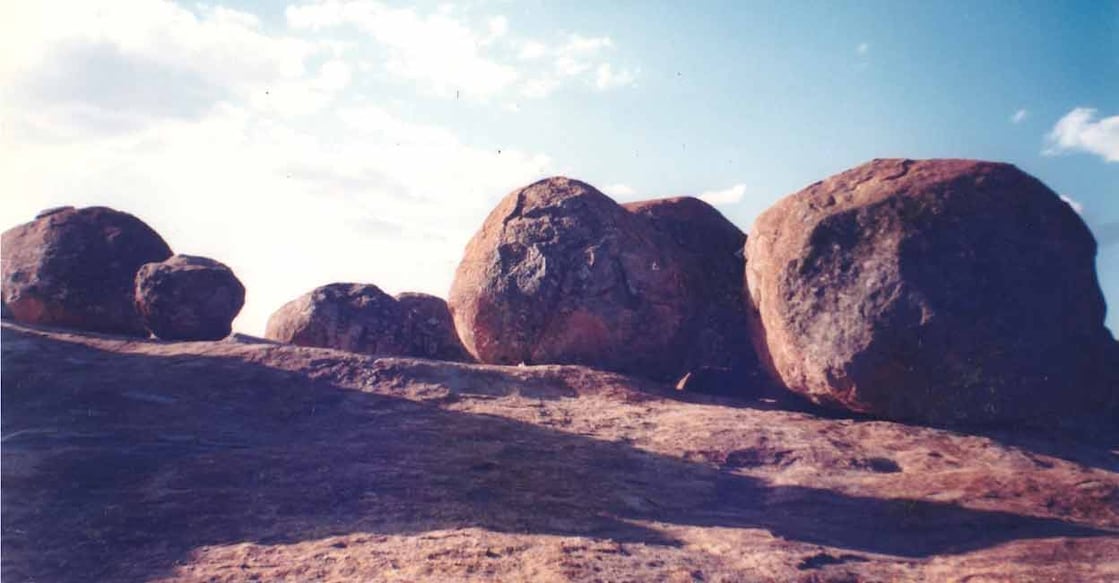
We picked up B and drove to Matoba National Park, where, upon a rocky mountain-top, Sir Cecil Rhodes, one of the architects of the British Empire in Africa, lay buried. The entry fee to the national park was a stiff amount. Guni dropped nearly every name that counted in the Zimbabwe administration, except for President Mugabe's, to get the guard to let us in for free. But the young guard stood his ground, smiling sweetly. Guni said, ‘Let’s leave him. He’s incorrigible – like Mugabe. We shall go to the second entrance where the old man at the gate is more amenable.’
When Guni had told him a string of lies and paid a moderate bribe, we were let in without tickets. He was immensely pleased. The businessman in him had succeeded in getting a deal! Rhodes’ grave amongst the giant rocks was an eerily beautiful, haunting place. It was evening, and the shadows were lengthening. Guni lit his umpteenth cigar and said, ‘Let me tell you. I don’t have the guts to spend a night here alone.’ ‘Why?’ I asked. Guni said, ‘Suppose the man in that grave got up to take a look at his empire? He was so much in love with it.’
I think Guni took a liking to me. Because he told Damodar that he would himself take me to Harare, the capital, which was my next destination, where he presided over a mind-boggling zoo of friends, as I was to find out soon. Harare is 400 kilometres away. If I thought he was going to drive straight to Harare, I was thoroughly mistaken.
We set out at 8.30 am, and Guni headed straight to the house of a client, an African running a garage who wished to sell it. He drowned him in a sales talk in English and Bantu, filled with laughter and much back-slapping, without letting him put in a word in between. It didn’t take much time for him to become Guni’s client.
Then we proceeded to the house of a white old lady, a widow with a mind of her own who wished to sell her home. I think Guni succeeded only in getting her to agree to a tentative price. Onwards to the next house for sale. There, only the African owner’s wife and four children were present. That didn’t discourage Guni. He picked up each child, played with them, pulled out candy from his pocket and gave it to them and kept the lady giggling over his jokes. At the end, he seemed to have made her sympathetic to the price he proposed.
The last meeting was with a rich young African in the truck-service business and his beautiful girlfriend. We met them at the house Guni wished to sell them – a dream-house with five bedrooms situated on a three-acre plot. The negotiation took some time, but I watched in admiration as Guni clinched the sale and shook hands with the couple. Their eyes were wet, not from the joy of buying a house, but from too much laughing. Guni told me the sale price was 160000 Zim-dollars – about the same in rupees (at that time). His commission was 70000 Zim-dollars. All transparent. He told me, ‘Do you understand why I said shopkeeping is so boring? Here, I have to persuade people to buy or sell. I exert my brain. And these people become my friends.’
Guni now said, ‘Let me show you my latest investment. This is where I expect to become a multi-millionaire. Because the demand for my product is unending. What’s needed is just innovation.’ He then drove me to his coffin manufacturing unit. It was a big workshop where dozens of carpenters, painters and other workers were busy. Tall stocks of timber stood on one side. Hundreds of coffins were undergoing different stages of making. Finished ones were stored in one corner. Their shining colours ranged from gold, silver and white to black, blue and yellow, all adorned with glittering decorative motifs. Guni waved towards them all as if he was blessing them and said, ‘See! Death is my new business!’
AIDS was killing Africans in their hundreds and thousands, and coffins were big business. AIDS or not, death, for Africans, is a celebration to splurge money on. And they invest big money in coffins. Guni was investing not only in death but also in the African love for grand funerals. He made coffins from the same common wood and charged the world for the different colours. Guni told me, ‘They’re willing to pay almost the same price of a gold ornament for a ‘golden’ coffin.’ ‘Hahaha,’ he added, ‘God makes people die! I complete God’s work!’ He also showed me the green-and-white camouflage-painted coffins he made for soldiers.
As we drove back, the sun was warm, but the winds were cool. The sky was an impeccable blue, with white clouds hanging as if in a three-dimensional painting, slowly disintegrating in the wind. ‘Ha!’ Guni exclaimed, ‘How beautiful is this world!’ Then he mused aloud, ‘At the end of the day, coffins are just another kind of real estate. Only, they are small plots: 84”x28”x23”.’ I said, ‘Guni, even cemeteries are real estate.’ He roared with laughter. ‘You’re absolutely right! Maybe I’ll invest in one!’
Next: ‘Discovering Harare with Guni.’
 Add as a preferred source on Google