

The women in ‘Vilayath Buddha’: Free of stereotypes or still shackled by it? | Analysis

Mail This Article


The portrayal of women in Malayalam cinema has undergone a striking evolution over the years. The once-stereotypical, coy heroine has increasingly given way to complex, assertive female characters who now anchor many contemporary narratives. ‘Lokah,’ which hit theatres recently, was perhaps the biggest surprise, a film that handed Mollywood its very own woman superhero.
Amid this shift, women making a living as sex workers have also begun to receive a more nuanced voice. Take Khadeeja in Sajin Baabu’s ‘Biriyaani,’ a woman crushed by patriarchy yet determined to break free through her unconventional and unsettling choices. Or consider Sajitha Madathil’s Thankam in ‘Shutter,’ who challenges the moralistic labels attached to her profession and shows that women in that line of work, too, operate within their own codes of ethics.
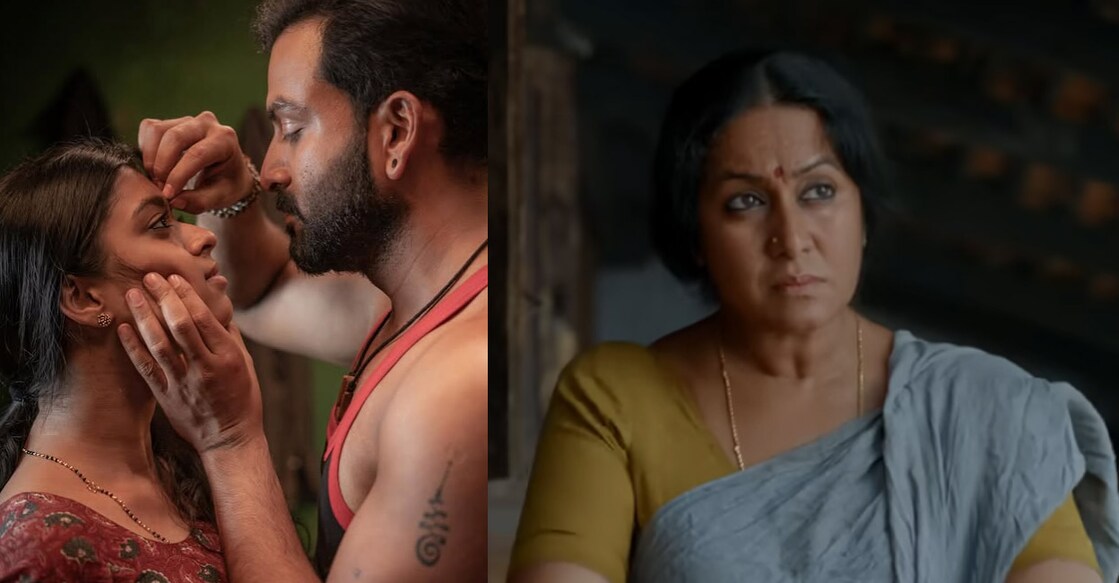
In ‘Vilayath Buddha,’ directed by debutant Jayan Nambiar, we are introduced to yet another sex worker, Cholaykkal Chembakkam (Rajashri Nair), and her daughter Chaithanya, portrayed by Priyamvada. Given that the movie arrives at a time when women’s narratives in Mollywood have evolved significantly, one would expect Chembakkam to be written with greater agency. Sadly, she is reduced to the familiar stereotype of the village prostitute, name-shamed and forced to fight for her dignity.
Her appearance reinforces this typecasting: the red bindi, the constant paan chewing, and the brash exterior of someone hardened by circumstance. She even lashes out at her daughter when confronted about the stigma attached to her identity, highlighting a character shaped more by cliché than complexity.

While Chembakkam is written as a stereotype, her daughter Chaithanya, who wants to break out of her mother’s identity, gets a much stronger storyline. Her bold and layered character makes her one of the most memorable figures in the film. Chaithanya is neither the virtuous, self-sacrificing heroine nor the shy figure Malayalam cinema once favoured. She navigates her relationships on her own terms, telling Ani (Anu Mohan) he may kiss her even though she is already ‘claimed’ by Double Mohanan (Prithviraj). Her ambition is equally bold, she aligns herself with Mohanan because he helps her pursue her goals. In this way, she challenges familiar ideas of desire, ambition, and morality, offering a fresh take on women’s roles. Chaithanya lives on her own terms and doesn’t rely on anyone to shape her path. Double Mohanan (Prithviraj) is shown as someone willing to move mountains to help her regain her dignity, yet she also proves she can defend herself independently. However, it is disappointing that the filmmaker and writer could not break away from the cliché of hero oriented narration, ultimately making Chaithanya rely on a man to reach her goals instead of believing in their heroine.
Overall, the women in ‘Vilayath Buddha’ are granted some agency, but never completely. While the male heroes find closure, the female characters remain partly constrained by stereotypes, even as they seek their own redemption.
 Add as a preferred source on Google