

Bahul Ramesh reveals how a childhood memory shaped the character of Mlaathi chettathi in ‘Eko’
Mail This Article


When cinematographer-writer Bahul Ramesh was around five or ten, he once accompanied his father to a friend’s house. They spent a long time chatting, and as they stepped out, his father casually asked, “Did you notice his mother? She isn’t Indian.” The remark stunned him. The woman who spoke perfect Payyanur slang all evening wasn’t Malayali? The idea was too strange for his young mind. He kept replaying the encounter, trying to understand what he had missed. That moment of curiosity settled deep within him.
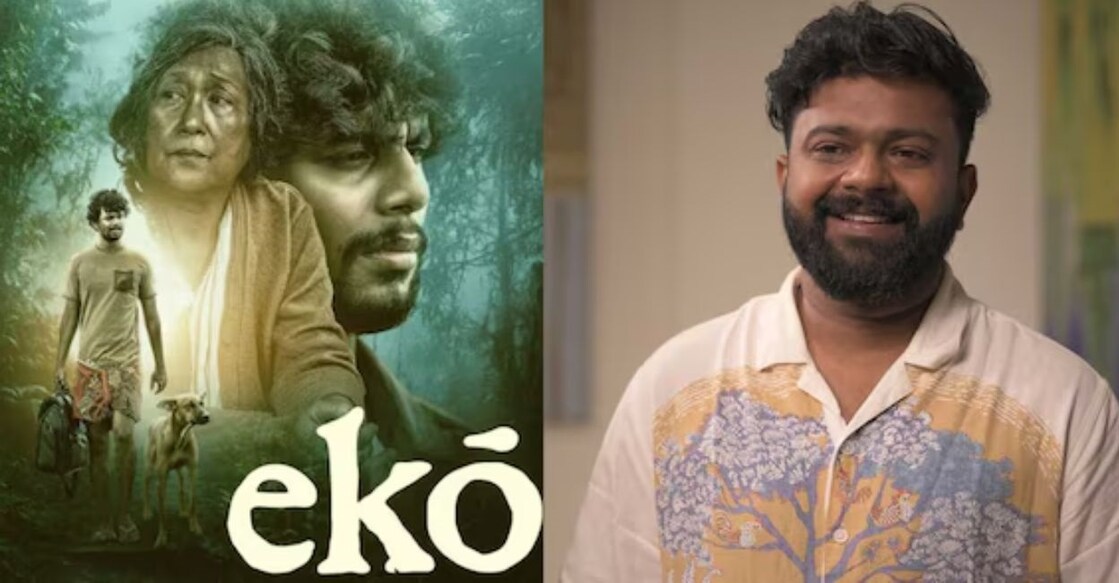
Years later, while writing a screenplay, a character quietly surfaced in his descriptions — a woman with narrow, East Asian eyes, her face almost like a charcoal sketch. That spark became the foundation for one of the strongest female characters in recent Malayalam cinema. Today, audiences know her as Mlaathi Chettathi from ‘Eko’. Speaking to Manorama Online, Bahul explained how both the character and the film took shape, eventually earning praise from viewers and critics as a world-class Malayalam film.
The earliest idea for ‘Eko’ came not from a visual, but from a single line of dialogue. It arrived long before he had a story or characters. For a while, he imagined placing the narrative in the eighteenth century, but the technician in him knew the logistics would break the film. He didn’t want to write a script that couldn’t be made.
So he shifted the story to the 1930s. Even then, the first scene — with a bullock cart — proved expensive. He replaced it with a jeep, which naturally pushed the setting to the late seventies or early eighties. With that change, the world of ‘Eko’ slowly began forming on its own.
A few scenes later came a moment where a doctor meets an elderly woman. While trying to capture the mood of the shot, he described her eyes — narrow, almost Southeast Asian. He hadn’t planned it; the detail simply flowed. But it felt significant, as if it was telling him where to go. That was the moment Mlaathi Chettathi truly took root.
Only then did he realise the source of that image. During that childhood visit, his father had told him the woman they met was Malaysian. In those days, many Malayalis migrated to Malaysia, Singapore and Burma just as they now travel to the Gulf. She had married into a Kerala family and lived like any other Malayali, speaking fluent Payyanur slang. For a child, the idea of someone being both familiar and foreign was fascinating. That memory resurfaced naturally while writing ‘Eko’.
Bahul says he never plans the climax in advance. He lets the story unfold. After finishing the first half, he gave it to his father to read, and listening to his father’s predictions, he instinctively steered the story in the opposite direction.
Music guided much of his writing. While working on ‘Kishkindha Kaandam’, he often listened to the Interstellar soundtrack. For the second half of ‘Eko’, he drew energy from the theme music of ‘Season’, especially the track that plays during Mohanlal’s jail escape. Its blend of swagger and mischief added a playful electricity to the writing.
And when he reached the climax, he immersed himself in the ‘Inception’ track “528491”. Its emotion and mystery carried him through the final scenes. Whatever he felt while listening became the dialogue on the page, letting instinct, memory and music guide ‘Eko’ to its finish.
 Add as a preferred source on Google