

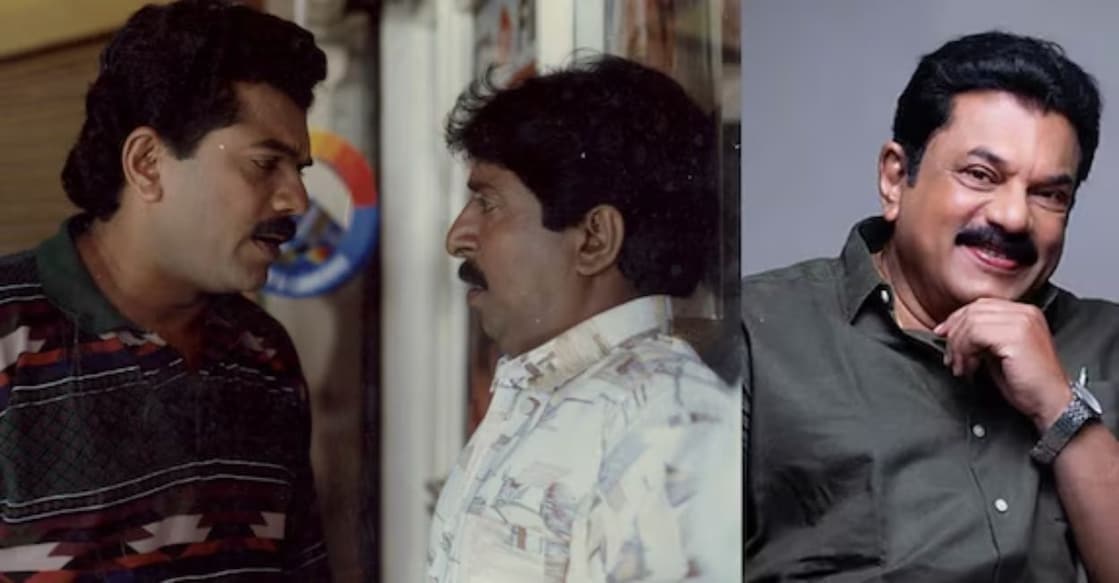
A friendship like no other: Mukesh reflects on 43 years of bond with Sreenivasan
Mail This Article


For Mukesh, the loss of his dear friend Sreenivasan is more than just the passing of a colleague—it's the end of a decades-long bond that was built on mutual respect, shared dreams, and deep affection. Sreenivasan, known for his ability to make people laugh while also provoking thought, was like a senior brother to Mukesh, a mentor and a close companion whose absence has left a profound void.
Looking back at their forty-three years of friendship, Mukesh is flooded with memories of countless moments spent laughing, dreaming about films, and navigating the ups and downs of their shared journey in cinema. With a heavy heart, he recalls Sreenivasan as the most sincere artist he had ever met, and how their collaborative spirit and shared vision for cinema brought them together.
“I had an exceptionally strong and lasting friendship with him,” Mukesh says. “Sreenivasan had a distinctive personality. He was someone who spoke his mind openly and honestly, never holding back, no matter the situation. Whether it was cinema, a TV programme, a story, or a script, he demanded quality and integrity in everything. He would ask at least ten questions when you brought him a script—questions that were precise and thought-provoking. Only when he was satisfied with the answers would he move forward. Many people hesitated to approach him because of how thorough and meticulous he was.”
Mukesh continues, his voice tinged with sorrow: “What hurts the most is that after sharing so many years of friendship with him, I never imagined I would have to speak about him only in the shadow of his passing, without celebrating his work, his characters, and his incredible contributions. This is a deep sorrow for me.”
"He was the kind of friend who never showed the slightest sign of displeasure, no matter what happened. I would often tell him, ‘I’m putting up with all of this because it’s me. Anyone else would have walked away by now.’ But he would just laugh. That laughter of his was legendary—endless and filled with joy. He approached both his art and life with the same passionate, unrestrained happiness.”
The first film that comes to mind from their early years together is 'Odaruthammava Aalariyam'. Mukesh fondly recalls how, even in the early days when their bond was still growing, Sreenivasan would step in and defend him whenever there were disagreements or doubts. It was during these moments that their friendship solidified, creating countless memories they would cherish forever.
Mukesh shares one such moment: “One day, I told him, ‘We’ve been working together for so long. You know everything about filmmaking—story, script, dialogue, direction. Let’s produce a film together. It doesn’t need to be a big blockbuster, but it should be something meaningful, something that will be a milestone in our lives.’ And he laughed. I can still hear that laugh.”
But then, during a wedding in Ernakulam, Sreenivasan pulled Mukesh aside and said, “I have something important to tell you.” Surprised, Mukesh asked if it was about the wedding, but Sreenivasan responded, “This is more important than the wedding,” and then revealed the story for 'Katha Parayumpol'.
As Mukesh listened to the story, emotions overwhelmed him. Tears welled up in his eyes as Sreenivasan finished narrating. Sreenivasan then asked, “Didn’t you once tell me we should make a film together? Should we take this story?” Mukesh, moved by the sincerity of the story, replied, “There’s no better story than this one. It’s a story of friendship, meant for friends everywhere. We must do this ourselves.”
Sreenivasan laughed again and said, “My brother-in-law, Mohan—Vimala’s brother—is involved. I’ve promised him this. He’s handling the direction. As the producer, if you have any objections, we can leave this story behind.” Mukesh reassured him, saying, “It’s no problem, he’s your brother-in-law. Let’s go ahead.” And thus, 'Katha Parayumbol' was born.
The journey continued with 'Thattathin Marayathu'. Sreenivasan, moved by a story written by Vineeth, came to Mukesh with his usual honesty: “I’ve heard this story, and I don’t know if it’s out of joy or sadness, but my eyes welled up. Should we produce this film?” Mukesh immediately agreed: “We don’t need to look back. Let’s do it.”
However, Sreenivasan added, “But there’s no guarantee that either of us will have a role in it. The decision is entirely up to the director. Even though Vineeth is my son, he should be the one to decide.”
Mukesh asked if there was any chance they could be part of the cast. Sreenivasan replied, “There are possibilities, but the final call rests with the director and scriptwriter. As producers, we shouldn’t interfere.” Mukesh, ever the supporter, replied, “Even if we’re not in the film, it doesn’t matter. We’ll produce it anyway.”
A week later, Sreenivasan called again, laughing uncontrollably. “I’m in. Your case is still uncertain,” he joked. That was Sreenivasan’s way of looking at life—light-hearted yet profoundly serious.
Both films went on to become huge successes, but as time passed, their respective commitments to other projects left little room for continued collaboration. Mukesh recalls how their mutual decision to put their production company, Lumiere Films, on hold was a natural outcome. “Being a producer demands full-time involvement, and we were both pulled in different directions,” he says.
Even later, whenever they discussed new projects, Sreenivasan never stopped challenging Mukesh as a scriptwriter. “Is this really a film we should make? Is there a logical gap here?” Sreenivasan would ask, always seeking perfection in the stories they wanted to tell. His uncompromising clarity was at the heart of everything he did.
The pain of Sreenivasan’s loss is deepened by the fact that just days before his passing, his wife, Vimala, had called Mukesh with concerning news. “Mukesh, Srini Ettan is finding it difficult to speak. He had a fall,” she said. Mukesh was unaware of his condition. She mentioned that he was experiencing some leg pain and that a small document was missing for income tax purposes. She asked if he could check with the auditor. Mukesh assured her he would take care of it.
It was only that morning, when Mukesh turned on the television, that he learned the tragic news. “This is not just a personal loss for me, but a huge loss both as a friend and a filmmaker,” he says, overwhelmed with grief. “Sreenivasan was an irreplaceable presence in Malayalam cinema, a national award-winning artist. His work, including 'Chinthavishtayaya Shyamala', carried profound messages and sharp social critique, but it was always wrapped in humor. His satire never caused confrontation. Instead, it made people think without making them feel attacked. That was his unique gift. No matter whose conscience it touched, he never gave anyone a reason to react with anger.”
This loss is immeasurable. “He leaves behind countless memories—memories I can hold onto, even in silence,” Mukesh concludes. “I offer my tributes to him.”
 Add as a preferred source on Google