

How producer Geo Kuttappan took Malayalam cinema beyond its borders
Mail This Article


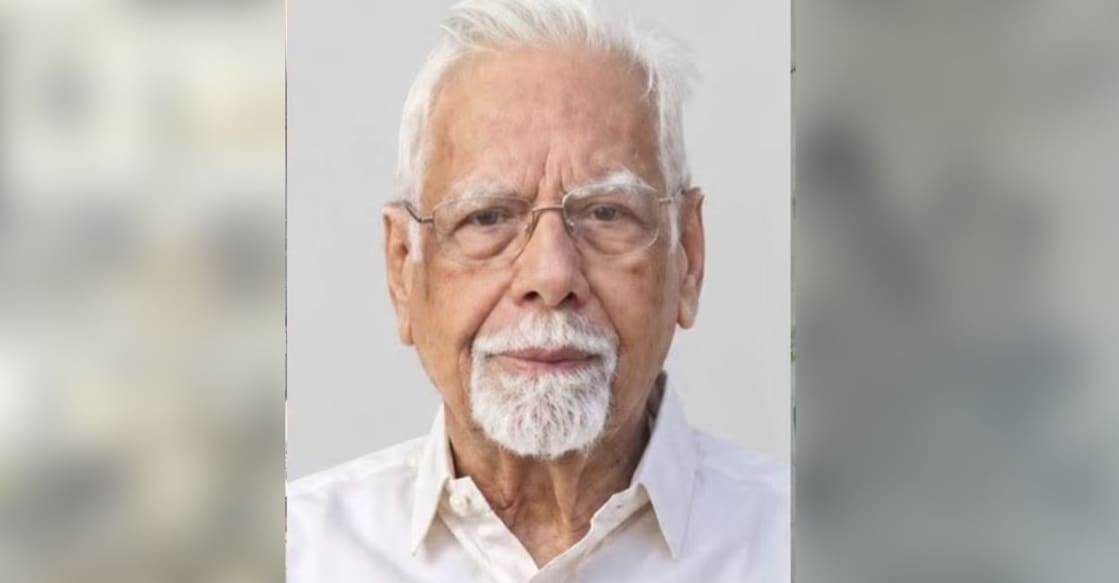
N G John, better known in the film world as Geo Kuttappan, a veteran producer who passed away on Wednesday, shared a close friendship with K Gopinathan Pillai, father of actor Suresh Gopi. Whenever Kuttappan’s films were being shot in the Kollam region, Gopinathan Pillai would make it a point to visit the sets. Once, around that time, a tall, good-looking young man turned up at Kuttappan’s house in Madras. His name was Suresh, Gopinathan Pillai’s son, and he had arrived carrying a letter from his father. Kuttappan was in for a surprise when he opened it.
“Dear Kuttappan, the young man carrying this letter is my son Suresh. He has come to Madras with a keen interest in cinema. Keep him there for a few days and then send him back home. He is preparing to become a police officer. Under no circumstances should you encourage him to enter cinema,” the letter read.
But Kuttappan had already begun imagining the six-foot-plus, handsome youngster standing before him on the silver screen. Had he sent Suresh Gopi back that day, he could hardly have carried a greater sense of guilt, Kuttappan wrote later.
The story is among the many evocative memories captured in ‘Cinema and Me: Through 70 Years’, a book authored by Kuttappan that meticulously chronicles his long journey through the Malayalam film industry. The book brings to life, in vivid detail, memories that have remained undimmed by time, while offering a ringside view of an era when Malayalam cinema was evolving, experimenting and reaching beyond its familiar boundaries.
Yesteryear actors Lalitha and Padmini, part of the famous Travancore Sisters trio, made their silver screen debut in ‘Prasanna’, a film produced by Kuttappan’s father, N X George. Years later, during a shoot in Alappuzha, Lalitha asked director I V Sasi whether they could make a film in the US, pointing out that her sister Padmini was living there. The idea eventually became ‘Ezham Kadalinakkare’, the first Malayalam film to be shot in the US, in 1979. Thanks to Kuttappan’s meticulous planning, Niagara Falls, Kennedy Airport and the streets of New York all found their way into the cinematic landscape of Malayalam cinema.
The film, made in both Malayalam and Tamil, told the story of a woman who devoted herself entirely to providing for her family, bringing her relatives to the US in the process, but forgot to live for herself. Made at a cost of Rs 70 lakh, the film was an adventure off camera too. Kuttappan later recalled how he kept expenses down during the shoot by living simply, eating burgers, doing his own make-up and even washing his own clothes.
Known for bringing a professional and experimental approach to film production, Kuttappan had a distinctive way of making movies. He would start with a one-line story, find a director and then bring in a writer to develop it.
“I would decide to produce a film first and then find the director. After that came the writer. I came up with the central idea for most of the films I produced. Those ideas were then developed into films. The story of ‘Minimol’ came from an article written by Justice Anna Chandy. Likewise, I got the story for ‘Iniyum Puzhayozhukum’ from a book by Harold Robbins. I would have only a one-line story in hand, which would eventually become a screenplay. It was a time when the hero was central to a film and there were only a few leading actors. So the screenplay was written with the actor in mind,” John used to say.
A screen adaptation of the Bible was among his biggest dreams. As executive producer of the ambitious project, he wanted to tell the story from Adam and Eve to Christ’s Ascension. Though John Huston had earlier attempted a cinematic retelling of the Bible, his version ended with Abraham. Kuttappan’s project began to take shape as the Bible started being telecast on Doordarshan’s national channel, but the production was eventually abandoned midway.
Kuttappan also watched the transformation of Malayalam cinema with keen interest, drawing comparisons between the changing phases of the industry and those navigating them. After a lifetime spent travelling through the unpredictable world of cinema, he would quip: “How can someone who has driven an Ambassador all his life suddenly feel at home in a new Benz?”
When MGR sent police to escort John
There was another unusual episode in Kuttappan’s long association with cinema, this one involving none other than actor-politician M G Ramachandran. Nearly five decades ago, N X George sent his son John to Kuttikkanam, where an MGR film was being shot. As John prepared to leave, MGR asked him how he had arrived and how he planned to return.
“I have a car and a driver,” John replied. “In that case, I’ll have the police accompany you up to Mundakayam,” MGR told him. Tamil Nadu police officers soon arrived to escort John on MGR’s instructions. But after travelling a short distance, John told them: “You can go back. Just have a good sleep here for a while and then return to where MGR is staying.”
AVM Studios, one of the leading film production houses in Tamil Nadu, used to screen its films first for N X George, a prominent film distributor then, and John would often accompany his father. John also maintained close friendships with several of the biggest names of the era, including MGR, Sivaji Ganesan, Prem Nazir, Madhu, Jayan and Soman.
