

Mohanlal’s Georgekutty has the heart, Ajay Devgn’s Vijay has the edge: The great ‘Drishyam 3’ divide

Mail This Article


There has always been something compelling about the ‘Drishyam’ franchise: an ordinary man willing to go to extraordinary lengths to protect his family, and the thrill of never knowing what he will do next or what challenge he will have to overcome. That combination made Jeethu Joseph’s ‘Drishyam’, the Malayalam original that later went pan-Indian with Ajay Devgn as the lead, such a phenomenon. Now, with both the Malayalam and Hindi franchises reaching their third chapters, the differences between the two versions have become more apparent than ever.
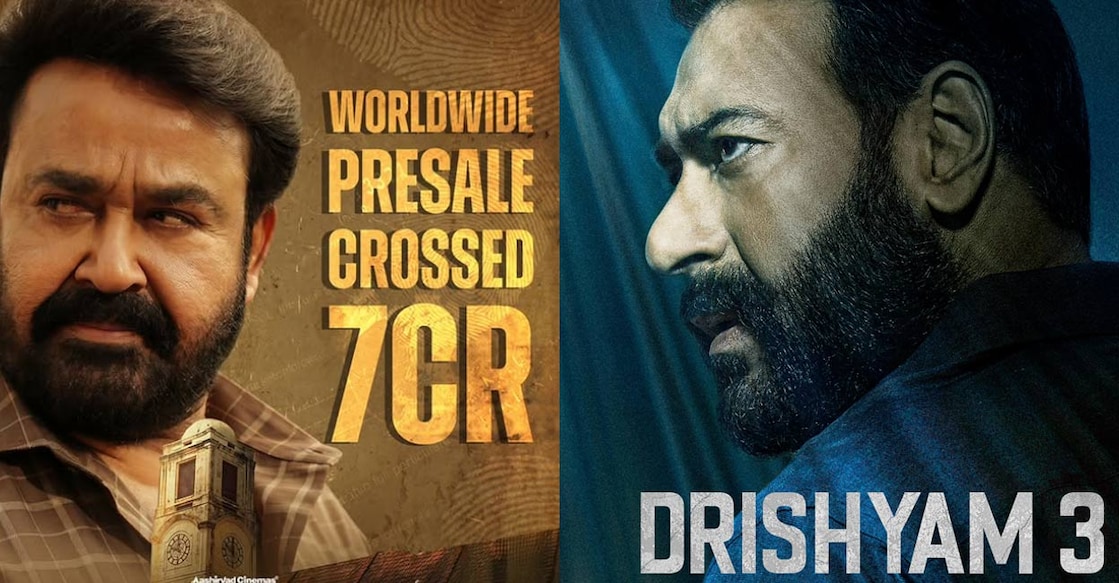
The Hindi ‘Drishyam 3’, directed by Abhishek Pathak, marks a departure from its predecessors, as it is not a direct remake of the original. With a story of its own, it approaches the franchise primarily as a tightly constructed thriller, keeping Vijay Salgaonkar (Ajay Devgn) and his increasingly difficult battle with the police at the centre. Jeethu Joseph’s Malayalam ‘Drishyam 3’, meanwhile, remains more deeply invested in Georgekutty (Mohanlal), his family and the world that has grown around them. The result is two films built on the same foundation but driven by different priorities.
No one saw Georgekutty pulling off a masterstroke with Varun Prabhakar’s body in the first ‘Drishyam’. In ‘Drishyam 2’, he did it again, reminding us that neither people nor circumstances can be taken at face value, and then showing us why. By then, Jeethu had made audiences deeply invested in Georgekutty’s world. We had watched him protect his family from the police, followed the cat-and-mouse game and marvelled at how he consistently stayed several steps ahead of the investigators. That emotional investment is important when watching the third film. Georgekutty is no longer simply a man trying to escape a crime; he remains a character whose family, relationships and history audiences have followed across three films. The Hindi franchise, by contrast, has increasingly made Vijay's ingenuity and his battle with the system its primary attraction.
That difference works in favour of the Hindi ‘Drishyam 3’. The Malayalam sequels have always given considerable space to the family, including their fears, relationships and the society around them. Their Hindi counterparts are more interested in the mechanics of the thriller and in watching Vijay find a way out of an increasingly difficult situation. This is not to say that Malayalam ‘Drishyam 3’ loses sight of its strengths. Jeethu's original vision was always built around the thrill of watching a family desperately trying not to get caught, something that became particularly prominent in the latter half of ‘Drishyam’ and throughout ‘Drishyam 2’. For viewers invested in the family drama, this may not necessarily be a problem. Jeethu retains that sensibility, particularly in the first half, where the relationship between Georgekutty and Rani (Meena) also continues to receive much of the attention, especially as they discuss their daughter’s impending marriage. But in the third part, that central conflict is diluted at several points.
One reason is Jeethu’s decision to bring back some of the characters from the earlier films and give them their own story arcs. It is an understandable attempt to expand the ‘Drishyam’ universe, but some of these subplots, including the return of Sahadevan’s character (played by Kalabhavan Shajon) pull the narrative away from Georgekutty’s immediate battle with the police. The possibility of the family being caught remains present, but it is no longer always driving the narrative. The Hindi ‘Drishyam 3’, on the other hand, is far more disciplined about its central conflict. The focus is almost entirely on Vijay and his increasingly difficult task of staying ahead of a police force that has become stronger and more prepared.
We know Vijay is brilliant, just as we know Georgekutty is. But that knowledge does not tell us how he will escape his latest predicament. The screenplay keeps the uncertainty alive: What is his next move? Has he anticipated this? And, more importantly, can someone betray him? The court scenes, particularly, make the narrative more engrossing. The treatment of the antagonist further exposes the difference between the two films. Geetha Prabhakar, one of the most compelling elements of the earlier Drishyam films, is somewhat sidelined in ‘Drishyam 3’. She may come across as arrogant and overbearing in the first film, but her resentment towards Georgekutty has a clear emotional basis: he has outsmarted her, kept her son’s death from being avenged and, years later, continues to remain beyond her reach. That sense of unfinished resentment makes her a potent source of tension.
In the third part, however, Geetha’s prolonged battle with depression pushes her character into the background and brings Siddique’s Prabhakar more prominently into the conflict. The shift is understandable within the story, but the transition does not feel entirely organic. Geetha’s absence also means the film loses some of the personal animosity that had made the conflict between her and Georgekutty so compelling in the earlier films.
The Hindi version, in contrast, gives its antagonistic forces greater weight, making Vijay’s battle considerably more challenging. The difference becomes even sharper in the second half. The Malayalam film takes a few turns that stretch credibility, particularly towards the climax, where it feels pressured to keep up with the demand of churning out another instalment. The Hindi version, which the makers have announced as the final chapter, feels more assured in this regard. Its second half maintains the tension and pace, remaining anchored to the question that has always powered ‘Drishyam’: how will this man get his family out of this?
Performance-wise, however, Ajay Devgn cannot quite match Mohanlal. Vijay is written as a more restrained, stoic character, and Devgn maintains that quality almost throughout. It suits this version and its thriller-driven treatment, but Mohanlal has an undeniable advantage when it comes to emotional depth. His Georgekutty is more expressive and lived-in, making it easier to connect with him.
Yet, as a thriller, the Hindi ‘Drishyam 3’ is more pulsating. A tighter screenplay, better pacing and Ravi Basrur’s music keep the tension moving. It understands that the franchise’s greatest strength lies in making us wonder how an apparently ordinary man will once again stay ahead of the police. There is also a certain satisfaction in knowing that the Hindi makers have chosen to conclude the story, at least for now. The Malayalam ‘Drishyam 3’, meanwhile, leaves the door open for another chapter, suggesting that Georgekutty’s battle may not be over.
The two films therefore arrive at the same destination from different directions. The Malayalam ‘Drishyam 3’ is more interested in Georgekutty and the family that audiences have lived with for three films. The Hindi version is more interested in the puzzle surrounding Vijay and whether he can solve it one more time.
Ideally, the perfect ‘Drishyam’ would have both: the emotional weight of Jeethu Joseph’s Malayalam films and the relentless, tightly controlled suspense of the Hindi third part. But, having said that, the irony of the two ‘Drishyam 3’ films is that the Hindi version, despite being an adaptation of Jeethu Joseph’s creation, sometimes seems to understand the spirit of the original more clearly than the Malayalam film itself.
