

'Vala: Story of a Bangle’ review: A gleaming idea dulled by uneven execution

Mail This Article


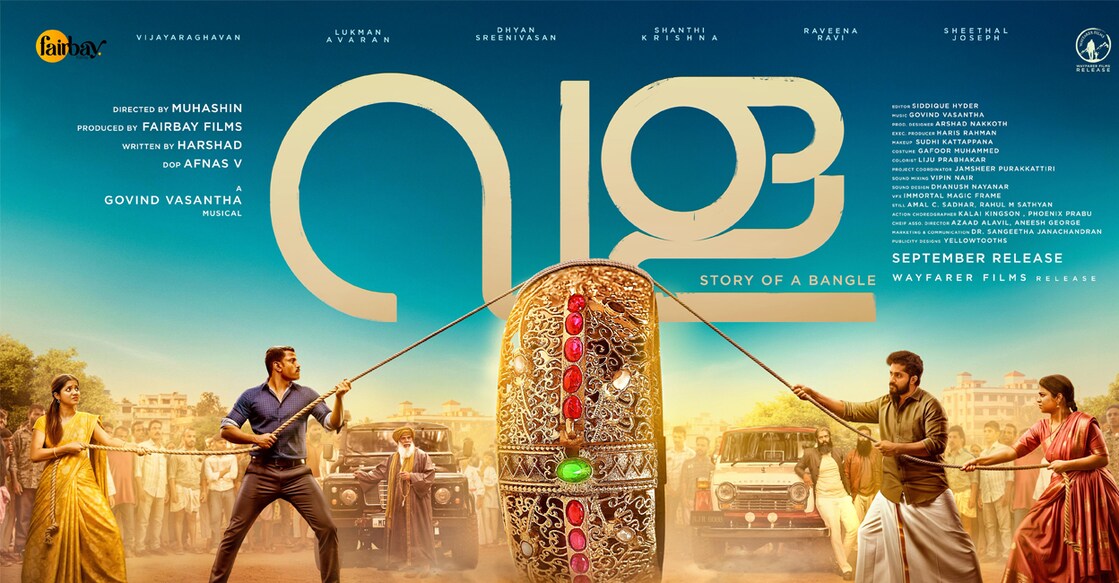
There is something instantly intriguing about the premise of Muhashin’s 'Vala: Story of a Bangle', a film that anchors its entire narrative around a single ornament. It is an unusual choice in contemporary Malayalam cinema. Bold in its simplicity, the idea carries promise, especially with Lukman and Dhyan Sreenivasan leading the cast. On paper, the story seems ripe to explore the messy intersections of greed, power and desire. On screen, however, it struggles to turn that potential into something lasting.
The film opens with Banu Prakash (Lukman), a police officer living a fairly ordinary life with his wife. Things change when she notices a striking bangle on another woman’s wrist and asks him to get her one just like it. That woman, Sarala (Raveena Ravi), is married to the character played by Dhyan Sreenivasan. What begins as a small domestic request spirals into obsession, with both men chasing the bangle for very different reasons — one framed as almost noble, the other openly malicious.
This is where 'Vala' initially sparks interest. The bangle becomes more than jewellery: it is a mirror of human weakness, a symbol of power and a silent disruptor in the lives of those who covet it. The makers build anticipation around the object. Is it magical, cursed, or simply a spark that exposes fragile ambitions? That central mystery sustains intrigue for a while.
Malayalam films often grow out of simple, everyday stories into layered narratives with historical or mythical resonance. Vala clearly aims for that space, tying personal motives to larger echoes of myth and history. Unfortunately, the execution falls short. The tone often tips into melodrama, and instead of drawing the audience closer, the story feels curiously distant.
The parallel tracks of Lukman and Dhyan’s characters never gain the depth they need. Their conflicts are presented but remain thin and oddly placed. Many turning points feel borrowed from older films rather than freshly imagined. A subplot in which greedy locals attack a family that once owned the bangle should have been gripping, but instead plays out like something we have seen far too many times. In such moments, the writing feels lazy, as though the film relies on chaos alone to create drama.
The second half introduces a thread about the origins of the bangle. For a moment, it seems the film might finally click into place. Yet even this subplot cannot hold, offering partial answers that create more clutter than clarity. By the end, there is no sense of resolution — just repetition of themes without a meaningful breakthrough.
What prevents 'Vala' from collapsing entirely are the performances. Lukman plays Banu with restraint, grounding the character with realism even when the script falters. Dhyan has less to work with but shows glimpses of what could have been a layered role. Raveena Ravi is quietly effective, while seasoned performers like Vijayaraghavan lend presence and weight. The cast is capable, but too often left stranded by the writing.
In the end, Vala had every element for a sharp fable about human desire and the illusion of control: mystery, symbolism, and a central object rich with meaning. What holds it back is its reliance on clichés, uneven structure and reluctance to dig deeper into the flaws it hints at. The bangle gleams at the centre of the story, but the film wrapped around it never manages to shine.
 Add as a preferred source on Google