

Newly discovered plant in Iravikulam may have exceptional medicinal properties

Mail This Article
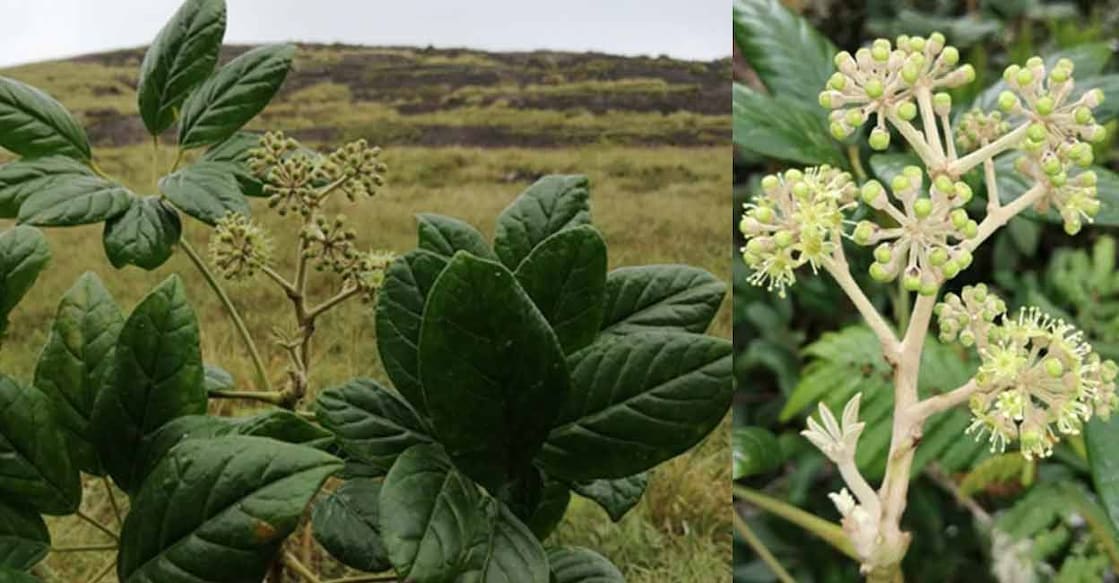
Hundreds of new plant species are identified across India every year. But a rare plant found in the Anamudi Hills in Iravikulam National Park in Idukki district early this month shot to prominence because of its prospective medicinal properties. Ever since the finding of Heptapleurum anamudianum was published on January 6, enquiries have been rife seeking more details of the plant.
Having similarity with the Ginseng family of herbs, which is used in China for extracting medicines, the high altitude plant holds significance and has ignited curiosity among botanical researchers and the scientific community at large to know whether it can be a highly valuable medical herb, if not a panacea.
The plant has been described as a shrub or treelet, up to 5 m tall with glabrous, branchlets, terete with semi-circular leaf scars and circular to elongated lenticels. While the young plants are brownish at the base and greenish towards the apex, it fully brown at maturity.
"Heptapleurum anamudianum, a new species of Araliaceae from the Anamudi Hills of Idukki District, Kerala, India, is described and compared to H. rostratum and H. clarkei. The species differs distinctly from all other taxa by its leaves... architecture, stylar extension, and trichome morphology," the published research paper on the plant wrote.
The plant, which belongs to Heptapleurum genus in the Araliaceae family, was discovered by a team of researchers consist of Sujana K A, Scientist 'E' and her research student, Amrutha Sundaran of Botanical Survey of India along with A J Robi researcher and lecturer, Bishop Abraham Memorial College, Pathanamthitta; V P Thomas, lecturer, Catholicat College Pathanamthitta; Salish Menancherry, Wild Life Assistant, Munnar Wildlife Division; P B Anoop scientist at the Research Centre of Hortus Malabaricus Botanical Garden made the finding.

"Upon a 1965 collection available in Madras Herbarium, noted by Amrutha, the team intensively surveyed in the Iravikulam National park, and the same plant was located in January last year, and it took exactly a year, going through all the description and publication procedures," said Sujana in a chat with Onmanorama. "The plant was collected by Robi along with his team during a recent visit to the park as part of their research work," said Sujana.
"Considering the diversity and pattern of distribution, the Himalayas and North Eastern India could be the one its centre of origin," Sujana said and added that all types of the growthform are found like trees, shrubs, climbers and epiphytes.
"As for the exact medicinal properties, it has to be tested and ascertained at the chemical laboratories. However, since it belongs to the Ginseng family, which is mainly used for making drugs to cure erectile disfunction, inflammation and to have immunity, Heptapleurum anamudianum can definitely have similar properties and may have some other exceptional qualities as well," Sujana said and added that whenever a new pant is discovered the phytochemistry and pharmacognasy department of various institutions swing into action to study it in detail and identify its bio-chemical properties.
There are more than 18000 angiosperms in India, and every year, hundreds of new species are identified. But a few attract special attention for their distinct properties. "One example is Heptapleurum bourdillonii, which was discovered in Agasthyamala. The pleasant smell of mango is considered to be the reason for making itself a favourite with elephants. Rampant incursions of elephants into human habitats can be stopped, maybe to a certain extent, by planting more such trees in the interiors of the forest," Sujana said emphasising the importance of the knowledge of trees in forest management.
According to her, plants like Heptapleurum agasthiamalayanam, Heptapleurum bourdillonii, and Heptapleurum chandrasekharanii necessitate immediate conservation efforts due to their restricted geographical distribution.
 Add as a preferred source on Google