

How air pressure checks in tyres ensure fuel efficiency, road safety; why nitrogen has the edge
Mail This Article


A staggering sum of over ₹4,500 crore is lost in India every year due to wasted fuel caused by under-inflated vehicle tyres, a recent study has revealed. The research, conducted by the Indian Tyre Technical Advisory Committee (ITTAC) – the technical wing of the Automotive Tyre Manufacturers Association (ATMA) – highlights how a simple oversight by motorists is leading to massive economic loss, reduced fuel efficiency, and compromised road safety.
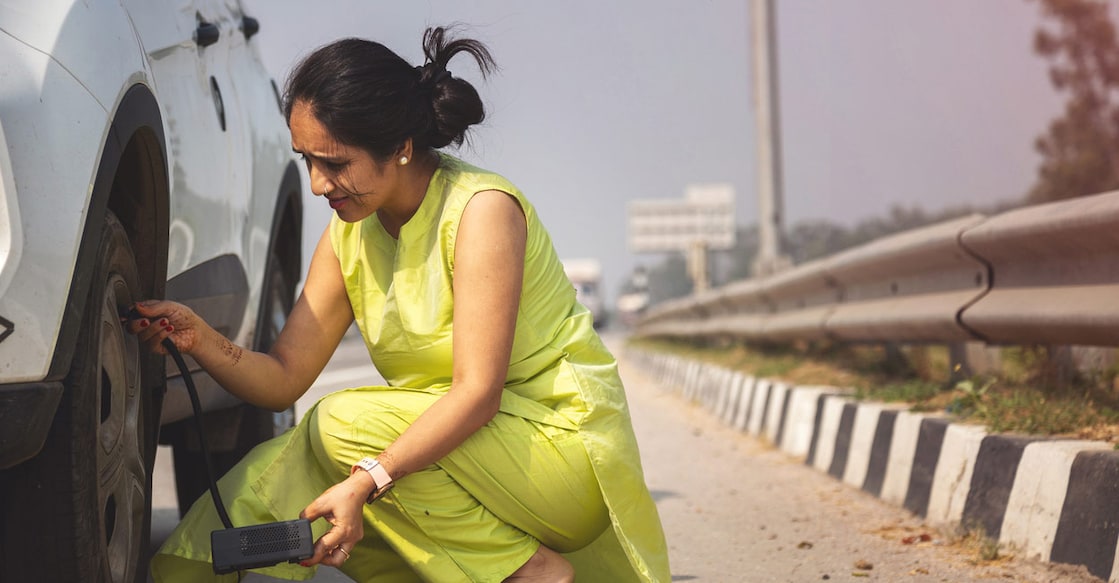
According to the study, the primary driver behind this national drain is the widespread habit of running vehicles on tyre pressure lower than recommended by manufacturers. Keeping your tyres inflated to the correct pressure is not just about extending the life of your rubber; it is a vital practice to reduce nationwide fuel waste, control personal vehicle running costs, and enhance road safety.
The mechanics of tyre pressure
Your vehicle weight is entirely supported by a very small patch of tyre in contact with the road, often referred to as the contact patch. When tyre pressure is incorrect, this contact area changes shape, which directly impacts vehicle handling. When tyres are under-inflated, rolling resistance increases dramatically. This forces the engine to work much harder to push the vehicle forward, resulting in higher fuel consumption and reduced mileage. For electric vehicles, under-inflation drains battery life rapidly, significantly cutting down the driving range.
Accelerated wear and safety risks
Improper inflation also causes tyres to wear out unevenly and prematurely. Under-inflated tyres suffer from heavy wear on their outer edges, whilst over-inflation leads to rapid wear along the centre of the tread. Both scenarios can slash the lifespan of a tyre by up to half. More critically, tyres lacking correct pressure compromise steering precision and increase braking distances, making the vehicle prone to skidding. At high speeds, under-inflated tyres are also highly susceptible to sudden blowouts due to heat buildup. This is why following manufacturer-recommended tyre pressure is absolutely critical.
When and how to check your tyre pressure
Motorists should check tyre pressure at least once a month, as well as before setting off on long road trips, carrying heavy loads, or when experiencing major seasonal weather changes. For accurate readings, always measure tyre pressure when the tyres are cold. This means checking them after the vehicle has been parked for at least three hours, or driven for less than two kilometres at a moderate speed. Checking pressure on hot tyres after continuous driving will yield inaccurate, inflated readings as the air inside heats up and expands.
Understanding PSI
Tyre pressure is measured in PSI (Pounds per Square Inch). The correct PSI varies based on the vehicle model and load capacity. To find the exact recommended pressure for your vehicle, check the placard or sticker on the driver-side door sill, or consult the owner manual. Avoid over-inflating tyres based on the myth that it delays the next refill, and never rely on petrol pump attendants to guess the pressure. Incorrect pressure, whether too high or too low, presents its own set of dangers.
Should you switch to nitrogen?
Using nitrogen instead of regular compressed air helps tyres retain pressure for longer periods because nitrogen molecules are larger and leak out more slowly. It also resists temperature-induced pressure fluctuations, making it ideal for long-distance driving. However, if nitrogen is unavailable, maintaining the correct PSI with regular air remains the absolute priority.
Ultimately, keeping an eye on your tyre pressure is more than basic car maintenance—it is a responsibility that protects your wallet, improves national fuel efficiency, and saves lives on the road. Taking a few minutes once a month to check your tyres against the manufacturer manual is a small habit that delivers huge returns.
(Dr Manoj Kumar B is an Associate Professor at SCMS Kochi.)
