

From banana leaf meals to backwater trips: Nobel laureate Henry Kagan’s Kerala memories
Mail This Article


Kottayam: “What are the benefits of having a meal on a banana leaf?” Nobel laureate Prof Henry B Kagan’s question left Dr S Anas slightly surprised. Before Anas could finish answering, Kagan had another question: “What are the names of these dishes? Why are they eaten?”
Anas recalls explaining the traditional meal in detail to Kagan, who was visiting Kottayam with his family. The banana leaf meal was clearly a hit, and Kagan reportedly told Anas that eating food on leaves had also been a practice in France in the past.
Kagan, who received this year’s Nobel Prize in Chemistry, has a special connection with Kottayam through his association with former Mahatma Gandhi University vice-chancellor Dr Sabu Thomas and Prof Anas, a faculty member at the university who was once his research student.
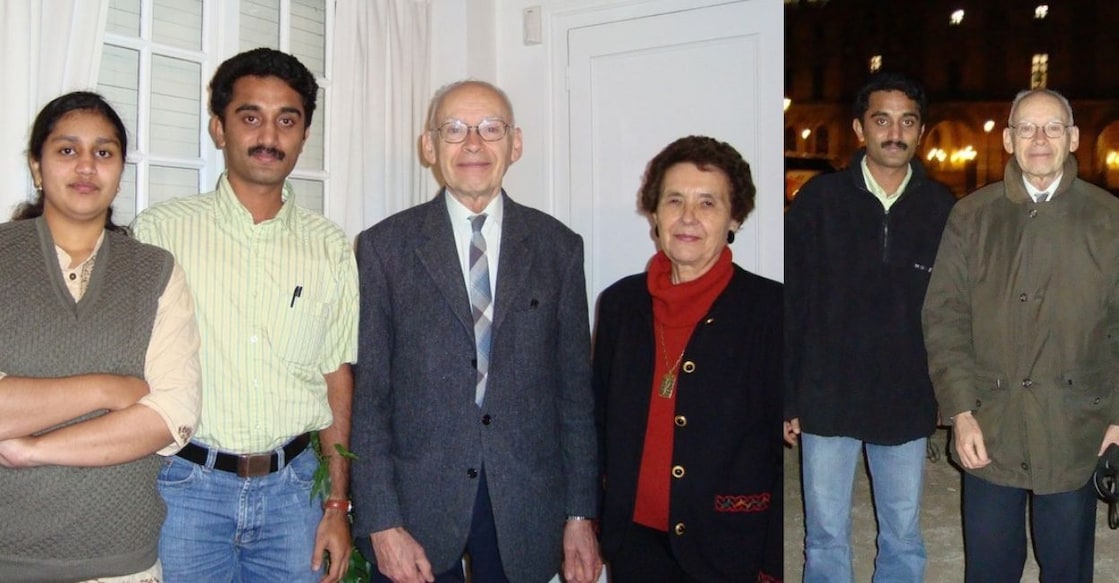
Kagan and his wife visited Kerala in August 2010 for a two-week academic programme at MG University. He presented his research at the School of Chemical Sciences and the Integrated Institute of Research in Basic Sciences and interacted with researchers. He stayed at the university guest house and spent considerable time with faculty and students.
“He had visited several parts of India, but this was his first visit to Kerala. He knew the state quite well. My wife Rafeena and I also accompanied him and his wife on a backwater trip,” Anas recalled.
Anas had worked with Kagan at Paris-Sud University for about a year from 2008 to 2009. He remembers Kagan as a highly respected scientist who continued to work in his laboratory despite his age.
“Researchers and teachers looked up to him with great admiration. Even at the age of 80, he would come to the laboratory every day and continue his research. There were only three of us as his research students. Despite his achievements, he had no arrogance. He was extremely dignified and led a simple life. We would occasionally visit his home as well,” Anas said.
Kagan’s Kottayam visit, however, was cut short after his wife fell ill. She received treatment at Caritas Hospital for two days, following which the couple returned.
Anas’ postdoctoral research was also in a field related to the work for which Kagan received the Nobel Prize.
Dr Sabu Thomas said Kagan’s Nobel recognition was a long-overdue honour, particularly considering that his name had been considered for the prize in 2001.
“I had spoken to researchers in France. They said this was essentially the recognition he had missed out on in 2001. The Nobel Prize that year was awarded for research in a similar field, and Kagan’s name was also considered. However, the rules allowed the prize to be shared by only three people. That was the only reason he was left out,” Sabu Thomas said.
Kagan visited MG University when Sabu Thomas was heading the School of Chemical Sciences.
