

Kerala Home Minister takes indirect swipe at Centre over Pegasus surveillance
Mail This Article


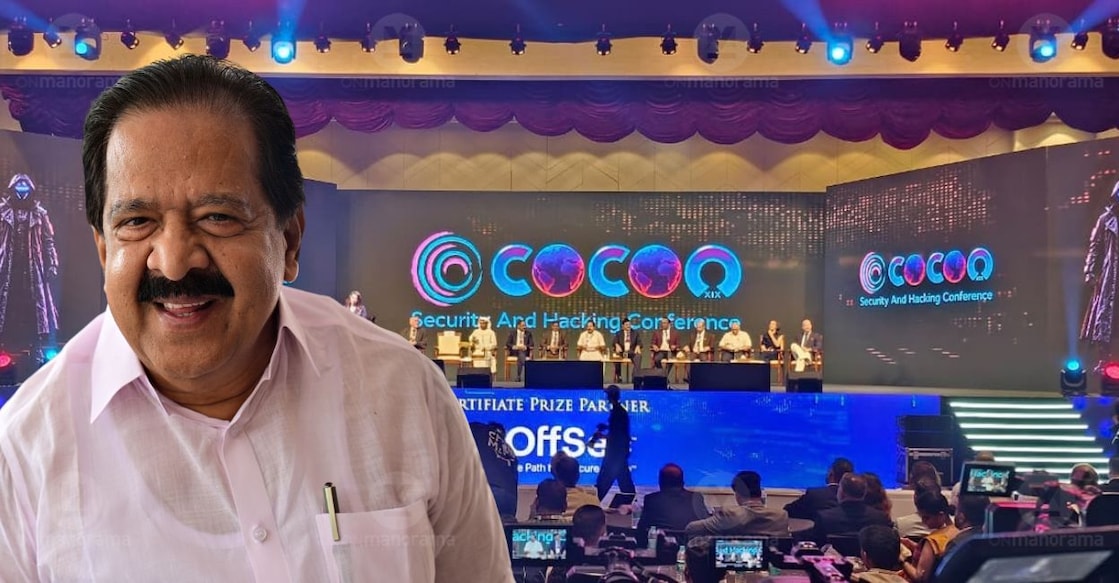
Kochi: Home and Vigilance Minister Ramesh Chennithala on Friday took an indirect swipe at the Centre over the Pegasus spyware controversy, alluding to allegations of surveillance in India while referring to the country as the “largest democratic country in the world” at the inauguration of the Cocon 2026 cybersecurity conference, organised by Kerala Police in Kochi.
Chennithala briefly touched upon the controversy surrounding Pegasus, the Israeli-developed spyware that has triggered concerns over allegations of surveillance targeting politicians, journalists, activists and other individuals. Without elaborating on the issue or directly accusing any authority, he warned that intrusive digital intelligence tools threatened not only individual privacy but also national security.
“There are so many case studies in our day-to-day discussion about Pegasus. This is an Israeli digital intelligence firm using spyware, Pegasus. There are a lot of discussions about Pegasus and how it operates even in the biggest democratic country in the world, India. There are so many questions we know that; I don't want to go into those details, but this kind of information is definitely threatening our normal life, not only the individual life, but the life of the country also,” Chennithala said in his inaugural address at the Grand Hyatt, Bolgatty in Kochi.
Stressing the need for safeguards, Chennithala said state use of intrusive surveillance tools must be subject to strict legal and institutional oversight. “Ensure that state use of intrusive surveillance tools should be lawful, necessary, and proportionate, with independent oversight,” he said.
Referring to major cybersecurity incidents, including the SolarWinds breach and the Colonial Pipeline attack, the minister highlighted the vulnerabilities of digital infrastructure and the consequences of cyberattacks.
The two-day conference, organised by the Kerala Police in association with the Information Security Research Association (ISRA), has drawn more than 2,500 delegates from 23 countries.
Chennithala also announced plans to revitalise Cyberdome, the Kerala Police’s public-private partnership initiative for cybersecurity, established during his earlier tenure. He also unveiled three indigenous Kerala Police robotic units designed to operate continuously for up to 20 hours for traffic management, citizen assistance and natural disaster response.
Dy NSA calls for technological sovereignty
Delivering the presidential address, T V Ravichandran, Deputy National Security Advisor, called for a shift from conventional cyber defence towards technological sovereignty and indigenous capabilities.
“National cybersecurity does not develop on software provided by foreigners. Building cybersecurity capacity associates standards, talent, technology, products, and sovereignty,” Ravichandran said.
He noted that India had more than 100 crore internet connections, while the Unified Payments Interface (UPI) processed upwards of 24 crore transactions daily, accounting for 80% of digital payments.
Citing data from the Indian Computer Emergency Response Team (CERT-In), Ravichandran said recorded cybersecurity incidents rose to 29,42,248 in 2025 from 20 lakh in 2024, marking a 2.1-fold increase over five years.
He also said 98% of cybersecurity issues and data breaches were traceable, directly or indirectly, to human errors.
SBI reports ₹28,000 cr in potential fraud losses averted
State Bank of India (SBI) Chairman Challa Sreenivasulu Setty said the bank’s cybersecurity measures helped prevent potential fraud losses of approximately ₹28,000 crore in the financial year 2025–26.
SBI serves more than 53 crore customers and processes 50 crore UPI transactions daily, averaging 18,000 transactions per second, Setty said.
“In the financial year 2025–26 alone, our real time rules helped save approximately ₹1,000 crore through the prevention of suspicious transactions, while transactions involving watch-listed accounts helped prevent potential losses of approximately ₹27,000 crore,” he said.
Setty, who also chairs the Indian Banks’ Association, said a government-constituted committee under his chairmanship had formulated a unified cybersecurity framework for financial institutions, with a focus on AI-driven tools to counter AI-powered attacks.
He highlighted three initiatives: the Indian Digital Payment Intelligence Corporation (IDPIC), a Section 8 non-profit established by a consortium of financial institutions to track and share intelligence on mule accounts; the “Captain Y” awareness campaign with the tagline “Hamesha Poocho Why” (Always Ask Why), targeting digital arrest scams, investment fraud, APK download exploits, utility bill fraud and KYC traps; and a round-the-clock cybersecurity cell alongside 357 Financial Literacy Centres nationwide.
The inaugural event was attended by State Police Chief DGP Ravada A Chandrasekhar, Vigilance Director and Cocon 2026 Co-Chairman Manoj Abraham; UAE Head of Cyber Security Mohammad Al Kuwaiti; CERT-In Director General and Controller of Central Government Sanjay Bahl; Oman National CERT Director General and RCC, C4IR Head Eng. Badar Al Salehi; Kelvin Lay, Director of the Technical Advisory Programme at Childlight - Global Child Safety Institute, among others.
