

How two Czech artists ended up in Travancore and fell in love with princely state

Mail This Article


In 1911, two young painters from Prague were at a low point emotionally. They were finding it difficult to make a name for themselves in the art world, and in addition, one of them was suffering from a breakup and the loss of a parent. Desperate for change, the duo, Otakar Nejedly and Jaroslav Hnevkovsky, decided to sell a few pictures and set sail for India and Ceylon, confident that they would draw inspiration from the villages and forests of the countries.
The artists were almost penniless and free of the prejudices characteristic of the Western European colonial elite of the time. They were keen to mix with tribal communities, forest-dwellers, fishermen and farmers.
Nejedly and Hnevkovsky were a bit disappointed with their first port of call in India- Karachi, which they described as a “noisy Oriental city.”
In a series of articles that Nejedly wrote for the British newspaper, Weekly Examiner, in 1934, he said, “Evidently the Indian business towns were not the place we were in search of, but the woods and the jungle, untouched by man, where culture had not found entry.” Essentially they were looking for a place as disconnected from their home, then a part of the Austro-Hungarian Empire, as possible.
They sailed on to Bombay and south to Colombo, hoping to find Ceylon an ideal place to find inspiration. But that was not to be. They wanted to visit places inhabited by the indigenous Veddas but were told by an English planter that the community was more or less assimilated into the dominant Sinhalese culture. “Furthermore, he told us that there was no part of the island where civilization had not been established,” Nejedly wrote in his newspaper series. “That was a thunderbolt for us. The nation which we were seeking did not exist, and we could not live the life for which we had come to Ceylon.”
Nejedly and Hnevkovsky decided to move to India, which they felt as a large and diverse country, would offer them more inspiration.
They sailed for India in a cargo vessel from Trincomallee, arriving in Nagapatinnam. Their initial plan was to settle down in Tanjore, but they faced several obstacles in the historic city. “One was that only Brahmins were permitted to reside in the town,” Nejedly wrote. “A foreigner was regarded as an outsider- a mere onlooker.”
Disappointed with their experience in Tanjore, they decided to go to Trinchinopoly to meet the Maharaja, unaware that the city had no such ruler. When the local policemen, who checked the travellers' passports, told them the city did not have a Maharaja. They faced the same kind of hostility from locals in Trichy, who were happy to have tourists visit but against the concept of foreigners living with them.
“We had no great wish to remain in Trichinopoly, and poor as we were, conversation with a native of Travancore, caused us to change our plans,” Nejedly added. “He described his district as the most beautiful in all of India, and he assured us that we should find the Maharajah of Travancore a great admirer of art, for his wife had also been a painter.”
Journey to Trivandrum
The Czech duo decided to try their luck in the princely state. “We knew that the celebrated painter Varma had lived at Trivandrum, and had no doubt there were chances for painters there,” Nejedly wrote. “We did not care what the fare might be, and soon were sitting in the train.”
They travelled in a third-class train compartment with their new friend. They told him they were poor and looking to make a livelihood as artists in India, but the Malayali man still treated them with a lot of respect and offered to help them as much as he could.
“The compartment was crowded, late at night the natives climbed up to a shelf near the ceiling in order to have a good night’s rest, and we followed their example,” Nejedly added. He said the train remained crowded throughout the British territory but the crowds thinned as soon as it entered the princely state.
“In the morning, we passed through a wild, mountainous country, richly wooded,” he wrote. “In some places, towered high rocks, over which a white stream of water fell down like a ribbon. The tops of the mountains were covered with clouds, and the train often ran through tunnels.”
At each station, the police asked for the passports of the Czech travellers. At that time, the railway line terminated in Quillon. “From there we had to go by boat on a long canal which runs parallel with the coast near the sea as far as Trivandrum and farther on,” Nejedly wrote.
The Czechs took an instant liking for the princely state. “Travancore justified its description as a paradise,” Nejedly wrote. “The people and their tiny huts look like paltry toys under the natural vault of green.”
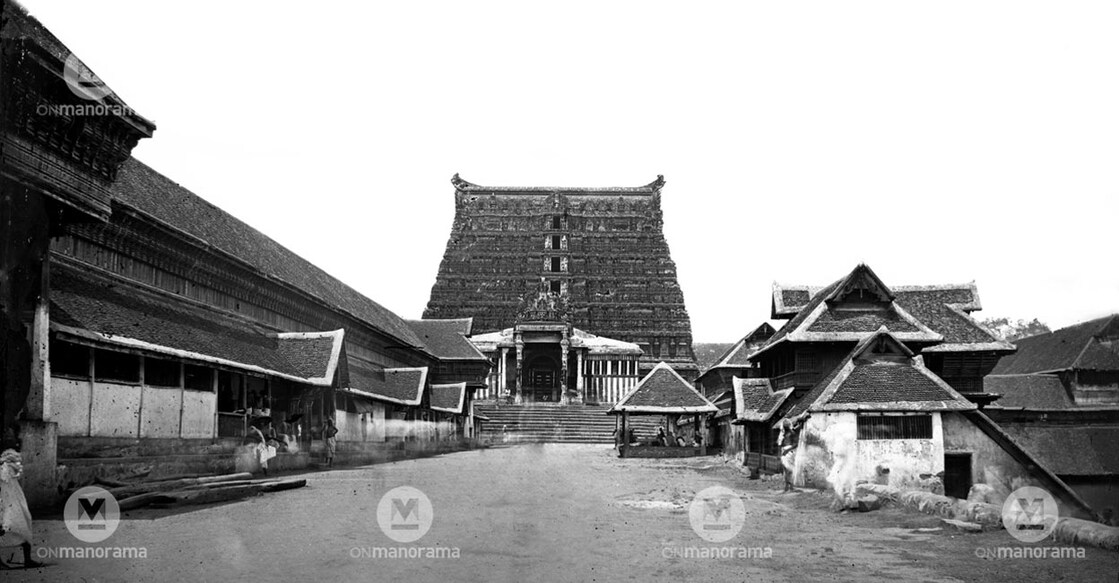
Nejedly made some sharp observations about Trivandrum. “There is a grand old Hindu temple in the centre of the town,” he wrote. “The ringing sound of metal discs clashing together from the inner temple and sometimes, though more rarely, the sound of the triton, or horn, which is blown by the priests at certain ceremonies only.”
The Czech painter also took note of the areas surrounding the Padmanabha Swamy temple. “On one side of the ‘sacred bath’ which is the clearing house for all kinds of contagious disease, is the Maharaja’s palace,” he wrote. “Short narrow streets branch out from the centre of the city. The majority of cottages have a porch, under which members of the family usually sit. Some sleep or read, while the women often do some domestic work there, such as grating coconut, cleaning rice, or pounding or stirring spices.”
Nejedly also noticed the odd Bharatanatyam dancer in the area, and the small shops selling delicacies to visiting tourists and pilgrims.
“The streets are not very populous, and few of them are broad enough to permit a wagon to go through,” he added. “Among the people, walk a few light-coloured sacred cows, which are allowed to smell at the goods at the stalls and even to eat them if they wish.”
The duo seemed to be happy in the hill station of Ponmudi, where Nejedly said the cool climate was conducive to growing European vegetables like cabbages, cauliflower and asparagus.
Nejedly and Hnevkovsky spent two years in the Indian subcontinent, thoroughly relishing their experiences. “This was a period of unforgettable impressions and creative inspiration for them both,” Czech academic Miloslav Krasa wrote in his 1969 book Looking Towards India: A Study in East-West Contacts. “Both left their hearts in India, Hnevkovsky returning to the country once more after the [First World] war.
In 1913 an exhibition of Hnevkovsky’s India paintings was held in Prague and was well received.
Nejedly’s writings in Czech and English show a deep love for the country, and especially for Travancore.
 Add as a preferred source on Google