

Paralysed dad moves Kerala youth to develop AI-powered armour that lets patients walk

Mail This Article


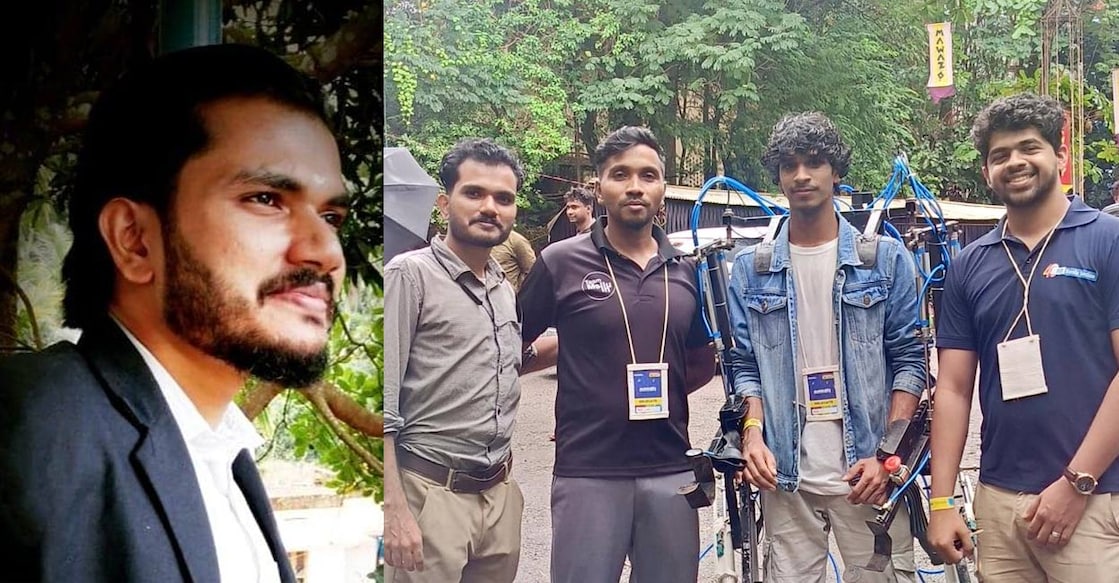
For nearly a decade, Alan Sindhu Dinsha from Kollam watched his father, Dinsha, struggle with paralysis following a two-wheeler accident. The experience gave him first-hand insight into the emotional and physical challenges faced by patients and their caregivers — and a determination to find a better solution.
The thought took shape as Exobonic, an Artificial Intelligence (AI)-supported exoskeleton that enables paralysed individuals to move by translating their brain signals into physical motion. The device, developed by Alan’s startup Innodots Innovations, represents a significant step forward in patient rehabilitation and assistive technology.
“When my father was bedridden, we took care of him ourselves and handled his physiotherapy. We understood how painful it is for both the patient and the bystanders. He now started walking; however, that thought stayed with me,” Alan told Onmanorama.
The 29-year-old holds an MBA from Bengaluru and a degree in Physics from Kollam. After a brief stint in the corporate sector, he turned his focus to artificial intelligence and launched his startup two years ago. Initially, the firm offered digital and transformative business solutions, but research soon became its core, leading to innovations like Exobonic.
Exobonic was developed under a separate brand co-founded by Al Imtias and Arun Aravindakshan, both from Sree Chithira Thirunal College of Engineering, Thiruvananthapuram. The team explored new frontiers by using fluid dynamics in robotics rather than traditional motor- or sensor-based systems. Their design is fully pneumatic, relying on air pressure to assist motion.
“We first thought of converting audio signals to movement. Then we wondered—why not our thoughts?” Alan recalls.
The team collaborated with a private hospital to collect and analyse a large dataset of EEG signals (brainwave data/brain electrical activity). Using AI, they identified patterns in these signals and built a program that could interpret them. The program, embedded in a chip attached to the exoskeleton, allows users to trigger movement simply by thinking about it.
The current prototype weighs around 35 kg and can support users weighing up to 80 kg. The device consists of pneumatic chambers that move the limbs through controlled air pressure, lifting and supporting the wearer. For fully paralysed individuals, assistance is required to put on the suit.
“When the wearer thinks about walking, the exoskeleton’s AI interprets that EEG signal and moves the leg forward. The person doesn’t have to exert any physical pressure. The process encourages cognitive engagement and optimism, aiding recovery,” Alan explains.
At present, the system achieves around 85 per cent accuracy. The prototype costs about ₹6 lakh, but Alan expects prices to drop significantly with indigenous mass production.
Beyond healthcare, the team is exploring industrial and defence applications. A future version of Exobonic could assist rescue personnel, defence forces, and construction workers in carrying heavy loads in challenging terrains.
“When someone lifts a 25 kg object using the suit, they only feel about 5 kg. It can even replace mules used for transport in hilly areas,” Alan says.
Customisation is another focus area. Future models will be adapted for children and individuals weighing over 80 kg, ensuring comfort and usability. The team also plans to integrate vision intelligence to monitor patients’ movements and safety.
The startup aims to bring Exobonic to clinics and homes alike — much like a wheelchair prescribed by doctors for long-term use. The team has self-funded the project so far and plans to launch it commercially by mid-2026, after completing all trials and certifications. “We hope investors who understand the humanitarian potential of this technology will come forward,” Alan says.
Innodots Innovations is also working on AI-driven camera surveillance systems. Separately, Alan runs a creative agency called Reelsmarrow, offering advertising design, campaign strategy, and marketing services.
 Add as a preferred source on Google