

Opinion | A new bargain between labour and capital

Mail This Article


On July 4, the United States Treasury began wiring $1,000 into investment accounts for every American child born since 2025. "Trump Accounts," seeded at birth, are locked by law into low-cost equity index funds until the child turns eighteen. The pitch, from an avowedly right-wing administration, was not subtle. "This makes every child in America a capitalist from birth," said Brad Gerstner, the investor who championed the idea.
This is a fascinating approach to the economic redistribution problem which is at the heart of many political systems. In my view, the most interesting place to test this idea is in Kerala.
Kerala has spent decades inside its own paradox: Kerala is a unique combination of Scandinavian human development indicators wrapped around a business climate that investors describe in the language of fear and aversion. The lament is very familiar for the Malayalis. Kitex taking its expansion to Telangana, the practice of nokkukooli outliving its own official abolition, project after project dying in the gap between announcement and land. The standard diagnosis blames the unions: CITU, INTUC and their thousands of registered cousins, cast as retrograde ideology standing between Kerala and its industrial future.
While the conventional narratives deride the unions, I, for one, believe that the harsh reality is that they are not being irrational. Industrial capitalism in India has mostly not been a tide that lifts all boats. The benefits of economic development mostly accrue to the industrial and urban classes before the benefit is seen (if at all they are seen) by the labour class. A Kerala labourer who surveys this record and concludes that the benefits of prosperity emanating from a new factory opening in his district are unlikely to reach him, is being entirely rational. When the upside is structurally out of reach, blockading the project is the sensible thing to do. It is effectively an act of bargaining with the only leverage you have.
Even if one were to argue that economic development would then lead to greater tax revenues for the state that can then be used for welfare programmes, that could be true. It is too abstract an argument for most people to believe. Therefore, the social base that supports capitalism and development in Kerala structurally excludes an important constituent who has the ability to block and throttle the speed at which development can take place in our state.
This is perhaps why, for far too long, Kerala has been stuck in a sub-optimal equilibrium. While several attempts have been made to get out of this gridlock, it's perhaps time to try some out-of-the-box ideas. The way out of Kerala's gridlock is not to defeat the unions, it might be to make them shareholders.
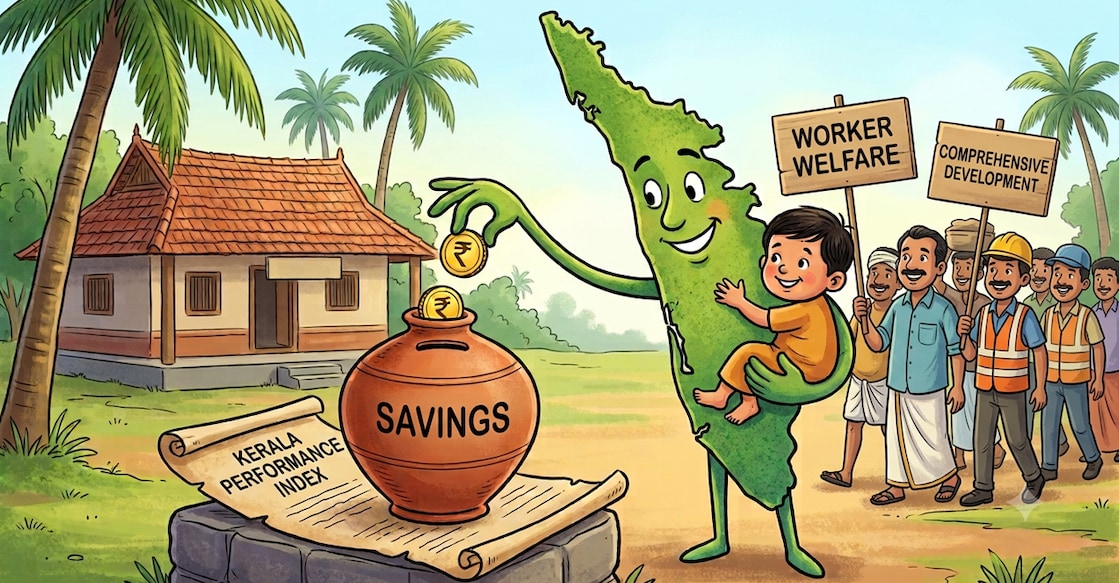
Based on the American precedent, if the Kerala government were to invest ₹25,000 each in the names of the children of all union members, into a basket of listed equities of Kerala-based or Kerala-owned companies — tentatively named Kerala Performance Index — it would make them directly invested in the prosperity created by Malayali capitalism. This would then help to create a more direct relationship between the labourer and the prosperity brought about by economic development.
The index itself is relatively straightforward to construct, and I have built a first iteration with twenty-eight listed companies headquartered in Kerala or built by Malayali promoters, including Federal Bank, Muthoot Finance, FACT, MRF, Aster DM Healthcare and their peers. A backtest from July 2016 to September 2026 shows the index returned roughly 19.2 per cent a year in price terms, against the Nifty 50’s 10.7 per cent: outperformance of 8.6 percentage points annually. With dividends reinvested, a base of 1,000 grew to 6,789.
Now run the counterfactual. Had the state seeded the accounts of one million working-class children with ₹25,000 each in 2016, for a total of ₹2,500 crore, that pool would be worth roughly ₹16,973 crore today, before costs. Each child turning eighteen would hold about ₹1.70 lakh. That could fund a degree, a trade certification, or the ticket and visa that remains the most reliable asset a Malayali family knows how to buy. Of course, this outperformance benefits from hindsight, and the next ten years may not resemble the last. Yet it may still be a bet worth taking.
The American example shows that to build this programme for a million children, the exchequer need not swallow ₹2,500 crore alone. Split it: half from the state as a capital grant, phased by birth cohort. The other half pooled from philanthropies or corporate CSR funds. Committed over five years on a voluntary basis, the companies that profit from Kerala can finance the children of Kerala's workers. This way, building this programme creates an effective infrastructure through which philanthropy can be channelled very effectively, directly to end beneficiaries.
What makes this idea actually viable is that the plumbing for this already exists. NPS Vatsalya, the pension regulator's scheme for minors, opens guardian-operated accounts that convert into regular NPS accounts at eighteen; under current rules, a corpus below ₹8 lakh can be withdrawn in full at that point. What is needed is just for the Kerala government to add a version with a single new asset class: a fund tracking an index of Kerala's own listed capital.
There are obviously several challenges around potential misuse, but much of these are obviously mitigated. A ten-year lock-in insulates the corpus from consumption shocks and quick-cash enrolment. And the full seed goes only to families already on the state's welfare-board rolls as a union member when the scheme is announced; later registrants receive a fifth of it. Thus ensuring that this programme does not create an incentive for more people to join a trade union.
The American experiment isn’t a lone data point for this approach. Connecticut has seeded "baby bonds" of $3,200 for every child born on Medicaid since 2023. Britain ran a Child Trust Fund for nearly a decade. Asset-based welfare — the idea that the state should endow citizens with capital, not merely income — is slowly starting to emerge as an interesting approach. As the state that pioneered the redistribution of land, Kerala also has an opportunity to pioneer the idea of redistribution of equity.
Historically, workers distrust the authorities because every promise made to them, whether about wages, safety or permanence, has been a contract someone else could break. Equity is the one contract that enforces itself.
Over time, the incentive should do its quiet work. The day a worker's child holds the index, the calculus of the wildcat strike changes: paralysing the port or the factory no longer wounds only a distant promoter, it shows up as a lower balance on the child’s brokerage app, creating an internal pro-capitalist constituency in every union member's house.
