

Hyundai Bayon review: A sharp, European-styled compact SUV ready to disrupt the market
Mail This Article


Why did Hyundai name its latest compact SUV after Bayonne, a historic city in south-western France? Beyond its rich history, Bayonne is a surprisingly cosmopolitan urban hub despite its modest size.
There is another intriguing historical connection: the bayonet, the weapon mounted on the tip of a rifle, originated in Bayonne during the 17th century when French weapon shortages forced hunters to improvise with hunting knives. Does Hyundai aim to convey that same spirit of aggressive resilience and combat readiness with this vehicle? A test drive provides the answer.
A signature naming convention
Hyundai has long excelled at naming its vehicles after iconic global locations, from the Creta and Kona to the Tucson, Santa Fe, and Alcazar. Entering a fiercely competitive space positioned between the Venue and the Creta, the Bayon faces formidable adversaries, including Maruti's Brezza. To secure its ground, Hyundai has deployed what can best be described as a full bayonet charge. First introduced globally in 2021 on the i20 platform and refreshed with a facelift in 2024, the Bayon is distinctly European in character. That heritage delivers European-standard driving dynamics, cabin comfort, and feature sets.
Is it an enlarged Exter?
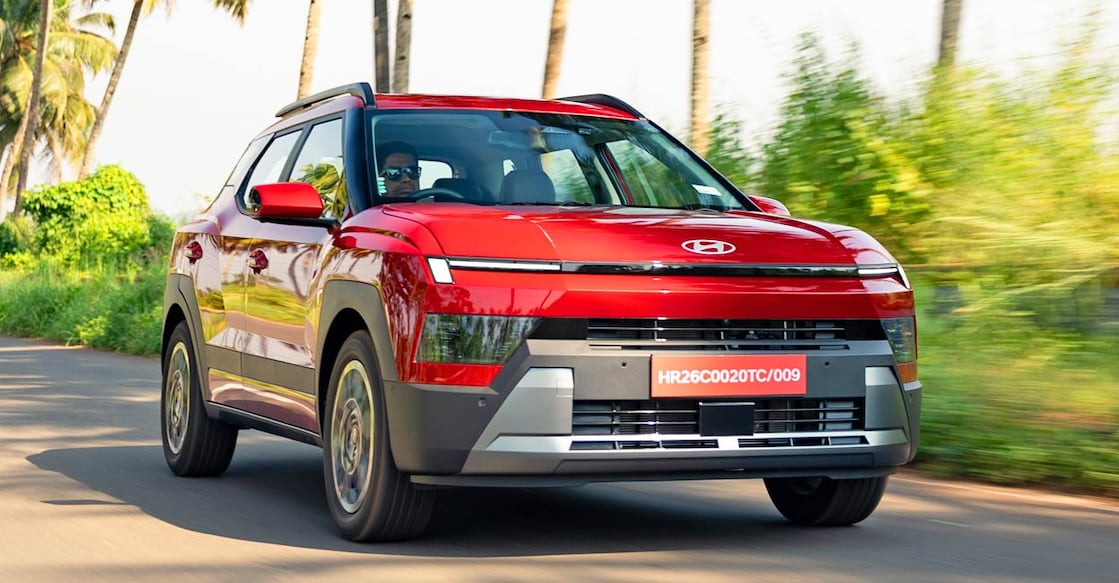
Marketed as an Intelligent Utility Vehicle, the Bayon blends futuristic design, a spacious cabin, modern technology, and refined performance. At first glance, the front grille might evoke memories of the Hyundai Exter, but the visual similarities end there. Moving to the side and rear reveals muscular, defined SUV proportions complemented by 17-inch alloy wheels and striking LED lighting signatures at both ends.
Inside, the cabin sports an elegant black and olive-green dual-tone finish with uncluttered, intuitive controls. The standout feature is the dual curved 12.3-inch screen setup spanning across three-quarters of the dashboard. Additional creature comforts include a sunroof, a premium Bose audio system, and a 2600 mm wheelbase that delivers generous legroom and comfortable seating throughout the premium cabin space.
Performance and drivability
Under the bonnet, the Bayon dispenses with diesel, electric, or CNG options in favour of a single powertrain: a 1.5-litre MPI petrol engine producing 115 PS. This engine pairs with either a 6-speed manual transmission or Hyundai's IVT automatic gearbox, accompanied by steering-mounted drive mode switches. The automatic variant offers exceptionally silky performance with intuitive paddle shifters. While official fuel efficiency figures remain unannounced by Hyundai, the test vehicle indicated an average reading of around 16 km/l during mixed driving conditions.

Prioritising safety
Safety takes centre stage in the Bayon, which is built on Hyundai's globally proven K platform. While official Indian crash test ratings are pending, Hyundai anticipates top-tier standard performance. The vehicle packs over 80 safety features, including Level 2 ADAS driver assistance systems.
Pricing details
The Hyundai Bayon is offered in petrol manual and petrol IVT automatic variants. The petrol manual range is priced between ₹9.99 lakh and ₹16.79 lakh, while the petrol automatic options range from ₹13.84 lakh to ₹18.14 lakh.
The verdict
With its compact footprint, youthful aesthetics, refined driving manners, feature-packed interior, and Hyundai's trusted reliability, the Bayon presents a strong case for urban car buyers seeking a premium compact SUV experience.
