

10 years of NaMo's DeMo: UPI soars, currency surges, questions remain
Mail This Article


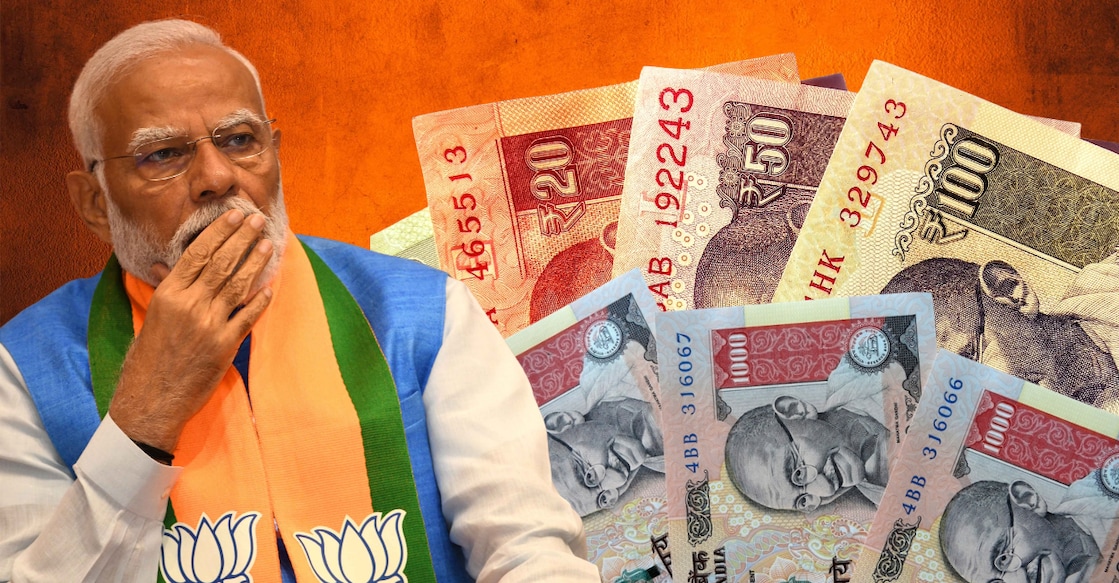
It will be 10 years on Sunday since Prime Minister Narendra Modi announced the withdrawal of ₹500 and ₹1,000 currency notes in circulation in a televised address to the nation on November 8, 2016. The move rendered 86.4 per cent of the currency in circulation worthless overnight, affecting more than 1.3 billion people across the country.
While the government has no definitive answer on how far demonetisation achieved its stated objectives, the changes it brought about in the way people handle money have been significant.
Cash usage changes, but currency in circulation rises
Two parallel trends have emerged since demonetisation in 2016. On the one hand, digital payment systems such as the Unified Payments Interface (UPI) have expanded rapidly. At the same time, the circulation of physical currency has also increased substantially.

As of October 15, the value of currency in circulation had risen to ₹43.46 lakh crore, its highest level in five years. UPI, meanwhile, continues to set new records.
Currency-to-GDP ratio
The increase in the volume and value of currency in circulation needs to be viewed in the context of the country's economic growth. India's GDP has been growing at an average rate of 6-7 per cent annually. Interestingly, there has been no significant increase in the currency-to-GDP ratio over the past few years, despite the rise in cash circulation.
The ratio stood at 12.1 per cent in 2015-16 before falling to 8.7 per cent in 2016-17 following demonetisation. It gradually recovered thereafter. During the COVID-19 pandemic, the tendency to hold cash amid economic uncertainty pushed the ratio to 14.4 per cent in 2020-21. It subsequently declined again, reaching approximately 12 per cent in 2025-26, almost back to its level before demonetisation.
The currency-to-GDP ratio indicates the value of currency in circulation relative to the size of the economy. A decline in the ratio does not necessarily mean that digital transactions have increased. It could also mean that the economy is growing faster than the currency in circulation.
Digital payments boom, but people still hold cash
Even as digital payment platforms such as UPI have made everyday transactions easier, people continue to hold substantial amounts of physical cash. When UPI was launched in 2016, it recorded 1.8 crore transactions. By 2026, the number had surged to more than 24,000 crore. The value of transactions also grew from ₹7,000 crore to ₹314 lakh crore.
Despite the massive expansion of digital payments, people continue to rely heavily on cash, largely because they consider it a safer option, according to an RBI study.
Did demonetisation achieve its objectives?
Demonetisation was intended to eliminate black money and counterfeit currency, prevent the flow of funds to terrorist activities, bring more people into the income tax net and create an economy that relied less on cash. The government's argument was that those holding the withdrawn notes would have to deposit them in banks to exchange them for valid currency, thereby helping eliminate black money.
For this objective to be achieved, there should have been a substantial difference between the total value of the withdrawn currency and the amount that returned to the banking system.
However, RBI figures show that there was hardly any difference. Currency notes worth ₹15.42 lakh crore, comprising the withdrawn ₹500 and ₹1,000 denominations, were in circulation at the time of demonetisation. Of these, notes worth ₹15.3 lakh crore, or 99.3 per cent, were returned to the banking system.
"Demonetisation caused considerable hardship to ordinary people in its initial phase. Small traders, industrialists and daily wage workers witnessed a sharp decline in their incomes. However, considering the intentions behind the move, demonetisation can be viewed as an attempt at financial reform, even though its implementation failed," said financial expert S Adikesavan.
