

KR Narayanan: The enduring legend
Mail This Article


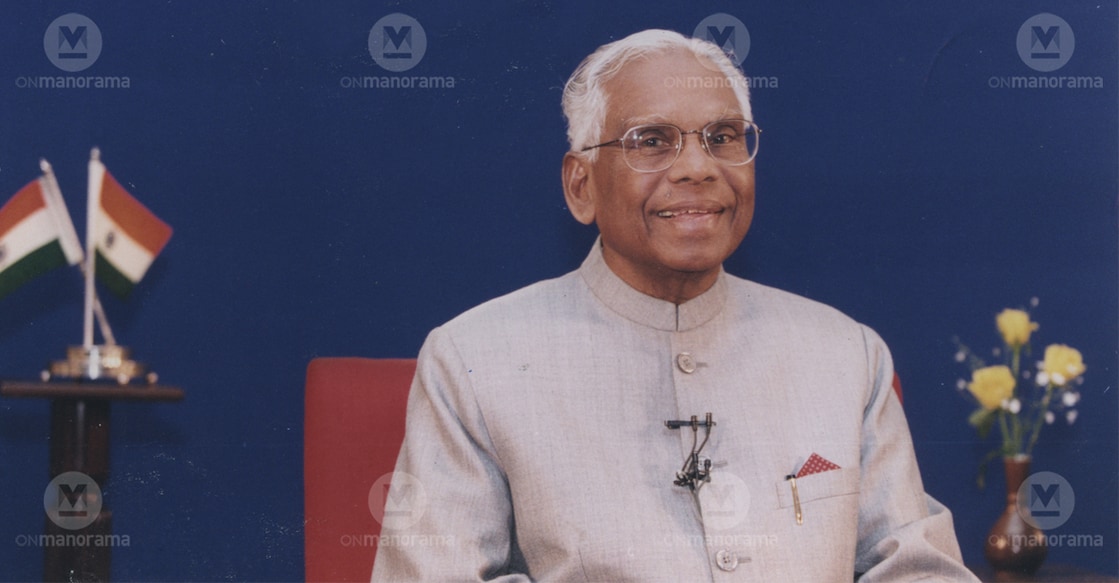
The unveiling of the statue of one of India’s most distinguished sons, KR Narayanan, by President Draupadi Murmu at the Kerala Raj Bhavan is a unique tribute to a man who rose from humble beginnings to become India's 10th President — a journey that continues to inspire countless citizens across the nation. His life epitomised the strength of democracy, the promise of education, and the triumph of perseverance over adversity.
From a small village classroom to the grand halls of Rashtrapati Bhavan, Narayanan’s path was defined by integrity, intellect, and compassion. He brought to public life a moral clarity that underscored that leadership must always be rooted in empathy and justice. As a diplomat, parliamentarian, and later as President, he remained deeply attuned to the voices of India’s marginalised and underrepresented.
He saw the Presidency not as a ceremonial office, but as a living embodiment of democratic conscience. With eloquence and quiet strength, he reminded the nation that our Republic draws its legitimacy from equality, inclusion, and the dignity of every citizen.

I have had the privilege of knowing him since his days as the Indian Ambassador to the US at a difficult time when the US tried to assert its hegemony in Asia, particularly through its nuclear blackmail. He stood firm and insisted that we were within the rules of nuclear cooperation and one project did not entitle the US to restrain our peaceful nuclear activities.
What made Narayanan truly exceptional was not only his rise through the ranks of public service but also his Nehruvian idealism and unshaken faith in nonalignment. After completing several crucial assignments around the world, he became the first Ambassador to China following a long break in relations due to Chinese aggression and its aftermath. He opened a new chapter in Sino-Indian relations, which eventually led to a decision to set aside the border dispute and foster cooperation in areas of common interest like trade, technology and strengthening multilateralism.
For us in Kerala, his achievements are a source of profound pride. Yet, beyond regional boundaries, his life stands as a universal symbol of hope and possibility, a testament to show that education, diligence, and moral courage can transform not only one’s destiny but also the destiny of a nation.
Narayanan had a tremendous sense of humour. Once, he referred to the American demand to inspect all our nuclear installations because of our agreement on Tarapore, to someone who marries into a family and seeks control over the entire household. In a discussion as to whether men should prefer grey hair or baldness, he remarked that it is a great blessing that a man cannot have both at the same time!
My brother, Ambassador TP Seetharam, who was his Press Secretary, has several stories to tell about his extreme kindness to his colleagues and his meticulous attention to detail and maintenance of traditions. On the eve of his visit to the United States to receive an award, I learned that the organisers were collecting money for the food served on the occasion. I asked my brother to check whether this should be permitted. Narayanan said that this was the tradition even at the time of Pandit Nehru, except that the price must have increased.
When Narayanan learned that my elder son’s fiancée, Roopa, the shooting star of India, was one of the Arjuna Awardees for her Commonwealth gold medal in rifle shooting, he invited my mother to the Rashtrapati Bhavan for the investiture ceremony.
He had a long conversation with her, which also turned to her future plans. He asked her who among her four children, two in the Indian Foreign Service and two in the defence services, would take care of her. She unhesitatingly said that she would live with one of her doctor sons who was in the army. He immediately congratulated her on her wise decision, noting that the diplomats could not be trusted, which made everyone laugh at the solemn ceremony.
By unveiling his bust at the Raj Bhavan, we are not merely honouring the memory of a former President. We are reaffirming the ideals he stood for -- integrity in governance, sensitivity to the underprivileged, and faith in the democratic dream of India.
When he returned to India, he decided to contest elections from Kerala and recalled an old Malayalam saying that true reward will come only from the place you started. Kerala embraced him wholeheartedly. Even abroad, he took special care of the international community, particularly Keralites. He facilitated the establishment of the Federation of Kerala Associations in North America (FOKANA) in 1983.
Narayanan’s life was not without shocks and disappointments. Legends have it that he was denied a post on the faculty of the University College, as was the tradition, and the Maharaja suggested that he should seek his fortunes outside the state for fear of caste prejudices in the College.
That took him to Bombay as a journalist, after which he went to the UK for higher studies under Harold Laski, who recommended to Nehru that he should be appointed to the newly constituted IFS. Nehru exempted him from taking the UPSC exam and Narayanan did better than many toppers who joined with him. He met his bride in Burma, called her Usha and had a successful married life without any challenges from society. He was proud of his origins, but did not want frequent references to his caste, even to praise him for his achievements. He was an Indian at heart with a vision for his country.
 Add as a preferred source on Google