

Judiciary cannot direct President, act as 'super Parliament': Jagdeep Dhankhar
Mail This Article
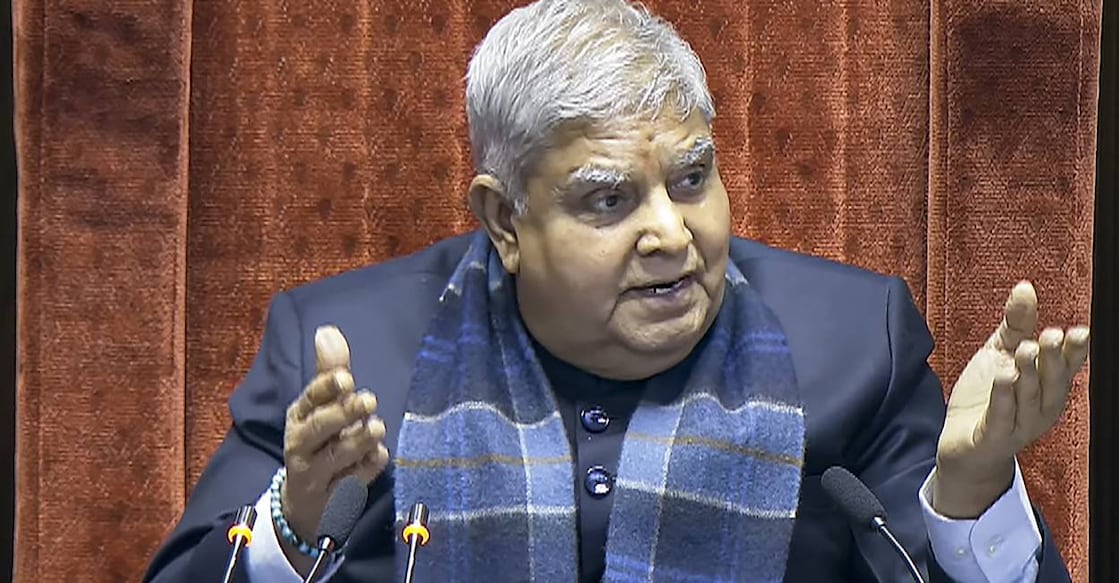
New Delhi: Vice President Jagdeep Dhankhar on Thursday criticised the judiciary for what he called an overreach into executive and legislative domains, particularly questioning the Supreme Court’s recent move to set a timeline for the president to take action on bills sent by state governors for her assent.
Addressing Rajya Sabha interns, Dhankhar warned against the judiciary acting as a "super Parliament" and stated that courts must refrain from issuing directives to the President, who holds a constitutionally elevated position, reported PTI.
"We have judges who legislate, perform executive functions, and act as if they are above all scrutiny, while constitutional checks and balances bind the rest of us," he remarked.
The vice president took particular aim at Article 142 of the Constitution, which allows the Supreme Court to pass orders to ensure "complete justice". He likened this power to a "nuclear missile" that, in his words, has become a 24x7 tool to target democratic institutions.
"What is happening in the country? A directive to the president? This is a situation I never imagined I would witness. Are we heading to a point where if the president doesn't act within a given time, the bill automatically becomes law?" he asked.
Dhankhar emphasised that only the president takes an oath to "preserve, protect, and defend" the Constitution. Others, including ministers, parliamentarians, judges, and even the vice president, pledge only to abide by it.
Underscoring the principle of separation of powers, he said democratic accountability flows from the people to Parliament, and through elections. "If governance starts flowing from the judiciary, who do we hold accountable? Whom do we question during elections?"
He cautioned that blurring the lines between the three pillars of democracy — legislature, executive, and judiciary — poses a serious threat. "Each institution must function within its domain. Any incursion into another's territory is a challenge to democratic balance," Dhankhar said.
 Add as a preferred source on Google