

India's water will now be used only for country’s interest: PM Modi
Mail This Article
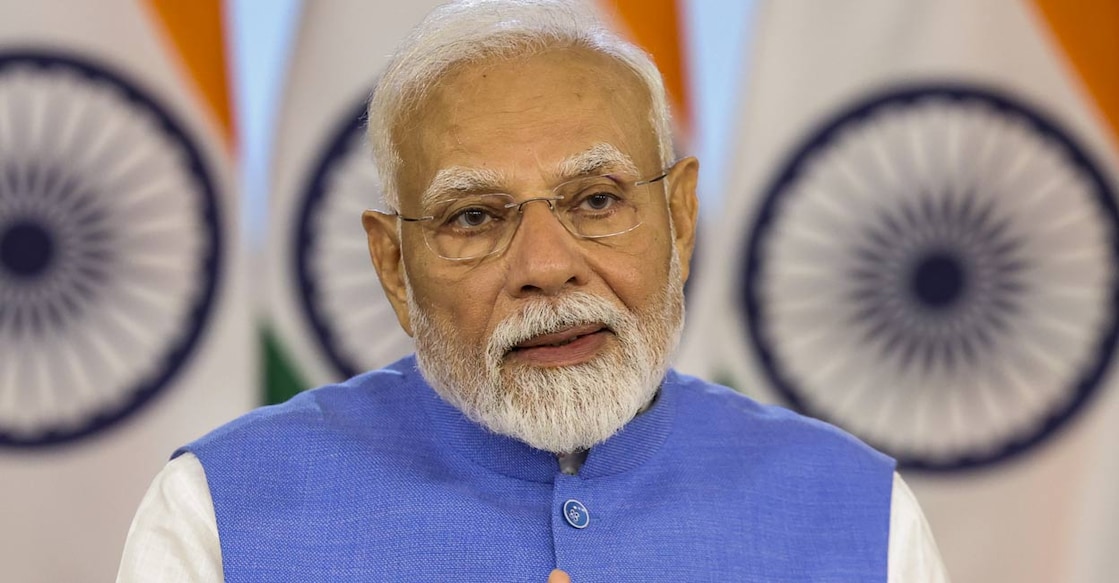
New Delhi: Prime Minister Narendra Modi on Tuesday asserted that India’s water resources will henceforth be used solely for the country’s benefit, in a veiled reference to Pakistan following India’s move to suspend the Indus Waters Treaty in the aftermath of the Pahalgam terror attack.
Speaking at the ABP Network’s ‘India@2047’ Summit, Modi underlined his government's push for river interlinking and equitable water use, reported PTI. “Earlier, even water that rightfully belonged to India was flowing out. Now, India’s water will remain within the country, serving its interests,” he said, as the audience responded with applause.
Although Modi did not explicitly name Pakistan, his remarks were seen as a direct message amidst growing tensions after the attack that claimed 26 civilian lives, most of them tourists.
Shifting focus to global trade, the Prime Minister hailed the finalisation of the India-UK Free Trade Agreement as a historic milestone. Calling it a breakthrough between two open economies, he said the pact would energise India’s MSMEs and expand opportunities for the youth. “It’s a major step forward in making India a dynamic hub for trade and commerce,” he noted.
Modi highlighted the government's reforms over the last 11 years, describing them as being rooted in national interest rather than political convenience. “India has moved beyond a GDP-centric model to one focused on the Gross Empowerment of People (GEP),” he said, listing welfare initiatives in housing, healthcare, and social security.
He stressed that development under his leadership has blended tradition with technology — from making India a global leader in digital payments to promoting yoga and Ayurveda on the world stage.
The Prime Minister also spoke about the trust deficit that existed before his government took charge, blaming past regimes for allowing vote bank politics to delay critical reforms. Citing the recent amendments to the Waqf law and the abolition of triple talaq, he said his administration had taken long-pending decisions that directly empower marginalised communities, including Muslim women and Pasmanda Muslims.
On India's broader aspirations, Modi reiterated the goal of achieving a developed India, or ‘Viksit Bharat’, by 2047. “We have the capability, resources, and the resolve,” he declared, adding that bold decision-making anchored in the ‘Nation First’ approach has driven India’s transformation in the past decade.
He also pointed to India’s emergence in sectors traditionally seen as weak, including defence and electronics. “Today, over 100 countries import Indian defence products. We are also becoming a significant exporter of electronics,” he said.
The Prime Minister concluded by noting that the Direct Benefit Transfer system had eliminated 10 crore fake beneficiaries, saving the country ₹3.5 lakh crore — a testament, he said, to the power of political will and digital governance.
 Add as a preferred source on Google