

Indian Navy remains at sea in deterrent posture to counter any Pakistani action: Vice Admiral
Mail This Article
New Delhi: In a media briefing held on Sunday, Vice Admiral A N Pramod provided insight into the Indian Navy’s operations during the escalation. He explained that India’s naval assets were deployed swiftly and maintained a deterrent posture in the Arabian Sea.
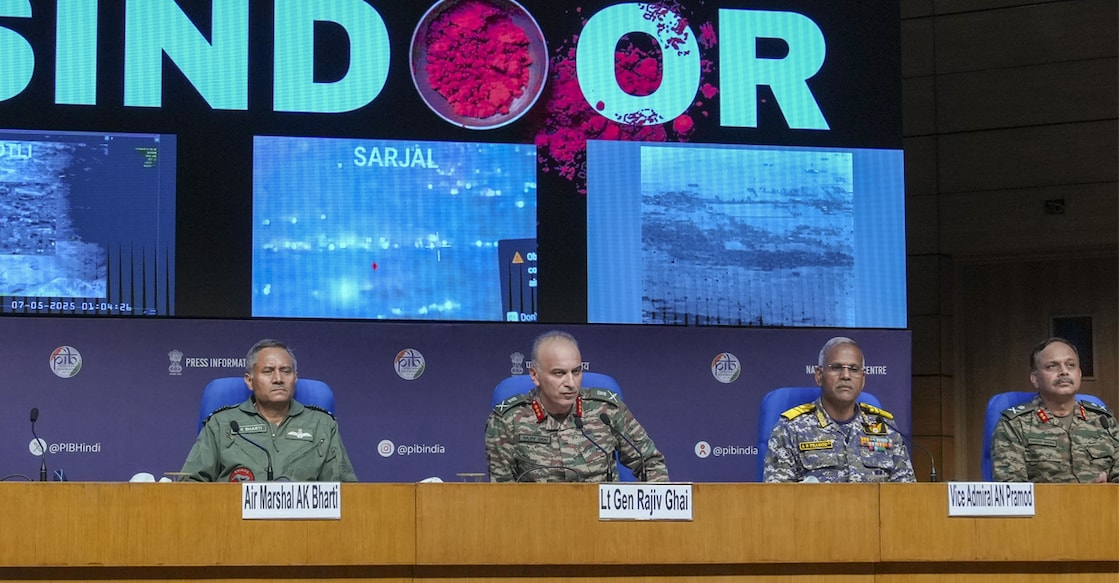
Vice Admiral A N Pramod, leading maritime operations in the multi-domain strike, was joined by DGMO Lieutenant General Rajiv Ghai, who is overseeing land operations, and Air Marshal A K Bharati, representing the air domain.
“The Indian Navy's Carrier battle group, surface forces, submarines and aviation assets were immediately deployed at sea with full combat readiness...We tested and refined tactics and procedures at sea during multiple weapon firings in the Arabian Sea within 96 hours of the terrorist attack.

“Our response has been measured, proportionate, non-escalatory and responsible from day one. As we speak, the Indian Navy remains deployed at sea in a credible deterrent posture to respond decisively to any inimical action by Pakistan, the Vice Admiral added.
Meanwhile, Air Marshal Bharti emphasised that the Indian response focused strictly on neutralising strategic targets rather than causing casualties. “Our aim was not to inflict casualties, but in case there have been, it is for them to count. Our job is to hit the target, not to count the body bags,” he added.
Bharti added that the Indian Air Force conducted coordinated and deliberate strikes on key Pakistani military positions across the Western Front. “The bases we struck include Chaklala, Rafiqui, and Rahim Yar Khan, sending a clear message that aggression will not be tolerated. This was followed by strikes at Sargodha, Bhulari, and Jacobabad,” he said.
Director General of Military Operations (DGMO) Lieutenant General Rajiv Ghai stated that Operation Sindoor resulted in the elimination of over 100 terrorists across nine identified hubs in Pakistan and Pakistan-occupied Jammu and Kashmir (PoJK).
“Operation Sindoor was conceptualised with a clear military aim to punish the perpetrators and planners of terror and to destroy their terror infrastructure,” Ghai confirmed that the strikes across nine identified terror bases led to the deaths of over 100 terrorists. He added, “Those strikes across those nine terror hubs left more than 100 terrorists killed, including high-value targets such as Yusuf Azhar, Abdul Malik Rauf and Mudasir Ahmed, who were involved in the hijack of IC814 and the Pulwama blast.”
He further stated that the Indian Army estimated between 35 and 40 Pakistani Army personnel were killed during retaliatory strikes carried out between May 7 and 10.
He explained that Operation Sindoor involved a thorough intelligence-led mapping of the terror ecosystem. “It set into motion a very diligent and microscopic scarring of the terror landscape across the borders and the identification of terror camps and training sites,” said Ghai.
“The locations that emerged were numerous, but as we deliberated more, we realised that some of these terror hubs were now bereft of presence and had preemptively been vacated, fearing retribution from us...
“There was also a term of reference and our own binding self-imposed restriction to target only terrorists and thus prevent collateral damage. There were nine camps that you are now all familiar with which were confirmed by our various intelligence agencies to be inhabited.
“Some of these were in PoJK, while there were others that were located in the Punjab Province in Pakistan. Nefarious places such as Muridke, the hub centre of the Lashkar-e-Taiba, has over the years bred infamous characters such as Ajmal Kasab and the likes of David Headley.”
Lt Gen Ghai said the Pakistani response following India’s strikes was “erratic and rattled,” noting that Pakistan violated the Line of Control (LoC) and targeted civilians. “The line of control was also violated soon after by Pakistan and the erratic and rattled response of our enemy was apparent from the number of civilians, inhabited villages and religious sites such as Gurudwaras that were unfortunately hit by them, leading to a sad loss of lives,” he said.
He credited the Indian Air Force for playing a vital role in the execution of the strikes. “The Indian Air Force played a major part in these strikes by engaging some of these camps and the Indian Navy provided wherewithal in terms of precision munitions. The Indian Air Force had their assets up in the sky…”
Responding to Pakistan’s claims of downing Indian aircraft, Air Marshal Bharti dismissed the allegations. “…All I can say is that we have achieved our objectives that we selected and all our pilots are back home…”
 Add as a preferred source on Google