

India stands firm against nuclear blackmail and terrorism: MEA
Mail This Article


The Ministry of External Affairs (MEA) on Tuesday asserted that India will not give in to nuclear blackmail or allow cross-border terrorism to be conducted. MEA reiterated this stance during a media briefing on Tuesday, underlining the nation's resolve to maintain security and peace without yielding to such pressures.
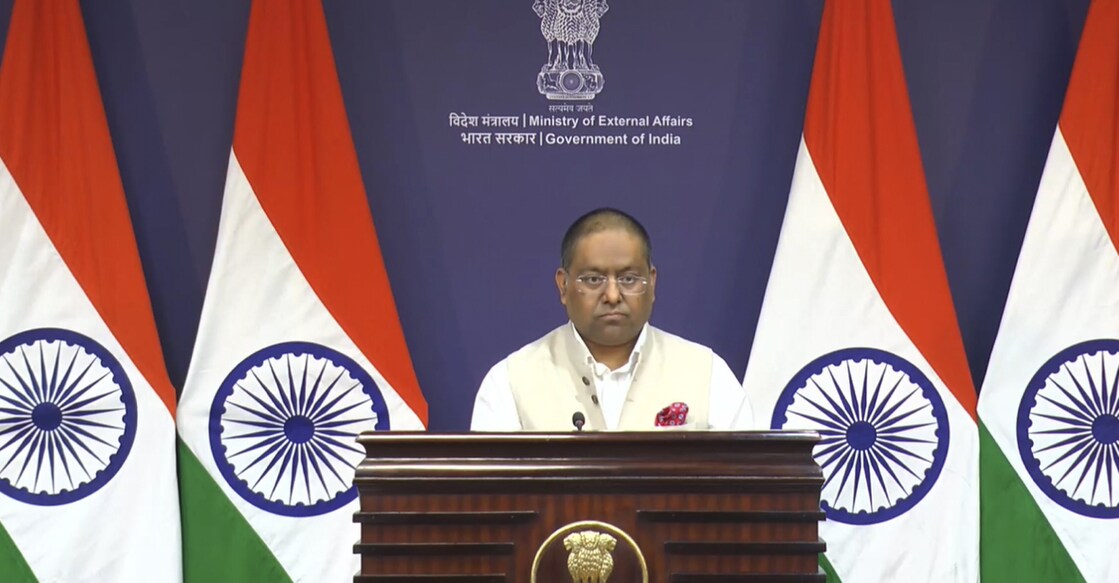
Addressing the media, Ministry of External Affairs (MEA) spokesperson Randhir Jaiswal said, “The military action from our side was entirely in the conventional domain. There were some reports, however, that Pakistan National Command Authority will meet on 10th May but this was later denied by them. Pakistan FM has himself denied the nuclear angle on record."
Reiterating India’s consistent position, Jaiswal added, “India has a firm stance that it will not give into nuclear blackmail or allow cross border terrorism into invoking it.”
India also confirmed that the recent ceasefire understanding with Pakistan was finalised directly between the Directors General of Military Operations (DGMOs) of both nations, following a formal request from Pakistan. Jaiswal said the specifics, including the date, time, and wording, were finalised during a phone call at 15:35 hrs on 10 May. Pakistan’s High Commission had requested the call at 12:37 hrs, but initial technical issues delayed the connection. The timing was eventually fixed based on the Indian DGMO’s availability.
“The Indian Armed Forces compelled Pakistan to stop firing. Our message was clear and consistent,” Jaiswal said, crediting India’s decisive military posture. Responding to a recent statement by Pakistan, Jaiswal remarked, “That a nation which has nurtured terrorism on an industrial scale should think that it can escape the consequences is fooling itself.
“The terrorist infrastructure sites that India destroyed were responsible not only for the deaths of Indians but of many other innocents around the world. There is now a new normal. The sooner Pakistan gets it, the better it is.” He reiterated that the terrorist infrastructure destroyed by Indian forces was responsible not only for the deaths of Indian citizens but also for the loss of innocent lives worldwide.
Jaiswal also confirmed that India has placed the Indus Waters Treaty (IWT) in abeyance, following a decision by the Cabinet Committee on Security (CCS). “The IWT was concluded in the spirit of goodwill and friendship as specified in the preamble of the treaty.
“However, Pakistan has held these principles in abeyance by its promotion of cross-border terrorism for several decades now. Now as per the CCS decision, India will keep the treaty in abeyance until Pakistan credibly and irrevocably abjures its support for cross-border terrorism.”
He further noted that shifting global and domestic dynamics — including climate change, demographic trends and technological advancements — have introduced new ground realities since the IWT was brokered by the World Bank in 1960. On India’s international engagement, Jaiswal clarified that Indian and US leaders were in contact from the beginning of Operation Sindoor on 7 May until the ceasefire understanding on 10 May. “The issue of trade did not come up in any of these discussions,” he added.
 Add as a preferred source on Google