

Pak PM Shehbaz Sharif confirms Indian strike on Nur Khan Air Base, seeks peace talks
Mail This Article


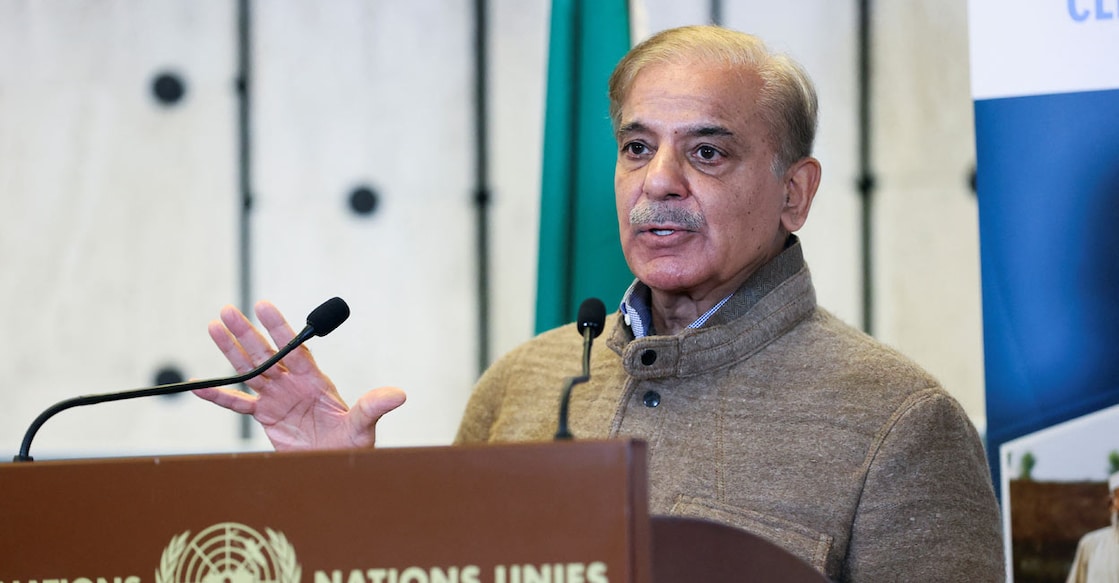
Pakistan Prime Minister Shehbaz Sharif on Friday acknowledged that India had targeted Nur Khan Air Base and several other locations during Operation Sindoor on the intervening night of May 9–10. Speaking at a special ‘Youm-e-Tashakur’ (Day of Thanks) event at the Pakistan Monument, he revealed that General Asim Munir had alerted him at 2.30 am on a secure line about ballistic missile strikes from India.
"One went to Nur Khan Air Base and the rest to several other locations," Sharif said, about the confrontation that was part of a broader military exchange between the two countries. The video of his remarks was shared by BJP leader Amit Malviya on X.
The prime minister’s comments came as Pakistan observed ‘Youm-e-Tashakur’ to honour its armed forces for what Sharif described as a “befitting” and “effective” response to the Indian strikes. He called the military's actions a “golden chapter” in Pakistan’s history and reiterated the country’s right to defend its sovereignty.
India had launched Operation Sindoor on May 7, targeting terror infrastructure in Pakistan in response to the April 22 Pahalgam terror attack that killed 26 people. In retaliation, Pakistan attempted to strike Indian military bases between May 8 and 10, prompting a fierce counter-offensive from Indian forces.
The military escalation culminated in a ceasefire agreement on May 10 after four days of cross-border drone and missile attacks. Sharif expressed gratitude to all friendly nations for facilitating the ceasefire and specifically thanked US President Donald Trump for his “active role”.
Sharif used the occasion to appeal for renewed diplomatic engagement with India. Emphasising the futility of past wars, he said, “India and Pakistan have fought three wars and got nothing. The lesson is to sit down as peaceful neighbours and settle all outstanding issues, including Jammu and Kashmir.”
However, India has made its position clear—that talks can only be held on the return of Pakistan-occupied Kashmir and end of terrorism. “If peace comes, we can also cooperate in counterterrorism,” Sharif added, stressing the need for a regional settlement to ensure lasting peace.
Earlier in the day, Sharif hoisted the national flag at the PM House in Islamabad. Gun salutes were held in Islamabad and provincial capitals, and rallies were organised nationwide to honour the military.
The prime minister also visited the family of Squadron Leader Usman Yousaf, who was killed during the Indian strikes. Accompanied by Defence Minister Khawaja Asif, Army Chief Asim Munir, and Information Minister Attaullah Tarar, Sharif extended his condolences and later visited Rawalpindi’s Combined Military Hospital to meet soldiers and civilians injured in the attacks.
“Pakistan is a peaceful country, but we reserve the right to give a befitting response in defence,” he said.
President Asif Ali Zardari echoed these sentiments, declaring that Pakistan would never compromise on its sovereignty, territorial integrity, or core national interests.
‘Youm-e-Tashakur’ was observed for the second time since the ceasefire was declared. The first observance, held on Sunday, also included nationwide rallies to celebrate the military’s actions during the recent conflict.
 Add as a preferred source on Google