

Jaishankar urges SCO to take uncompromising stand against terrorism
Mail This Article


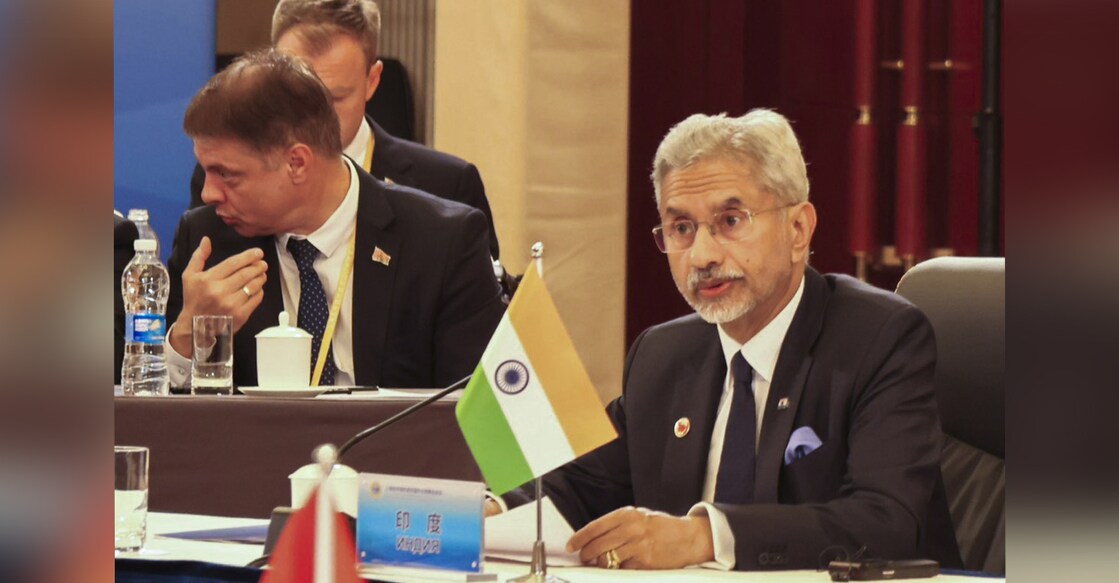
External Affairs Minister S Jaishankar, speaking at the Shanghai Cooperation Organisation (SCO) foreign ministers' meeting on Tuesday, called on the bloc to remain committed to its core objective of fighting terrorism and extremism.
Emphasising the need for an "uncompromising" stance, he strongly defended India’s retaliatory action following the recent terrorist attack in Pahalgam.
Addressing foreign ministers of SCO member states, including China and Pakistan, Jaishankar asserted that the Pahalgam attack was a calculated attempt to disrupt Jammu and Kashmir’s tourism sector and incite communal tension. He stressed that India would maintain a resolute approach in countering such threats.
"Recently, we in India witnessed a graphic example in the terrorist attack in Pahalgam on April 22," Jaishankar said. "The three evils that SCO was founded to combat were terrorism, separatism and extremism. Not surprisingly, they often occur together."
He highlighted that the United Nations Security Council had condemned the Pahalgam attack, stressing the importance of bringing all responsible parties to justice.
"The UN Security Council, of which some of us are currently members, issued a statement that condemned it in the strongest terms and 'underlined the need to hold perpetrators, organisers, financiers and sponsors of this reprehensible act of terrorism accountable and bring them to justice'," he said.
"We have since done exactly that and will continue doing so. It is imperative that the SCO, to remain true to its founding objectives, take an uncompromising position on this challenge," he added.
India had launched Operation Sindoor on May 7, targeting terror camps in Pakistan-controlled areas, following the April 22 incident. The operation led to several days of heavy exchanges, concluding on May 10 after a mutual agreement to cease hostilities.
Jaishankar's remarks also come amid India's unease over China’s backing of Pakistan during Operation Sindoor and Beijing’s repeated obstruction at the UN Security Council to blacklist Pakistan-based terrorists.
He further stressed that the organisation’s collaboration must uphold values like “mutual respect”, “sovereign equality”, and be in line with the “territorial integrity and sovereignty” of all members. These comments are seen as a veiled reference to China's Belt and Road Initiative (BRI), which has faced criticism for ignoring national sovereignty and lacking transparency.
"We will continue to positively approach new ideas and proposals that are genuinely for our collective good," he said.
"It is essential that such cooperation is based on mutual respect, sovereign equality and in accordance with territorial integrity and sovereignty of member states."
He expressed concern over growing global instability and urged the SCO to work together in managing risks and protecting shared interests.
"We meet at a time of considerable disorder in the international system. In the last few years, we have seen more conflicts, competition and coercion," he noted.
"Economic instability is also visibly on the rise. The challenge before us is to stabilise the global order, de-risk various dimensions and through it all, address longstanding challenges that threaten our collective interests."
Highlighting India’s role in the SCO, he pointed out initiatives in fields such as traditional medicine, startups, and digital infrastructure. Jaishankar also stressed the need to resolve current roadblocks to boost connectivity and economic cooperation.
"Deepening collaboration within the SCO naturally requires more trade, investment and exchanges. For that to move to the next level, it is imperative that we address some current issues," he said.
"One of them is the lack of assured transit within the SCO space. Its absence undermines the seriousness of advocating cooperation in economic areas. Another is to ensure the promotion of the International North-South Transport Corridor (INSTC). We are confident that it will continue to gather momentum."
The INSTC is a 7,200-km multimodal network linking India with Iran, Central Asia, Russia, and Europe, aimed at improving regional trade and logistics. India has been an active proponent of the corridor.
Addressing the situation in Afghanistan, Jaishankar said the country’s stability remains a top priority.
"Afghanistan has been long on the SCO agenda. The compulsions of regional stability are buttressed by our longstanding concern for the well-being of the Afghan people," he said.
"The international community, particularly SCO members, must therefore step up with development assistance. India, for its part, will certainly do so."
He concluded by highlighting the SCO’s role in shaping a multipolar world and underlined the importance of consensus within the organisation. "The world is today moving towards greater multi-polarity. This is not just in terms of redistribution of national capacities, but also the emergence of effective groupings like SCO," he said.
"The SCO's ability to contribute to the shaping of world affairs will naturally depend on how well it comes together on a shared agenda. That means taking everybody on board."
The SCO, which now includes India, China, Russia, Pakistan, Kazakhstan, Kyrgyzstan, Tajikistan, Uzbekistan, Iran, and Belarus, is a key economic and security platform. Founded in 2001, it has grown into one of the largest transregional organisations in the world. India and Pakistan joined in 2017, followed by Iran in 2023 and Belarus in 2024.
(With PTI Inputs)
 Add as a preferred source on Google