

Onmanorama Explains | Revisiting Salwa Judum judgement after Amit Shah’s ‘spread of Naxalism’ remarks

Mail This Article


Union Home Minister Amit Shah has stirred a fresh political storm by targeting former Supreme Court judge B Sudershan Reddy, the opposition INDIA bloc’s Vice-Presidential nominee, over his 2011 judgment on Salwa Judum. Speaking at the Manorama News Conclave 2025 in Kochi, Shah alleged that Reddy’s verdict “helped Naxalism spread” and claimed that Left-wing extremism could have been eliminated from India before 2020 had the court not struck down the controversial anti-Maoist militia movement. The controversy comes just days ahead of the Vice-Presidential election, where Justice Reddy is facing the NDA’s nominee, Maharashtra Governor C P Radhakrishnan, a veteran BJP leader.
“Sudershan Reddy is the person who helped Naxalism. He gave the Salwa Judum judgment. Had that judgment not been delivered, Naxal terrorism would have ended before 2020. He was guided by the ideology that led to that verdict,” Shah told the conclave audience during a Q&A session.
Sharp response from judges
Justice Reddy has strongly rejected Shah’s claims. Speaking to NDTV, he said: “I am not a Naxal supporter. The Salwa Judum judgment was not in favour of the Maoists. If it was, why has it not been challenged till now?”
Shah’s remarks also drew a rare collective response from senior members of the higher judiciary. In a joint statement, retired Supreme Court and High Court judges—including A K Patnaik, Kurien Joseph, Madan Lokur, J Chelameswar, Abhay Oka, and Vikramjit Sen—condemned the Home Minister for misrepresenting the 2011 ruling.
“The judgment nowhere supports, either expressly or by implication, Naxalism or its ideology,” the statement said. It warned that “prejudicial misinterpretation of a judgment of the Supreme Court by a high political functionary is likely to have a chilling effect on the judges of the Supreme Court, shaking the independence of the judiciary.” The judges urged political leaders to conduct campaigns for high constitutional offices “civilly and with dignity” and to refrain from name-calling.
What was Salwa Judum?
Launched in 2005 in Chhattisgarh’s Bastar region, Salwa Judum—meaning “peace march” or “purification hunt” in the local Gondi language—was projected as a grassroots tribal uprising against Maoist insurgents. In reality, it became a state-backed vigilante movement.
The BJP government of Chief Minister Raman Singh in Chhattisgarh armed and deployed tribal youth as Special Police Officers (SPOs), while the Congress-led UPA government at the Centre, under Prime Minister Manmohan Singh, supported it with paramilitary deployments and internal security funds. Both parties justified Salwa Judum as part of the national campaign against Maoism, which Manmohan Singh in 2006 had described as “the single biggest internal security threat.”
However, the movement soon became synonymous with human rights abuses. Entire villages were emptied, homes were torched, and families were forcibly displaced. Tens of thousands of Adivasis were pushed into poorly resourced camps. Allegations of sexual assault, killings, forced recruitment of minors, and vigilante excesses mounted, leaving tribal communities trapped between Maoist violence and state-sponsored militancy.
What did the Supreme Court rule in 2011?
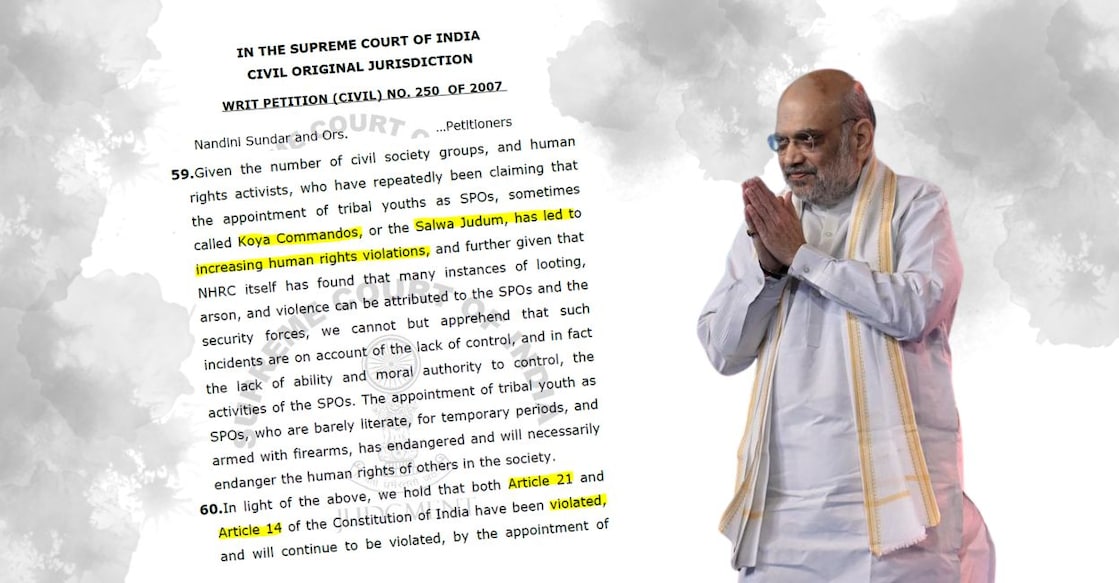
Civil rights activists, including historian Ramachandra Guha and sociologist Nandini Sundar, petitioned the Supreme Court challenging the constitutionality of Salwa Judum. In July 2011, a bench led by Justices B Sudershan Reddy and S S Nijjar delivered a landmark verdict that declared the movement unconstitutional.
The court held that arming civilians and recruiting tribal youth as SPOs to fight Maoists violated Articles 14 and 21 of the Constitution, which guarantee equality before law and the right to life and personal liberty.
The judgment issued sweeping directions:
- Immediate cessation of SPO recruitment: Chhattisgarh was ordered to “cease and desist” from using SPOs in any counter-insurgency role.
- Withdrawal of central support: The Union government was directed to stop funding SPO recruitment or vigilante-style operations.
- Disarmament of civilians: All firearms, rifles, and launchers issued to SPOs had to be surrendered.
- Protection for ex-SPOs: The state was told to provide security to former SPOs against Maoist reprisals.
- Ban on vigilante groups: The order explicitly prohibited Salwa Judum and similar outfits such as the “Koya Commandos,” and directed investigation into past atrocities.
The bench observed: “We recognise that the State faces many serious problems on account of Maoist/Naxalite violence... Notwithstanding the fact that there may be social and economic circumstances, and certain policies followed by the State itself, leading to emergence of extremist violence, we cannot condone it. The attempt to overthrow the State itself and kill its agents, and perpetrate violence against innocent civilians, is destructive of an ordered life.
The primordial value is that it is the responsibility of every organ of the State to function within the four corners of constitutional responsibility. That is the ultimate rule of law.”
By attacking Reddy’s judicial record, Shah has revived attention on the Supreme Court’s intervention in the Salwa Judum case and cast the Vice-Presidential contest as an ideological clash over how India should confront extremism — a path the judiciary has already declared unlawful.
 Add as a preferred source on Google