

ISRO scripts history as ‘Bahubali’ rocket places heaviest communication satellite CMS-03 in orbit
Mail This Article


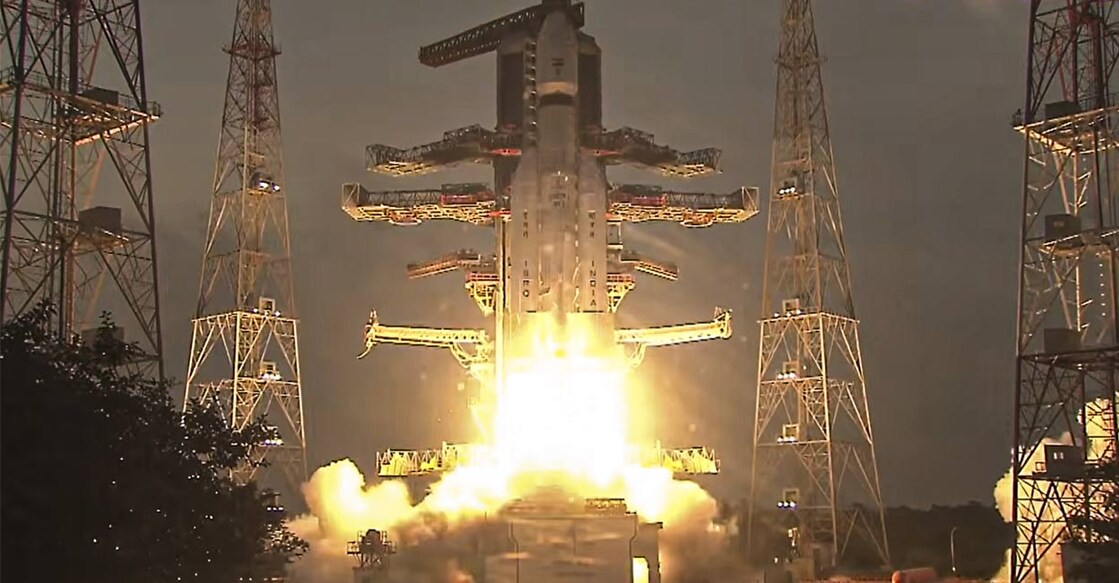
Sriharikota (Andhra Pradesh): India on Sunday achieved another major milestone in its space journey as the Indian Space Research Organisation (ISRO) successfully launched its heaviest communication satellite, CMS-03, onboard the homegrown LVM3-M5 rocket from Sriharikota.
The 4,410-kg satellite was precisely placed in the intended Geosynchronous Transfer Orbit (GTO), marking a major step in India’s self-reliance in space technology. CMS-03, a multi-band communication satellite, will provide services over a wide oceanic region, including the Indian mainland. It also serves as a replacement for the GSAT-7 series launched in 2013.
ISRO Chairman and Secretary, Department of Space, V Narayanan, hailed the successful mission as “yet another shining example of Atmanirbhar Bharat.” “The 4,410-kg satellite has been precisely injected into orbit,” he said, referring to the LVM3 launcher as ‘Bahubali’ for its heavy-lift capability. He recalled the rocket’s previous triumph with Chandrayaan-3, calling Sunday’s mission “another proud moment for the nation.”
Despite challenging weather conditions, ISRO scientists ensured the mission’s success, Narayanan added.
The launch marks the fifth operational flight of LVM3, also known as GSLV Mk-III, and its eighth successful mission overall—maintaining a 100% success record. The three-stage vehicle comprises two S200 solid boosters, an L110 liquid stage powered by twin Vikas engines, and an indigenous C25 cryogenic upper stage.
Until now, ISRO has relied on France’s Arianespace and the Kourou launch base in French Guiana for deploying heavier satellites. With the LVM3, India now possesses full self-reliance to launch satellites weighing up to 4,000 kg to GTO and up to 8,000 kg to Low Earth Orbit (LEO).
The satellite is designed for a mission life of at least 15 years. Its success reaffirms India’s capability in launching heavy communication satellites from its own soil, a feat that once required foreign collaboration.
ISRO classifies its launch vehicles based on payload weight and targeted orbit:
- PSLV, the agency’s trusted workhorse, carries payloads up to 1,750 kg.
- GSLV, with a cryogenic upper stage, handles satellites of around 2,200 kg.
- SSLV serves lighter payloads up to 500 kg in Low Earth Orbit.
- LVM3, the most powerful of them, now enables heavy satellite launches independently.
The LVM3’s indigenous development, including its cryogenic stage, was first demonstrated in 2014 with the CARE mission (Crew Module Atmospheric Re-entry Experiment). The same rocket configuration—when human-rated—will power the upcoming Gaganyaan mission, India’s first human spaceflight program.
With this successful launch, ISRO has not only reaffirmed its technical prowess but also reinforced India’s position among nations capable of independently deploying heavy communication satellites.
(With PTI inputs)
 Add as a preferred source on Google