

Pradhan's resignation not just a minister's downfall, but Modi's political setback
Mail This Article


The achievement of the youth uprising initiated by the CJP is far greater than securing the resignation of Dharmendra Pradhan. It has inflicted a far deeper wound that would only worsen and rot: it has shattered the painstakingly cultivated image of Narendra Modi as an invincible ruler and exposed the hollowness of the carefully nurtured myth of Amit Shah's mastery of political strategy. Faced with a revolt he neither understood nor anticipated, Shah fell back on the only instinct that has repeatedly guided this government, to silence, discredit and crush every dissenting voice, every democratic cry.
Narendra Modi's greatest political asset has never been his governance; it has been the image that surrounded him. For more than a decade, that image appeared almost impregnable. It rested on the belief that he possessed an extraordinary ability to shape public opinion, dominate political communication and bend the national conversation to his will. During this uprising, however, that carefully inflated image was punctured before the eyes of the country. Young people transformed the Prime Minister into the subject of thousands of memes. The aura of sanctity that had been so meticulously constructed around him was stripped away. They laughed at him, mocked him, caricatured him, and, in the privacy of their bedrooms as well as in public gatherings, subjected him to the ordinary irreverence that democratic politics reserves for those in power. The memes they created are unlikely to disappear with the dispersal of the crowds from Jantar Mantar. They have entered the political memory of a generation. Long after the tents have been folded and the slogans have faded, those images will continue to circulate, reminding people that even the most carefully manufactured political persona can be reduced to ridicule.

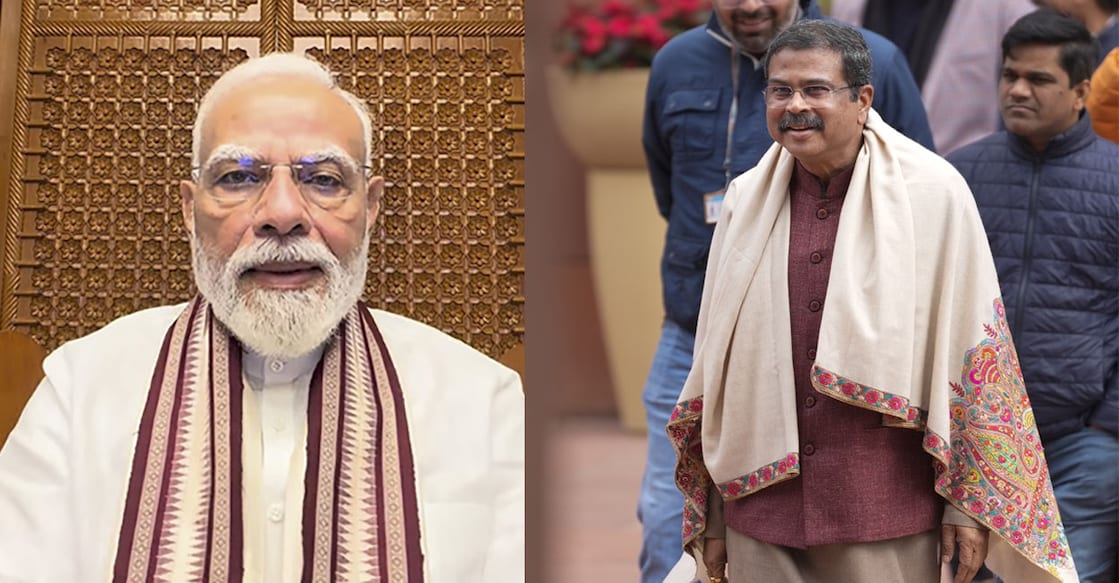
We must recognise that Dharmendra Pradhan's resignation is widely seen not merely as the fall of a minister but as Narendra Modi's own political retreat. The government will undoubtedly present it as a statesmanlike act of responsiveness or as a calculated exercise in damage control. The young, however, see it differently. They see it as the moment when an apparently unyielding Prime Minister was compelled to bend before the collective will of the country's youth. He yielded only after a nationwide wave of anger and public humiliation threatened to gather such force that it could no longer be contained. Before conceding, he and his formidable propaganda machinery exhausted every familiar tactic.
The movement was described as foreign-funded, instigated by Pakistan, manipulated by the Opposition and infiltrated by hidden conspirators. Government-friendly television channels sought to trivialise the protests, question the motives of the students and reduce their demands to partisan politics. The youth were demeaned as misguided. The young watched this campaign unfold in real time. They therefore do not interpret Pradhan's resignation as a democratic acknowledgement of public sentiment but as a reluctant admission of political defeat.

In an ideal democracy, the language of victory and defeat ought not to define the relationship between a government and its citizens. Governments are expected to listen, not to wage war against those who question them. But once a government begins to treat its critics as enemies, it should not be surprised if citizens, too, begin to confront it as an adversary. This government deployed every instrument at its disposal to exhaust the protesters.
It attempted to isolate them, malign them through a pliant media and break their morale. The young saw through each of these strategies. They responded not with despair but with the stubborn courage that only youth can summon. They endured police batons, pellet guns and intimidation, yet refused to abandon the streets. They understood that they were engaged not in a passing protest but in a prolonged democratic struggle, and they prepared themselves accordingly.
Somewhere along the way, Narendra Modi appears to have concluded that the problem lay not with the government's conduct but with his own communication. He was advised that Instagram remained an unconquered territory, and he entered it with the familiar confidence that had long sustained his political success. Surrounded by admirers who never ceased to celebrate his rhetorical brilliance, he seemed convinced that his powers of communication, even those that many among India's intellectual elite have admired, would effortlessly win over the young. Instead, the young laughed. They dismantled the carefully rehearsed performance, exposed its artifice and transformed the country's most formidable political communicator into the object of collective ridicule.
This is, above all, a victory of speech. The young fought with words, imagination and their own bodies. They astonished their elders not merely with the sharpness of their wit but with the steadiness of their resolve. If this movement leaves behind one enduring lesson, it is this: do not be afraid. Trust your democratic instinct. Do not surrender your moral judgment to those who govern. Refuse to let the state occupy your conscience.
This may well become the moment when a nation, inspired by its own youth, begins to recover its lost voice. Whether India proves equal to the task that its young have now set before it is a question only the future can answer.
(The author is a professor at the University of Delhi and a writer.)
 Add as a preferred source on Google