

Modi, Shah must face Parliament, says Mallikarjun Kharge; flags caste discrimination, job crisis
Mail This Article


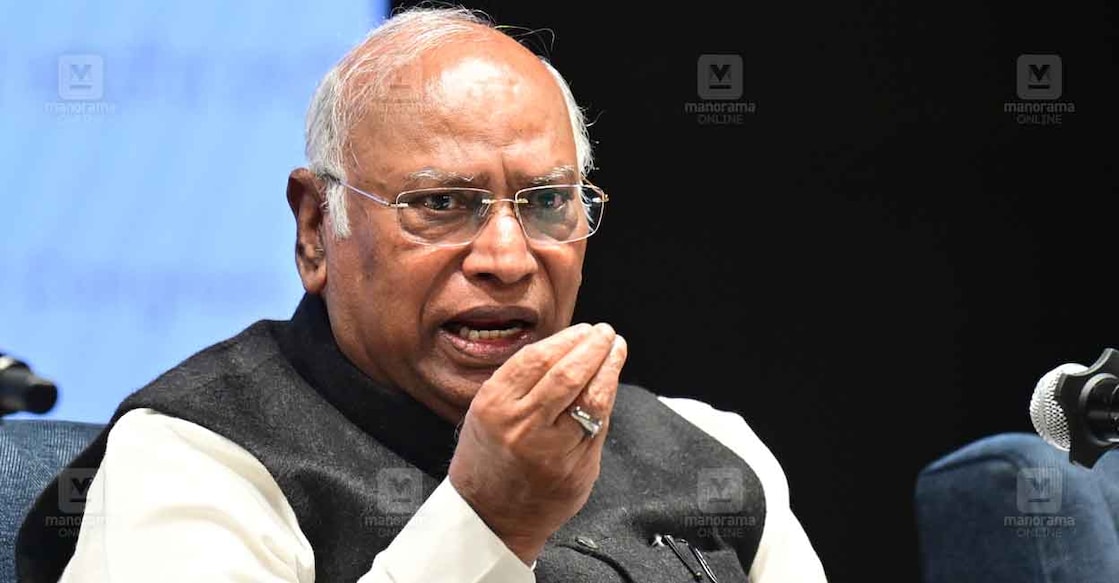
In an exclusive interview on Independence Day, Congress chief Mallikarjun Kharge spoke to Malayala Manorama, launching a scathing attack on Prime Minister Narendra Modi and Home Minister Amit Shah for their absence from critical parliamentary debates. Kharge, a veteran of Indian politics, addressed various issues, including the recent student protests, the education system, caste discrimination and the future of the opposition coalition.
A persistent battle against social prejudice
Addressing the controversial 'purification ritual' that reportedly took place in Haldwani, Uttarakhand, after his visit, Kharge expressed concern that such practices persist even in the 80th year of India's independence. He attributed this mindset to the deeply rooted caste hierarchy championed by the RSS-BJP ideology. Historically, Dalits have suffered the most under this system, a social injustice that Dr BR Ambedkar fought against throughout his life.
Kharge emphasised that the Congress has consistently stood against caste discrimination and untouchability. Having personally fought this injustice throughout his career, he clarified that the true challenge lies in transforming societal attitudes. True freedom, according to him, will only be achieved when every citizen can live with dignity, free from discrimination based on their birth.

Lip service versus real action
When asked about BJP leaders promising to investigate the purification incident, Kharge questioned their sincerity. He pointed out the gap between hollow political statements and concrete action. While leaders may express regret or distance themselves from such acts, the ground reality remains unchanged.
Untouchability is not merely a social issue but a direct assault on human dignity that often escalates into violence. Referring to past instances at the Jagannath Temple involving Union Ministers and the President, Kharge urged the BJP leadership to address the root causes of discrimination rather than offering cosmetic condemnations after the event.
Beyond identity politics
Kharge rejected being categorised solely as a Dalit leader, stating that his politics is anchored in the Constitution and Dr Ambedkar's vision of social justice. Having risen through decades of hard work and struggle, he recalled how former Prime Minister Indira Gandhi and senior leader Devaraj Urs recognised his potential, giving him opportunities to serve. He underscored that the primary objective of the Congress was to ensure every Indian had the chance to succeed through merit and hard work. He contrastingly criticised the current BJP-RSS government, warning that the constitutional guarantee of equality was under severe threat today.
The unfulfilled promise of social equality
While the Constitution granted the historic right of 'one person, one vote', Kharge argued that political equality was hollow without social and economic democracy. He cited National Crime Records Bureau (NCRB) data showing a sharp rise in crimes against Scheduled Castes over the last decade, from 33,000 cases in 2012 to over 57,000 in 2022. Low conviction rates under the Scheduled Castes and Scheduled Tribes (Prevention of Atrocities) Act point to systemic gaps in justice delivery, leaving millions of Dalits without genuine protection.
A journey shaped by struggle
Reflecting on his challenging childhood, Kharge recalled how he and his father rebuilt their lives after their house was destroyed in a fire. His father, a mill worker, prioritised education, a belief that guided Kharge throughout his life. Later, Kharge studied law to help mill workers fight for their rights against powerful owners. Growing up in Gulbarga, he was deeply influenced by the speeches of national leaders like Jawaharlal Nehru and Dr Ambedkar, who shaped his lifelong commitment to democracy, social justice, and secularism.
Evasion of parliamentary accountability
Kharge criticised the government's conduct during the Monsoon Session of Parliament, stating that there was no genuine effort to ensure smooth functioning. The opposition's sole demand was for the Prime Minister and the Home Minister to address the House on major issues. Instead, the government avoided accountability and blamed the opposition. Kharge noted that this session would be remembered for the Prime Minister's prolonged absence, showing a lack of respect for parliamentary traditions.
An advisory to the leadership
When asked what advice he would offer the PM and the Home Minister, Kharge urged them to face Parliament, answer questions, and engage with elected representatives. He highlighted that students and citizens have a right to know who ordered police actions against peaceful protests. A strong government, he noted, does not fear scrutiny but actively addresses it.
Addressing youth unrest and educational crises
The Congress and the INDIA bloc have consistently raised concerns over unemployment and the recurring paper leaks in competitive examinations. Kharge pointed out that since 2014, there have been over 150 paper leaks under five different education ministers. Ideological interference from the RSS has further weakened educational institutions. Despite demands to allocate at least 6% of GDP to education, spending remains under 2.5%.
The current job crisis is unprecedented, with millions of young Indians struggling to find stable employment. Coaching centres charge exorbitant fees, forcing parents to deplete savings or mortgage assets. When exams are cancelled due to paper leaks, it shatters the dreams of entire families. The NEET crisis alone has seen tragic instances of student suicides, showing the devastating human cost of this systemic failure. In response, Rahul Gandhi launched the 'Chhatron Ki Goonj' initiative to give voice to student grievances, supported by nationwide protests by the NSUI and Youth Congress. Kharge praised the courage of young students protesting at Jantar Mantar despite facing police high-handedness.
Reforming the education sector
The Congress's 2024 manifesto outlines a clear roadmap for educational reform, emphasising increased public spending and decentralised consultation with students, educators, and state governments. Kharge criticised the National Education Policy (NEP) for lacking broad consensus and accused the government of trying to politically manipulate school curricula by removing key chapters on the independence struggle and legendary leaders like Nehru, Gandhi, Patel, and Maulana Azad. He warned against replacing scientific inquiry with superstition and regressive ideologies.
He also questioned the effectiveness of newly announced committees to look into exam reforms, noting that experts' previous recommendations have been largely ignored. The Congress remains committed to standing with students in their fight for fair examinations, quality education, and secure futures.
The demand for a comprehensive caste census
Kharge reiterated the party's demand for a nationwide caste census, a key promise in the Congress's recent manifestos. While the government has finally agreed to conduct the census, Kharge expressed concern over the methodology and questionnaire design. He argued that the exercise must be scientific and aimed at understanding socio-economic disparities to guide effective policy-making, rather than being treated as a mere political exercise. The Congress-led surveys in Telangana and Karnataka serve as robust models that the Union Home Ministry should replicate.
Maintaining opposition unity
Addressing questions on the cohesion of the INDIA bloc, Kharge dismissed rumours of discord, emphasising that the opposition stands united on core issues of federalism, democratic institutions, and constitutional balance. He argued that no regional party can compromise its state's interests for short-term political gains.
Delimitation and federal balance
Kharge expressed concern over the proposed delimitation process, stating it should not be used as a political tool to benefit specific regions. States that have successfully implemented family welfare and population control measures should not be penalised with reduced political representation. The INDIA bloc remains committed to protecting the federal balance and ensuring fair representation for all regions.
The culture of political opportunism
Having remained loyal to a single party flag for nearly six decades, Kharge expressed disappointment over politicians frequently switching sides for career advancement. He noted that while such opportunism might yield temporary benefits, long-term political survival depends on ideological commitment and credibility. He expressed optimism about the younger generation of leaders emerging through youth wings, who are driven by ideals rather than mere convenience.
Hope for India's future
Despite the current challenges of unemployment, social division, and economic stress, Kharge remains deeply optimistic about the nation's future. He credited the resilience of Indian citizens and the impact of the Bharat Jodo Yatra for reviving hope in democratic values. He concluded by asserting that the collective strength of the youth and constitutional advocates will drive a positive political transition in the coming years, restoring the core values of justice, equality, and social harmony.
