

Nepal floods: Rescue ops resume amid flood warning; death toll rises to 676; around 500 Indians missing
Mail This Article


The death toll from flash floods in central Nepal rose to 676 on Saturday, with more bodies being recovered and nearly 2,000 people still missing following the disaster.
A total of 4,451 people have been rescued from affected areas in Nepal so far. Among them are 129 foreign nationals, including 85 Indians, and 191 people who were trapped in tunnels at various hydropower projects. At least 101 injured people are undergoing treatment at hospitals in Kathmandu.
Search and rescue operations entered their fourth day on Saturday, with 7,451 security personnel deployed, including 2,391 Nepal Army personnel. Helicopters have been used to reach isolated areas and evacuate survivors, while ground teams continue searching riverbanks and downstream settlements.
The scale of the disaster has also put pressure on morgues in several areas, with bodies swept downstream from Rasuwa and Nuwakot being recovered as far away as Chitwan, Tanahun, Nawalparasi and Gorkha.
Meanwhile, around 500 Indians remain uncontactable, and another 400 are stranded on the Chinese side of the Nepal-Tibet border but are safe and in contact with their families, according to the latest updates from Indian authorities.
Search and rescue operations resumed at full pace after a brief slowdown triggered by fears of another flood following a rise in water levels in the Bhotekoshi River area.
The National Disaster Risk Reduction and Management Authority (NDRRMA) warned of the possibility of another flood after water mixed with mud accumulated at the site of Wednesday's devastating flash flood.
"The water level mixed with mud has increased at the same place where the flash flood occurred on Wednesday, and there is a risk of more flooding in the area," the NDRRMA said.
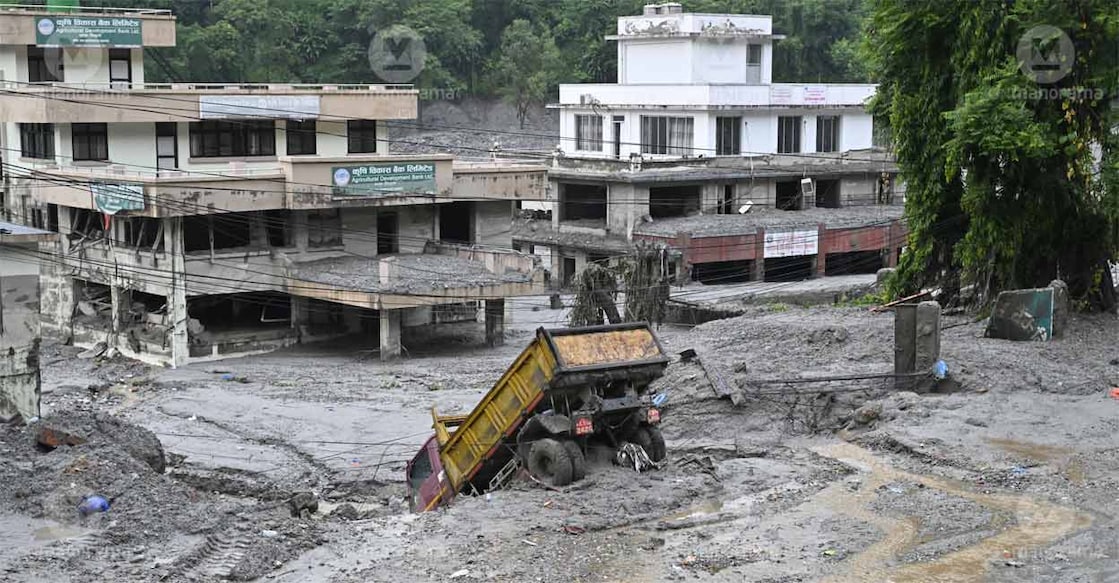
The warning came after a massive flash flood swept through Rasuwa and other parts of central Nepal on Wednesday, killing hundreds and causing widespread damage to settlements, roads, bridges and hydropower infrastructure.

The NDRRMA urged people involved in search and rescue operations, as well as those living in the Bhotekoshi and Trishuli areas, to remain alert and move to safer locations if they face any risk.
China warns of barrier lake
China issued a Level-IV alert late on Thursday after a large barrier lake formed near the confluence of the Chhochen Khola and Purepu Tsangpo rivers in Nepal.
Chinese authorities informed Nepal that around two million cubic metres of water had accumulated in the lake, with another three million cubic metres potentially flowing into it over three days, raising concerns about a possible breach.
The rivers originate in Tibet and flow into Nepal as part of the Bhotekoshi river system.
320 Indians remain missing
India's Ministry of External Affairs (MEA) said at least 320 Indian nationals remain uncontactable following the floods. Another 400 Indians are stranded on the Chinese side but are safe and in contact with their families.
MEA spokesperson Randhir Jaiswal said 153 Indian nationals stranded in China had safely crossed into Nepal. The ministry also said 63 Indians working at the Trishuli-One hydropower project had been rescued.
Around 100 people of Indian origin are also uncontactable. They may have been travelling for the Kailash Mansarovar Yatra but hold nationalities other than Indian, Jaiswal said.
The MEA released a photograph of 53 Indians who crossed from China into Nepal. The group includes 37 people from Maharashtra and has reached Kathmandu.
Twenty-one Indians arrived in New Delhi on Friday after reaching Kathmandu from flood-affected areas of Nepal a day earlier. External Affairs Minister S Jaishankar received the group at the airport.
Jaishankar also held a high-level meeting with senior officials to review the situation, with a focus on tracing missing Indians. Indian envoys in Kathmandu and Beijing joined the meeting virtually.
"Discussed the relief and rescue efforts underway in Nepal today. Our Embassies in Kathmandu and Beijing provided an updated picture in respect of the status and well-being of Indian nationals," Jaishankar said.
India has sent 57.5 tonnes of emergency supplies to Nepal since Wednesday night using three military transport aircraft. The latest consignment, comprising 10 tonnes of relief material, was sent on Friday evening.
India has also sent an 11-member team of doctors and paramedics, along with a reconnaissance team to assess rescue operations in hydropower tunnels.
Jaiswal said India had offered Bailey bridges and associated technical teams to help restore connectivity in flood-hit areas. New Delhi has also offered to deploy National Disaster Response Force (NDRF) teams and equipment to support search and rescue operations.
"We stand ready to offer any assistance that the Nepal authorities might require," Jaiswal said.
Jaishankar said the immediate focus was on supporting Nepal's relief and rescue efforts.
Nepal denies reports of refusing assistance
The Nepal government has decided to suspend all examinations from August 29 in view of the situation following the disaster. Prime Minister Balendra Shah and his cabinet members have also decided to donate a month's salary to the disaster relief fund.
The cabinet directed the finance ministry to prepare a relief, concessional financing and rehabilitation package for individuals and businesses affected by the floods.
Nepal has also denied reports that it refused assistance from friendly countries and the international community. Foreign Minister Shisir Khanal said the government had prioritised deploying its own security forces because they were familiar with the country's rugged terrain and local environmental conditions.
"International assistance was not rejected but the rescue strategy was decided based on national capacity, immediate need and Nepal's unique geographical situation," Khanal told Nepal's National News Agency.
