

60-year-old woman returns to her childhood place to save lives

Mail This Article
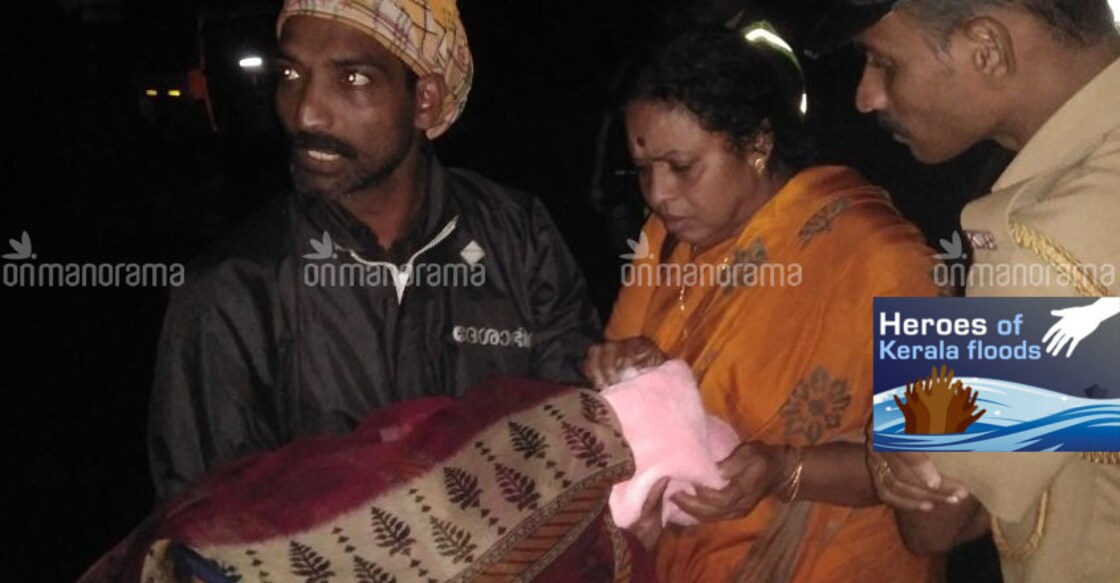
It was on August 16 afternoon that 60-year-old Krishnakumari heard that Puthuvel, Mooleputhuvel, Arunoorilputhuvel and Komencherychira areas in Changanassery were getting submerged fast. She rushed to the spot, asked the men standing around dumbstruck to arrange as many boats as possible, and without wasting time, waded through chest-high waters yelling at people in fast-sinking houses to pack all their important stuff.
Being a councillor of Changanassery Municipality, and its former chairperson, it was only natural that she coordinated the rescue effort. The police, the Navy, revenue officials and locals took orders from her. The last of the families, five women and an asthmatic child, were rescued and brought to safety by 2.30am on August 17. “All of us were scared but together we managed to bring people to safety,” Krishnakumari said.
Return to childhood
But the face of the asthmatic child who was one of the last rescued haunted her. “I just could not sleep. I saw how frightened the child was. I thought of my childhood,” she said. Early morning she got hold of a large fibre boat and a small wooden boat, collected a bunch of youngsters including her son, and set out south to Mithrakkari in Kuttanad. “That was where I lived till I was 16, and I knew the place like the back of my house. I heard the place was badly flooded and wanted to be of some help,” Krishnakumari said.
It took the team an hour to reach Mithrakkari, and she was shocked to see how the waters had transformed the place. “There was no land to speak of. The water had completely taken over,” she said. Scattered far were isolated islands. In between, the top floors of houses could be seen. People were also found on narrow bridges that were already under water.
“We anchored the big boat in the water and used the small boat (which was tugged along) to pick people from chappaths (bridges) and houses,” Krishnakumari said. When the boat couldn't move forward because a bridge or a fallen tree had stood in the way, she and her team pushed the boat out of the water, dragged it through small patches of dry land and pushed it back into the water on the other side.

They did some four trips till dark, each time ferrying some 15-20 people to safety. From Mithrakkari, they travelled downstream along Puthukkari, Oorikkari (the place she was born) and Koduppana.“There were many who did not want to leave their homes and we had to cajole them, and at times even act stern with them, to get them into the boat,” she said. She also found it strange that there were not many boats around. “There was a time when almost all houses in Kuttanad had a boat,” she said.
The boats she used were available only for a day. So she returned home in a tractor. “We knew there were many more left in these small islands,” Krishnakumari said. So the next day, August 18, she asked the oarsman of the first boat she saw whether he could take her to Mithrakkari. He agreed. Since this was a smaller boat that could accommodate not more than eight people she went alone with the oarsman and the motor operator, both strangers to her.
Stranded, by chance
This time it took nearly three hours for the boat to reach Kuttanad. There were many people on top of the nearly submerged Narayanamangalam bridge after Mithrakkari. “I stepped out of the boat so that they could accommodate three children,” Krishnakumari said. The boat left without her, and did not return.
“They found more people in distress in other banks and they went on picking stranded people in other areas. Since I didn't know these people I didn't have their numbers with me. I found myself stranded,” she said. After a while, when her mobile charge had almost fully drained out, she barely managed to inform her son. Her accidental desertion, however, turned out to be a blessing in disguise. Her son and a friend came to pick her in a navy boat, which they then used to rescue more people. Nearly 90 people were saved. Krishnakumari had by then turned into a legend of sorts that she was the first person finance minister Thomas Isaac inquired about when he visited a camp in Changanassery on August 23.
Heart-rending farewell
What touched her most during these two days of struggle was the sight she witnessed at the house of an old couple. “They were waist-deep in water but were not particularly happy to see us. After helping us to lift his wife into the boat, the old man went back, pushing through the rising water, to his cattle shed. There were 12 cows. One by one he untied the rope from their necks. Then he walked back and got into the boat. There were tears in his eyes. As we moved away we could see the cows straining to swim our way,” Krishnakumari said.
 Add as a preferred source on Google