

Like in Ayodhya, Hindu sanyasins take over Sabarimala agitation
Mail This Article
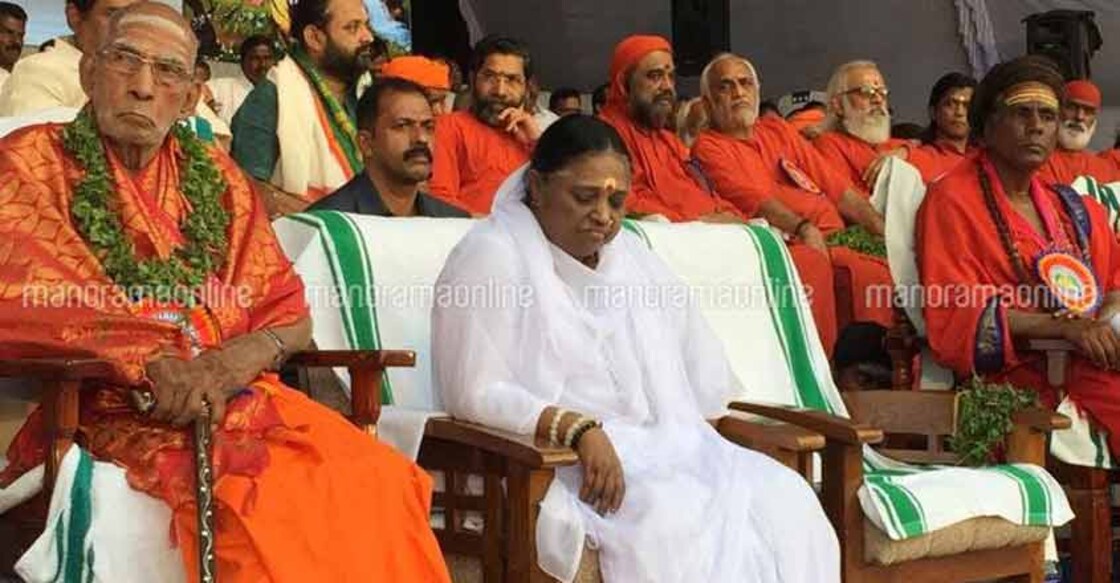
On Sunday, when the BJP's indefinite fast against the government's actions in Sabarimala had a tame end in front of the Secretariat, the Sabarimala agitation acquired an Ayodhya-like flavour. Right wing forces led by saffron-clad sanyasins staged a massive show of strength in the capital.
Sabarimala Karma Samithi, which organised the Ayyappa Bhaktha Sangamam (Congregation of Ayyappa Bhakts), has given the Sabarimala agitation a new direction. Where the politicians had apparently failed, spiritual leaders have stepped in. Top BJP leaders, including state president P S Sreedharan Pillai, were seated among the audience. In sporting terms, it looked like they have been benched.
Inaugurating the Sangamam, Mata Amritanandamayi said: “What took place in Sabarimala is unfortunate.” “Tampering with temple customs could invite unpredictable consequences,” she added. Thousands of devotees from across the state and hundreds of Hindu spiritual leaders from across the country took part in the Sangamam.

There were emotional calls to protect the customs and rituals of Sabarimala. Persecution of Hindus was the theme. The temple was used as a pivot around which mass Hindu mobilisation was sought to be achieved.
No one was in doubt who the real target was. Chief Minister Pinarayi Vijayan and his government. The congregation, though packed with saffron clad sanyasins, was animated more by politics than spirituality. At times, war cries were uttered. “Ayyappa will take care of Vijayan,” a saffron-clad speaker said. It felt a throwback to the late eighties and early nineties when the belligerent appeals of Hindu sanyasis powered the Ayodhya movement.
The presidential address of Swami Chidanandapuri was a scathing critique of Pinarayi Vijayan's police action in Sabarimala. “260-odd policemen took two pure women bhakths, a Rehna Fathima and another whose name I can't recollect, in police disguise up the hill,” he said. “It was just the bold statement of the tantri that he would shut down the temple and the opposition mounted by devotees that prevented the women from entering the shrine,” he added.
He said it was the chief minister's haste that precipitated the crisis. “The Supreme Court verdict was just a declarative order, which meant that there was no deadline specified for the implementation of the verdict. The chief minister could have called all stakeholders and tried to evolve a consensus. He should have prepared the people for the change,” Chidanandapuri said.
Ministers M M Mani and G Sudhakaran also came in for ridicule. “Let us forget M M Mani,” he said, hinting that he was best left ignored. “But it has to be said that no one had been as concerned about sanyasins as Sudhakaran. While we were in school it was usual for our mothers to ask us whether we had our underwear on. But as we grew older even our mothers were not concerned. But here we have a minister who makes it a point to ask us about our inner wear,” he said.
Former DGP T P Senkumar, one of the main speakers of the day, said that it was the state government's stand that brought the Sabarimala verdict upon the state. “Two of the five lawyers who argued for the state finally backed out saying they were cheated,” he said. The former DGP, using right-wing patois, said there was a conspiracy against the Hindu religion. “All our problems could be solved if a small amendment was made in the Constitution saying that the majority too will enjoy the same benefits as the minority in the country,” he said.
Mata Amritanandamayi, making her inaugural speech, said temple customs had to be preserved. She sought to make a distinction between the omnipotent God and a temple deity. “They are as different as a fish in ocean and a fish in a house tank. The fish in the tank has to be taken care of, not the one in the ocean. This is also why it is said that the deity is a minor. Like a child is taken care of by the mother, the deity also has to be properly attended to by the priests and devotees,” she said.
 Add as a preferred source on Google