

After August deluge, June's scorching betrayal leaves Kerala's power sector in dire straits

Mail This Article
The southwest monsoon this year has been too irregular for the comfort of Kerala's rain-dependant power sector. There has been a 40 per cent rainfall deficiency by the end of June.
The water level in the state's hydel reservoirs has dropped to a scary 11 per cent; it was way back in 2002 that water levels had plunged lower than this. Holding on to even this level now looks improbable because daily power consumption is on the rise. Normally, a rain-soaked June would have seen a fall in consumption, especially because air-conditioners and fans would be rested.
Not this time. Daily consumption that should have remained at around 73 million units is inching upwards to near 80 MU, to near summer levels, giving no respite to the state's quick-depleting water levels in dams. The KSEB has curtailed hydel generation as much as it can but it still cannot prevent water loss.
Water haemorrhage
On June 29, for instance, the generation or outflow from KSEB's reservoirs was only 9.2 million units, down from nearly 19 MU on June 1. (During May, daily hydel generation had crossed 25 MU). But since the inflow into the reservoirs, dependant fully on rains, was just 2.88 MU on the day, the KSEB lost over 7 MU units of water that day.
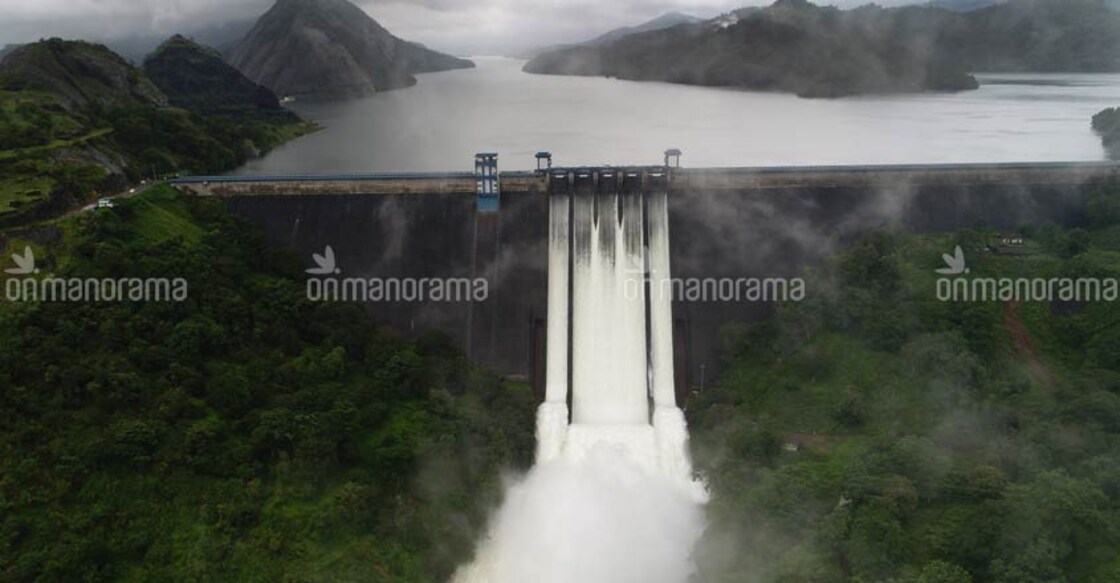
Consider the state's largest dam, Idukki. The usage was 1.98 million units on June 29. But the inflow was zero on the day. If last year the Idukki dam was filling up eerily, this time it is drying up fast. Last year same time, Idukki had water to generate over 1000 million units. Now, it has water to generate just 300 MU.

But if the KSEB desperately holds on to the little water it has in its reservoirs, there will be a price to pay. It will have to depend on costly outside purchases.
Waning hydel power
Even when things are smooth, the KSEB procures more than 70 per cent of its total daily requirement of 3700 MW from outside sources.
Internal generation, mostly hydel and a namesake quantity from renewable sources like wind and solar, make up for just about 30 per cent of the state's needs if it used its full potential. Last May, for the first time ever, the daily demand touched 4,316 MW. Then, the contribution of hydel to the state's power needs shrunk further.
At the best of times when consumption is reasonable, hydel stations can give the state some 1200 MW. At this stage, given the desperate need to conserve some water in the dams, it is not possible. Not even a quarter of the potential of dams under the KSEB's control is now being tapped.
Growing demand deficit
The KSEB secures 1,215 MW from long- and short-term agreements it had already struck with power producers within and outside the state. Since these agreements were struck early, the power comes at a reasonable price of Rs 4 a unit.
Another 1,724 MW flows from the central pool, from central generating stations in various parts of the country; this power is cheap, comes at an average of around Rs 2.5 per unit.
This leaves a deficit of nearly 500 MW that the KSEB now has to make up by purchasing from distress purchase markets where the power prices will be exorbitant. “It is true that on certain days the cost will be high,” a top KSEB official said.
Banking profits
Nonetheless, the official said that not all additional power needed to be bought at back-breaking prices. “We have made good use of the amazing inflow that we had during August last,” the official said.
The KSEB had in the official's words “banked” some additional power that the utility could generate using the extra inflow with power utilities in other states. For instance, KSEB had “banked” some power with Rajasthan Urja Vikas Nigam Limited last year in a swap arrangement.
Now, when the going got tough in the state, the Rajasthan power utility has returned with interest the power KSEB had deposited with it last year. “The RUVN has returned the power during June, making up for some of our deficit free of cost,” the official said.
Gamble that worked
Power minister M M Mani, too, insisted that the KSEB was in no trouble. He said the surplus water stock in the reservoirs during the heavy rains last year came in handy after August last year. Hydel generation more than doubled for three months from August when compared to the corresponding period in 2017.
For instance, hydel generation was 1,008 million units in August 2018. During August 2017, it was only 438 MU. “The additional power generated was either sold to other states in need at a high price or banked with them to be returned later,” the minister said.
However, hydel generation was drawn down dramatically to below 2017 levels since December last after a pale northeast monsoon. This move, on hindsight, was a masterstroke.
Even though the state witnessed record levels of consumption during May and hydel stations had to be overworked during the whole of summer, KSEB still managed to have more than adequate water stock in its reservoirs by June 1.
Normally, KSEB keeps water necessary to generate just 550 MU of power, a sort of reserve stock, in its reservoirs by June 1, the arrival of monsoons. This time it had water to generate 652 MU. This was one reason why the failure of monsoon in June has not really pushed the KSEB to the wall. “As it stands, there is nothing to suggest that we will have to impose power curbs this year,” M M Mani said.
However, there is fear that if the monsoon continues to play truant, KSEB will run out of options.
 Add as a preferred source on Google