

Modi's late cut: Govindan tries hard to break partnership with Adani
Mail This Article


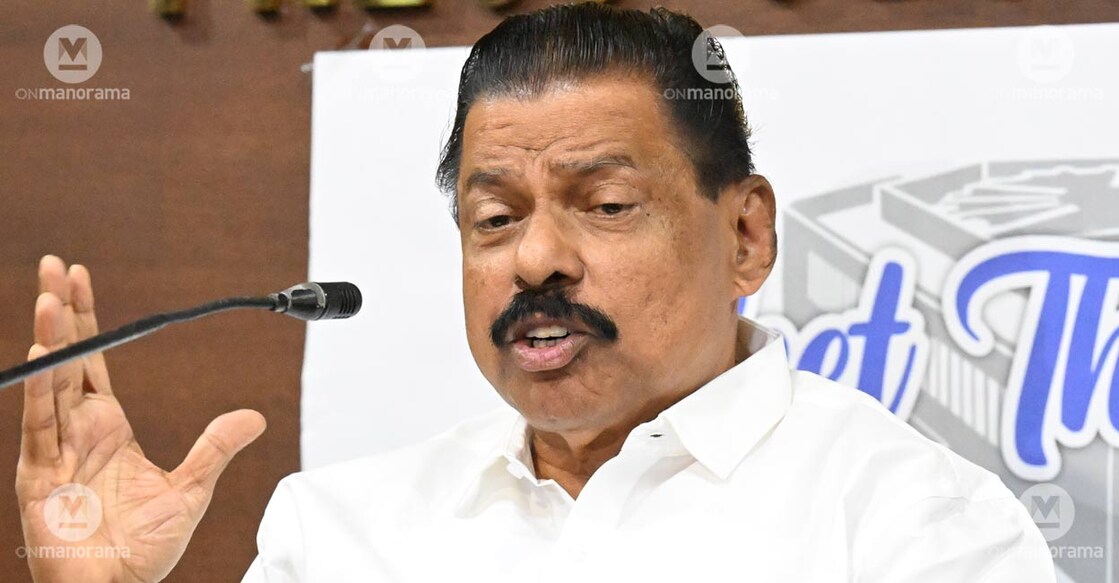
CPM state secretary M V Govindan on Monday struggled to shake off the awkwardness his party had to suffer on May 2 when Prime Minister Narendra Modi gleefully reminded that Kerala's ports minister had called Adani "partner". "See, this is a minister of a communist government speaking," Modi had publicly made fun of V N Vasavan's use of the noun "partner" to describe Adani at the Vizhinjam port dedication ceremony.
After the Modi sucker-punch, the CPM state secretary sounded eager to scratch out the glossy Adani trace on its working-class red flag. Yet, he was not ready to fully disown Adani either.
Govindan's argument was that the CPM could not be blamed for Adani's supremacy in Vizhinjam. He blamed it on Oommen Chandy. "We (The CPM-led government under V S Achuthanandan) had envisaged only a limited role for the private sector in Vizhinjam. Our plan was to mobilise money (₹2,500 crore) using SBI as the lead bank, but the UDF government that came to power in 2011 threw out our scheme. Instead, they adopted a scheme that had privatisation at its core," Govindan told reporters after the meeting of the CPM state secretariat. "The agreement was devised in such a way that 99 per cent of the profits will flow to Adani," he said.

Nonetheless, he said the LDF government that came to power subsequently did not withdraw from the project as it would have been legally untenable. In short, Adani was a private burden the Oommen Chandy government had forced upon the Pinarayi Vijayan government.
Even if Adani was a bitter pill to swallow, Govindan said that the CPM was not against private capital as the Prime Minister made it out to be. "We have never been fully against privatisation, nor have we ever said private capital should not be accepted. Our stand is that the government should have the upper hand (in any venture). As part of it, occasionally, other capitalist forces will also have to be included," Govindan said.
This grudging but careful acceptance of private capital was taken at the CPM's 18th Party Congress, held in April 2005. It was the prospect of foreign loans that necessitated a policy prescription. "The 18th Party Congress (2005) had clearly stated that state governments should be able to utilise funds that are not anti-people and not tied to many conditions," the CPM state secretary said.
Here is what the 18th Congress said: "The thumb rule that must guide our governments as well as other institutions in deciding the acceptance of such funds (loans from international agencies like World Bank, ADB, DFID, JBIC and the like) must be based on an evaluation that this will provide some relief to the people and lead to economic improvement without compromising the state government’s autonomy in economic decision making."
Govindan said that even China was accepting foreign funds. "It was Deng Xiaoping (the most powerful figure in the People’s Republic of China from the late 1970s until his death in 1997) who said in the early 1990s that China would become a land free of poverty and unemployment by 2020. In these 30 years, see how China has grown. And one of the major factors that propelled this growth was foreign investments," Govindan said.
He said the CPM had long before identified private investments as one of the sources that could be tapped to improve the lives of people in Kerala. "So don't be under the impression that the party would squirm at the mere mention of private," he said.
It was clear that he did not endorse the "partner" qualification that Vasavan had given Adani. "We have not seen Adani as a partner but for the successful implementation of the project we have taken the assistance of Adani," he said.
So does it mean that the privatisation aspect has been taken out of the Vizhinjam project, he was asked. "Now also, it is part of privatisation. We did not sabotage the pact (made by the UDF government), we came as a continuation of another government. If we had decided to end the project, there would have been legal trouble, and the project would have ground to a halt. Calling off the project was not part of our agenda," he said.
Govindan was also asked the most obvious question. Why would the party describe as its "partner" a business conglomerate that was identified as the symbol of crony capitalism under Narendra Modi. He said Adani in Vizhinjam was not crony capitalism.
He gave a curious explanation for crony capitalism. According to the CPM state secretary, it meant the government-corporate-official nexus that sold off off public assets at low costs. The general understanding is, crony capitalism is a system where certain businesses thrived on their unfair closeness to the ruling elite and the top bureaucracy. "In Vizhinjam there is no attempt to sell of anything and so it is not crony capitalism," he said.
 Add as a preferred source on Google