

NH 66 work of KNR leaves Malappuram houses with cracks, slush, no water & access

Mail This Article


When Illickal Majeed, a 50-year-old autorickshaw driver from Malappuram, gave up a portion of his ancestral land to facilitate NH-66 construction, all he had on his mind was development and better access. A few months on, he can't drink clean water. If he has to reach the main road, he cuts through narrow paths in front of neighbouring houses. When it rains, slush fills the house. If it doesn't, he breathes dust. A heart patient, Majeed, struggles to protect what is left of his home.
He gave away a small parcel of land close to his house for ₹60,000 on the promise of an approach road. His house is located near the construction site of the Edarikkadu flyover and drainage system, part of the ongoing six-lane expansion of National Highway 66. KNR Constructions Ltd (KNRC) is the implementing agency, which has come under flak for the highway collapse at Kooriyad in Malappuram.
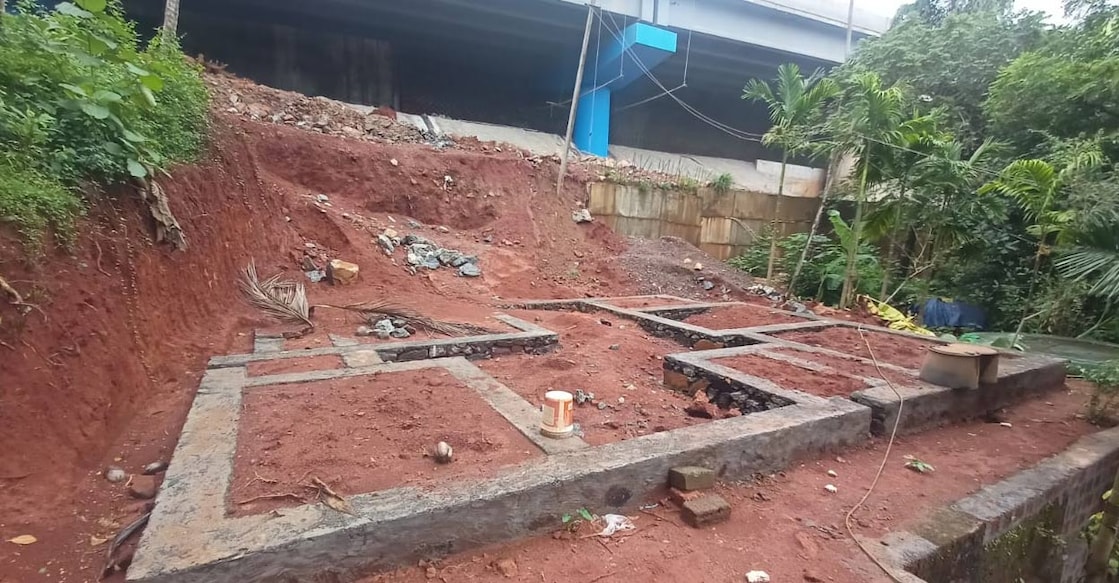
The road that once provided direct access to his house has disappeared. In its place is an “ill-planned” drainage system that channels water uncontrollably from the elevated structure, threatening to flood his courtyard, damage his home, and contaminate the family’s well.
“They assured me of a service road and a protective wall when they took the three-meter-long path to my residence,” says Majeed. “But nothing was delivered. Now, water from the flyover pours straight into my yard and house.”

The run-off first floods a basement Majeed had started building three years ago for his elder son, Muhammed Sijas, before spreading to the rest of the property. “I wanted to complete the house before my son’s wedding,” he says. “But with the highway work blocking access, we couldn’t even bring in the materials. Now, the basement is at risk of collapsing.”
At least ten households share Majeed’s ordeal in the area. New and old homes alike show cracks. Courtyards are often buried under layers of silt. Wells are polluted, and the air is thick with dust when it’s not raining.“There was a proper road in front of my house, used even by the contractors during construction,” he recalls.
Majeed and his family must walk nearly a kilometre to access the nearest main road. “When my mother collapsed three years ago, I had to carry her on my shoulder to reach the road. She passed away days later at the hospital,” he recalls. “We admitted my daughter-in-law days before her delivery, fearing the same ordeal.”
Majeed, a heart patient, has battled dust, waterlogging, and worsening health. “During the dry season, the air is full of dust. I’ve already suffered a heart attack once. Still, we kept quiet, thinking this road would bring development.”
Their well, once the family’s primary water source, is now contaminated. “We now buy drinking water when it's raining. During each rainy season, I hire earthmovers at least three or four times to remove the soil and sludge that collect in the yard, but even that doesn’t help when water levels rise too much.”
The promise of infrastructure — drainage, roads, boundaries — was fulfilled selectively, Majeed alleges. “For some, they built safety walls to protect homes. For me, nothing. It’s clear: they help only those who are rich or influential.”
Majeed’s neighbour, Abubacker, 57, knows the feeling. A blood cancer patient undergoing regular dialysis, Abubacker, built a new house with his compensation sum. But water from a nearby drainage now surrounds his property, flooding the land and entering the well. “There’s a public water line, but the supply lasts only 30 minutes a day. If it’s damaged during highway works, we could go without water for weeks.”
“The house is only three years old, yet cracks have appeared. Heavy drilling shook the entire area,” he says. “They took our land, and now the water from their drainage runs through what remains. What’s left is unusable. We are the victims of the project.” Like Majeed, Abubacker also hires earthmovers multiple times a year to clear flood-deposited soil.
An under-construction drainage near a local madrassa, a poorly planned one, now causes overflow. The contractor reportedly drilled a hole and redirected water underground, directly into neighbouring lands, endangering especially students and children who use the area.
Another neighbour, Arumukhan, faces an imminent threat. “There’s a drainage right into his courtyard. So far, they haven’t opened it. The day they do, it’s over for his house, too,” Abubacker says.
Locals say authorities have failed to connect new drainage systems to proper water bodies or build new outlets.“They’ve diverted all the water into old monsoon-only streams that is used as walkways during other seasons,” Majeed explains. “These channels can’t handle the volume and now overflow, causing widespread flooding.”
Majeed has approached the National Highways Authority, KNRC, Malappuram Collectorate, panchayat officials, and even dialled PWD Minister Muhammad Riyas. “Officials from the minister’s office assured me they would look into it. Later, they stopped answering my calls,” he says.
Meanwhile, KNRC liaison officer Ashraf told Onmanorama that he had informed higher officials about Majeed’s situation. Majeed was told a solution would come by May 8 from the district collectorate. “But like all other promises, that too didn’t happen.”
Cracks on Majeed’s walls, an eroding thatched roof, and an unfinished house meant for his son now symbolise neglect. “I can’t even invite my relatives or even my ailing sister Unnima here. She’s a cancer and kidney patient. How would she walk all the way here?” he asks.
 Add as a preferred source on Google