
Kerala forest officials stand guard for old woman living on forest fringe in Kasaragod

Mail This Article


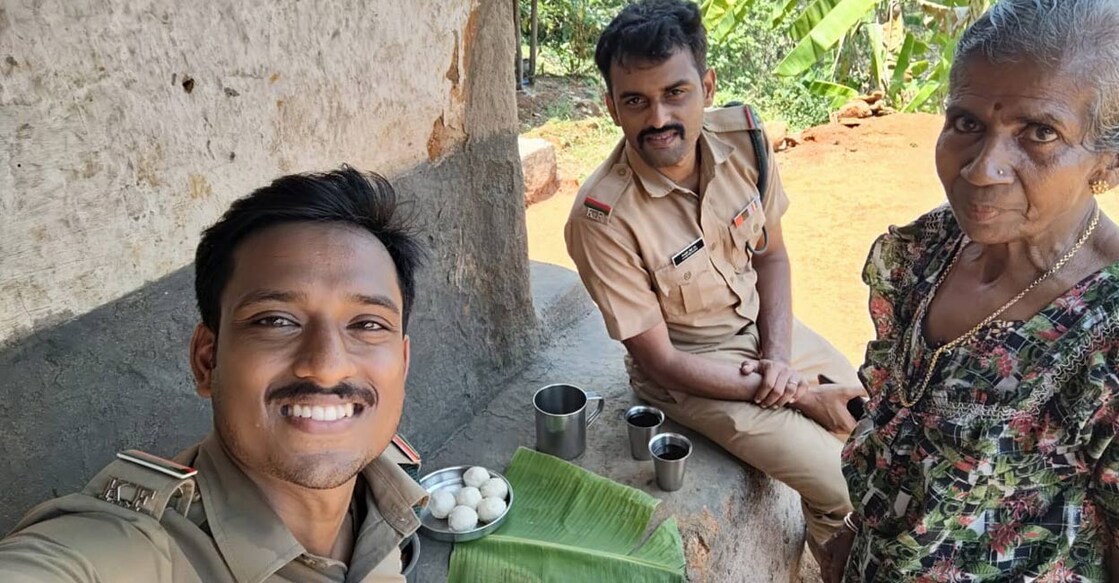
In her mud-walled home at Sreemala, a remote settlement in Kuttikol grama panchayat, bordering the Bandadukka forest in Kasaragod, a 68-year-old Vedavathi spends nights in fear. Her home, devoid of electricity, is dimly lit by a flickering kerosene lamp. Often the woman stays awake at night as wild elephants roam around precariously close to her dwelling on the fringe of forest. These days, she has company. Concerned by her situation, forest officials from the Mandakole Beat have taken it upon themselves to keep her safe.
Her modest house, with clay-tiled roofing and surrounded by fallow land with jackfruit and cashew trees, attracts elephants searching for food. With no electricity and poor eyesight, she wouldn’t know even if an elephant were right outside. "I stay indoors at night. I wouldn’t even see them coming," says Vedavathi.
“We came across her house during a routine patrol and saw she was living alone in a high-risk area. That’s when we began staying here on nights when high elephant movement is reported,” said MP Raju, Bandadka Section Forest Officer.
The team—comprising Mandakole Beat Forest Officers RK Rahul, B Vineeth, M Athira, and Sumithra B—takes turns keeping night vigil at her house. Raju himself stayed with her in the early days. "Sometimes, when we informed her that we were coming, she would prepare and keep food for us; other times, we took food for her," said BFO Rahul.

Karnataka forest officials alert the Kerala team when elephants cross from the Chulliyar range, prompting heightened surveillance and warnings to residents.
Vedavathi lost her husband, Maudhappa, 15 years ago. Her son Guruprasad works as a daily wage labourer in Karnataka, while her daughter Thilaka is married and lives in Kasaragod. A member of the Gowda community, Vedavathi speaks a mix of Kannada and Malayalam. She has no well or bathroom. Water is fetched from a stream downhill—an increasingly difficult task due to her age and poor vision. "I can’t walk far or carry heavy pots. But what can I do? I have to live somehow," she says. Cooking is done outdoors. Mobility issues and weather conditions prevent her from going to ration shops.
On stormy nights, if the forest officials are not there, she walks nearly half a kilometre to her neighbour Udayakumar Rao’s house—the last on the stretch and the only one with electricity—and stays there. “Her son visits once in a week or two. In summer, she lights fires to deter animals, but during rains, that’s not possible,” said Raju.
She uses a basic button phone, which she cannot read. Forest officials have set themselves as speed dial number 6 to ensure she can call them easily in emergencies.
The land around her house, once cultivated, now lies fallow—making it a natural corridor for wildlife. "Most neighbouring houses have solar fencing, but Vedavathi’s plot, jointly owned by family members living elsewhere, remains unfenced, giving animals easy access," Raju added.
Forest officers are working to improve her living conditions. Beat Officer Rahul said they are coordinating with the Kerala State Electricity Board (KSEB) to lay seven electric poles, with the board agreeing to do the work at no cost. According to Kuttikol panchayat member K R Venu, Vedavathi’s is the only house in the area without power. Around 25 poles will be required to bring electricity to her doorstep. She can only access her house through a narrow footpath, with the nearest motorable road located half a kilometre away.
According to BFO Rahul, Divisional Forest Officer Ashraf has agreed to give ₹1 lakh to construct a bathroom and basic needs for her. The land near Vedavathi's house, almost five acres, is jointly owned with relatives across Kasaragod and Karnataka. Since the property is not in her name, she is ineligible for several government welfare schemes. Her ration card is marked APL due to the landholding. “We’ve requested her relatives to transfer at least the house and a small portion of land to her name so that she could avail of government pension and other benefits,” said Rahul.
 Add as a preferred source on Google