

Bharat Bandh: University exams cancelled, KSRTC buses blocked across Kerala
Mail This Article


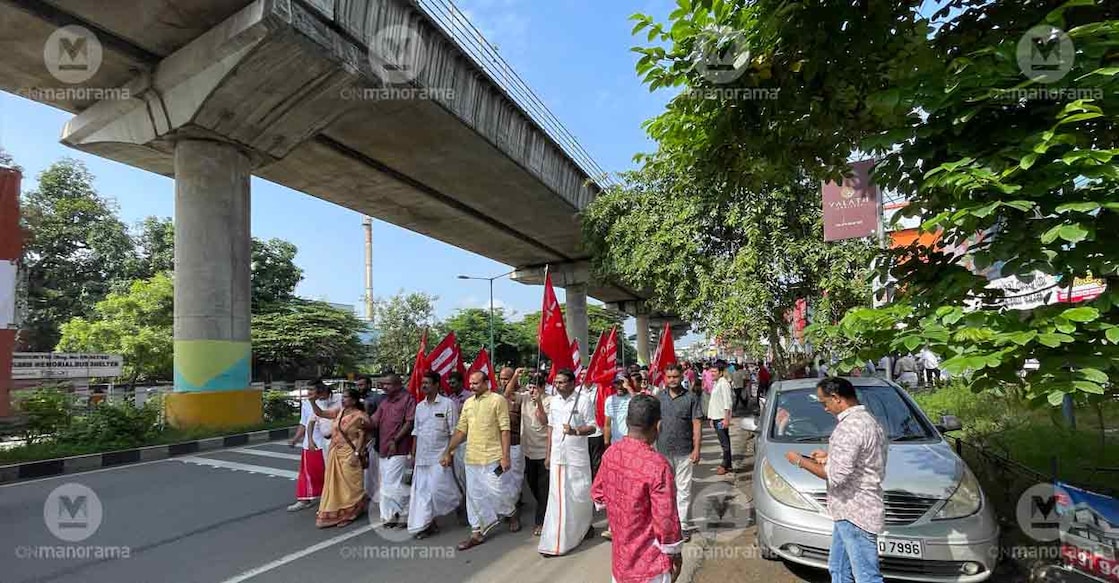
Thiruvananthapuram: The nationwide general strike called by central trade unions and farmers’ organisations started at midnight on Wednesday, significantly impacting services across the country. While essential services, the railways, and tourism have been exempted from the strike, most other sectors witnessed disruptions.
In Kerala, the impact was widespread. Public transport has been partially paralysed with private buses and some KSRTC employees joining the strike. On Wednesday morning, trade union workers blocked buses in Kochi, Kollam, and Thiruvananthapuram. In Kochi, a low-floor bus to Kozhikode was blocked by CITU workers, despite bus staff affiliated with BMS saying they had opted out of the strike and received no help from police. In Kollam, a Swift bus to Amrita Hospital was also stopped. While long-distance buses are running in Kozhikode from other depots, no services are operating from the city depot. In the capital, all KSRTC services are halted, forcing patients and other passengers at the railway station to rely on police vehicles and BMS-backed autorickshaws. Despite the Transport Minister's earlier assurance that services would run as usual, KSRTC unions joined the strike shortly after his statement.
Universities postponed examinations, including Kannur University’s MBA second-semester exam, which has been rescheduled from July 9 to July 27. Despite the state government declaring a 'dies non' and restricting leave for its employees, government offices and educational institutions are witnessing low attendance. Many shops and eateries across the state remain closed.

The strike is backed by all major trade unions, except the BJP-affiliated Bharatiya Mazdoor Sangh (BMS). Unions such as INTUC, CITU, AITUC, and others are protesting against the Centre’s economic policies, including the new labour codes and privatisation moves. They are also demanding a minimum monthly wage of ₹26,000, reinstatement of the Old Pension Scheme, and rollback of the Agnipath scheme, among other demands.
Demands and key issues
The 10 central trade unions leading the strike have presented a 17-point charter of demands. Key demands include:
- Repeal of the four labour codes
- End to privatisation of public sector units
- Legal guarantee for Minimum Support Price (MSP) as per the Swaminathan Commission formula (C2 + 50%)
- Comprehensive loan waiver for farmers
- Wage hike to ₹26,000 per month
- Implementation of an Old Pension Scheme and minimum pension of ₹9,000 for EPFO subscribers
- An 8-hour workday
- Halt to fixed-term employment and the Agnipath scheme
- Recognition and ESIC coverage for Anganwadi, ASHA, and midday meal workers
- Creation of a Climate Resilience Fund to address climate disasters
The unions argue that the government's neoliberal policies have worsened unemployment, reduced real wages, and cut funding in essential sectors like education, healthcare, and basic civic services, deepening economic inequality.
Farmers, MGNREGA workers join in
Farmer groups under the Samyukt Kisan Morcha (SKM) are holding parallel rallies at the tehsil level across India. Their key demands include a legal guarantee for MSP, loan waivers, and withdrawal of the National Policy Framework on Agricultural Marketing. The SKM also opposes free trade agreements and privatisation of power.
The NREGA Sangharsh Morcha has also extended support, calling for ₹800 daily wage for MGNREGA workers, scrapping of the NMMS and ABPS systems, and resumption of the scheme in West Bengal.
Strike rescheduled from May
This is the 22nd general strike since the liberalisation era began in 1991. Originally planned for May 20, the strike was deferred due to the Pahalgam terror attack and Operation Sindoor.
A R Sindhu, National Secretary of CITU, estimated that around 25 crore workers from both organised and unorganised sectors are taking part. She highlighted the worsening job insecurity, low wages, and lack of union rights as key grievances. “The right to unionise is the basis of democracy,” she said, adding that the strike marks a deepening alliance between workers and farmers.
Services in banking, insurance, postal, coal mining, construction, and highways are likely to be affected across India. Protest activities such as road blockades and ‘rail roko’ actions are expected through the day.
 Add as a preferred source on Google