

From Assam Rifles to hatching profit in a poultry farm in TVM
Mail This Article


Thiruvananthapuram, the capital city, is a major market that offers plenty of opportunities for farmers. Besides thousands of government employees, an impressive crowd of IT professionals, and the International Seaport at Vizhinjam employing many - hundreds more to come - the city is opening up a vibrant market for the farming community.
However, a question remains: How many could tap the opportunity that Thiruvananthapuram is offering? The skyrocketing production cost might discourage many, making the city totally dependent on farmers in neighbouring Tamil Nadu. Still, those who could cater to the needs of the city's market could reap decent benefits. Siblings Ajayakumar and Vijayakumar of Karakulam are a prime example of reaping the benefits of a city-centric market.
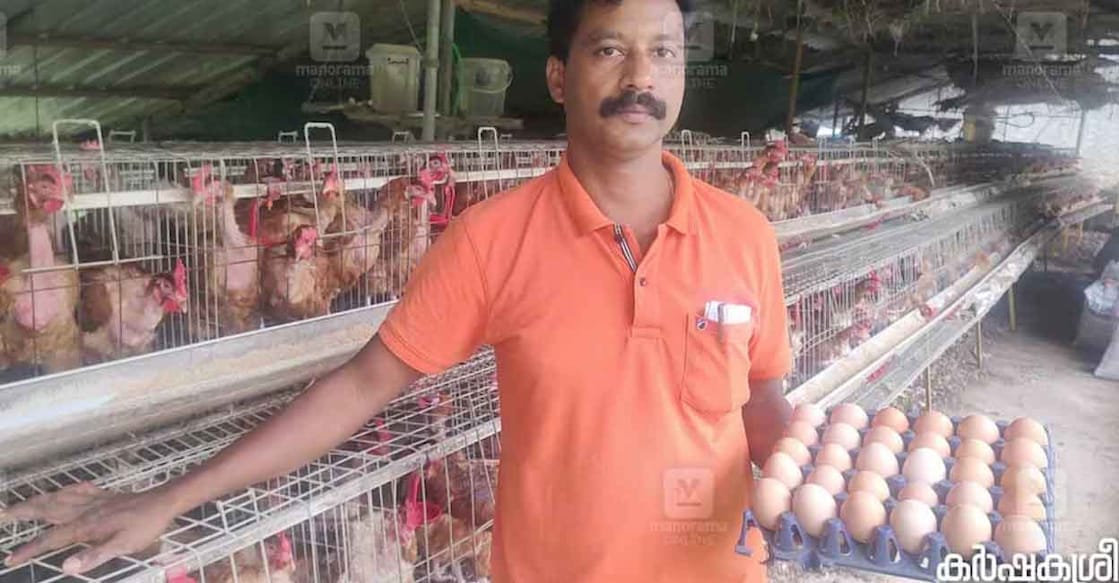
The brothers, both retired from the Assam Rifles of the Indian Army, have converted their ancestral property, spread over an acre at Karakulam, merely 12 km from the city's major transport hub, Thampanoor, into a poultry farm.
They have 5,000 BV 380 chickens and 4,000 quails in multiple sheds, and on average, produce 3,500 chicken eggs and 2,500 quail eggs daily.
BV 380 hens are a hybrid, dual-purpose chicken variety developed by the Venkateswara Hatchery. Used for both eggs and meat, these chocolate-brown-feathered birds, laying uniform brown eggs, are popular among poultry farmers for their high adaptation to heat and humid conditions.
The siblings started their poultry farm in 2017, after retirement from the Army. Both began by purchasing 500 BV 380 chickens each. When the hens started laying 800 eggs daily, marketing them in their immediate neighbourhood became impossible.
The brothers found a solution. They decided to find those who understand the benefits of the eggs of the local breed. They found such consumers, willing to pay more, in Thiruvananthapuram, and decided to ferry the eggs to the city in an autorickshaw, Ajayakumar said.
The ex-servicemen-farmers bought a bigger vehicle as production and demand increased. They brought together other poultry farmers in their area and formed the Fresh Egg Society. The society currently has 67 members, including women.
The USP of the society is that it pays the farmers within 10 minutes of purchasing the product. The business, which started with an autorickshaw, 'graduated' to a Maruti Omni, and now uses a cargo van, covering areas from Neyyattinkara to Kazhakootam.
The society now supplies 6,000-7,000 eggs daily to about 400 shops and hotels at a wholesale price of Rs 7.50 per egg. The original farmer gets Rs 7. If procuring from faraway farms, the society deducts 10 paise from the farmers' profit.
The better returns from the city prompted farmers to scale up poultry farming. Besides eggs, the poultry van now carries plantain leaves, banana flowers, curry leaves, papaya, and vegetables — all locally grown — to city shops. The society also has a separate counter to sell post-lay hens.
Ajayakumar said the society helps in jointly bargaining and slashing the production cost. The city pays at least Rs 1 more than what the farmer gets in rural areas. Meat also gets a better price in the city. Dried poultry manure is another profitable business. The farmers said keeping the manure dry could prevent it from emitting a foul smell. Additionally, the farmers sprinkle diluted EM solution under the cages.
However, Tamil Nadu poses a major challenge. Farmers in Tamil Nadu sell brown eggs in Thiruvananthapuram for Rs 7 apiece, including transportation charges. Ajayakumar said an awareness campaign could help local farmers, who, besides chicken feed, provide their hens with fresh grass and vegetable waste, which enhances the egg quality.
Ajayakumar further said that eggs from outside Kerala could be old and might rot fast. Additionally, at least two eggs in the tray will have their shells cracked.
Fresh Egg Society provides a guarantee of three weeks for its eggs. Also, it replaces damaged eggs with fresh ones.
Phone: 9074034171.
 Add as a preferred source on Google