

Mahadeva Gramam: Kannur village that keeps Gandhi's quiet architect alive
Mail This Article


Kannur: It is 6 pm in Mahadeva Gramam, a village barely a kilometre from Payyannur town. Men in their fifties and sixties, some in white dhotis, others in saffron, perch on the low boundary wall of the Sree Ashtamachal Bhagavathy Temple, their conversation playful and animated against the divine rhythms of a village evening. Cyclists pedal home from work, while freshly bathed men and women make their way to the sanctum for darshan.
One of the elders, noticing a stranger, gestures towards the shrine. "Go in and take photographs," he says. "There are no restrictions here." The weight of that remark becomes clear at the temple's main gateway. Crowning the arch is not a sculpted deity, nor an auspicious motif, but the Lion Capital of Ashoka, India's national emblem.
It is a sight rare in many ways. In a country where politics so often leans on religion, here religion makes space for a constitutional symbol. Yet in Mahadeva Gramam, the gesture feels entirely natural. The village is steeped in the spirit of the freedom movement and carries the name of one of the most indispensable, if understated, 'backroom boys' of India's struggle for Independence: Mahadev Desai.

In a 2021 article for The Telegraph, historian Ramachandra Guha distilled Desai's role with precision: Gandhi's private secretary, translator, counsellor, courier, interlocutor, troubleshooter, chronicler, and even cook, for twenty-five years.
Mahadev Desai was also a prolific writer, diarist, biographer and journalist. He meticulously recorded Gandhi's daily activities, speeches, and correspondence, translated 'The Story of My Experiments with Truth' into English from Gujarati, and authored personal accounts of his life with Gandhi. His writings also covered key leaders, such as Vallabhbhai Patel, Khan Abdul Ghaffar Khan, and his brother, Khan Abdul Jabbar Khan. Guha also recalled a US-based cousin lamenting why there aren't statues of Desai across the country, given his "colossal contribution" to the nation.
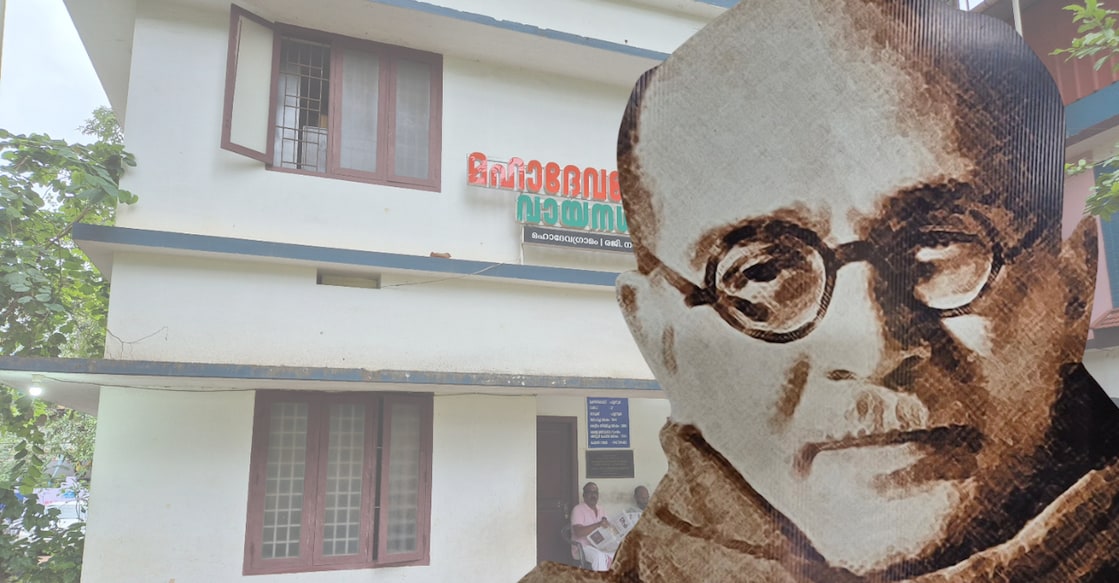
But in 1944, two years after Desai’s death, young freedom fighters in Payyannur established a library in his memory, the Mahadeva Desai Memorial Reading Room and Library, and later renamed the village around Sree Subrahmanya Swami Temple as Mahadeva Gramam. The overworked Desai had died of heart failure on August 15, 1942, exactly five years before Independence, at Pune’s Aga Khan Palace, where he had been imprisoned alongside Gandhi, Kasturba Gandhi, and other leaders during the Quit India Movement. He was just 50.

The youngsters in Payyannur were well aware of Desai's role in making Gandhi the leader he became, said T A Rajeevan, secretary of the Mahadeva Desai Memorial Library. "When they were in jail, Desai too was imprisoned in another state. They discussed his writings and spoke of him in their speeches. So his was the only name proposed for the library, especially since he had died only two years earlier."
Inside the library, a large portrait of Desai is accompanied by Gandhi's words: 'Desai has come to be my hands and feet, and my brain as well, so that without him I feel like one who has lost the use of legs and speech. The more I know him, the more I see his virtues. And he is as learned as (he is) And he is as learned as (he is) virtuous.' Gandhi said this in 1918, a year after Desai joined him at the age of 25. "While students come to the library to read and conduct research, many also step in to take photographs with Desai's portrait," said Rajeevan.
Change the village name
Mahadeva Gramam falls in Wards 28 and 29 (Gramam East and Gramam West) of Payyannur municipality. "It is the heart of the town, considering it is next to the Sree Subrahmanya Swami Temple," said Rajeevan. The town, Payyannur, got its name from the temple - Subrahmanya being Shiva's son, the place was called Payyan-tte Ooru (The boy's village).
But before Mahadeva Gramam, the area around the temple was known as Pattarattu Kovil, said Dr Vinod Kumar K V, a retired assistant professor from Thalassery’s Brennen College. The name was a shortened form of Pattar Yatra Kovil, meaning the place where Tamil Brahmins (Pattars) who lived nearby would walk or gather.
As the freedom movement gathered force, the people in Payyannur developed a strong sense of national consciousness. From the 1940s, reading rooms, arts clubs, and cultural centres flourished, nurturing both literacy and progressive thought. This agriculturally rich region also saw the rise of movements against caste discrimination and untouchability.
In 1934, Gandhi visited Payyannur to meet Swami Anandatheertha, who had been spearheading a crusade against casteism for six years. Residents and historians such as Prof C Balan said records of Mahadev Desai accompanying Gandhi were yet to be seen. Yet, the popularity of his work was known to freedom fighters. "So when leaders suggested renaming the village after Mahadeva Desai, there was no opposition," Rajeevan said.
Two years after Desai’s death, Gandhi’s wife, Kasturba, also passed away at the Aga Khan Palace in 1944. "I have been there," said Dr Vinod Kumar, who was with the Indian Air Force before becoming a teacher. "The British used it to detain freedom fighters. The samadhis of Kasturba and Desai lie side by side inside the prison." Perhaps it is fitting that in Mahadeva Gramam too, near the Ashtamachal Bhagavathy Temple, stands a reading room and library in Kasturba’s name.
"These are not new institutions," said T V Balakrishnan, president of the library. "The year Kasturba died, the people of the village bought a 20-cent plot and registered it in her name. Many were freedom fighters, weavers, and khadi workers." The Kasturba Bai Memorial Reading Room remains a cultural anchor, with over 1,000 active members and 16,000 books, earning it an A+ library rating in Kerala.
Mahadeva Gramam is home to around 14 reading rooms and libraries, several of which have direct ties to the National Movement, with Gandhi’s statue, portrait, or depictions of his famous marches proudly displayed at the entrance.
Dr Vinod Kumar said that naming libraries after Gandhi’s close associates was common in the 1940s. "In Kannur itself, at Muzhappilangad, there is another library in Desai's name. What makes this one remarkable is that it may well be the first, and it gave the entire village a new identity."
 Add as a preferred source on Google