

A potential alternative to rambutan? Check out this exotic fruit, Dukong
Mail This Article


The spread of rambutan, a tropical fruit native to Southeast Asia, was rapid in Kerala. Perhaps, no other fruit, other than the hairy-shelled one, has brought much moolah to the farmer.
Its taste, production, and the revenue it brought soon made rambutan dear to both hobby and commercial farmers in no time. There could be other fruits that taste better than rambutan, but none of them could be commercially produced. And those that could be commercially produced did not bring in a decent revenue.
Rambutan met the expectations of the farmers. It reigned supreme until dukong, a hybrid fruit, showed signs of a potential alternative to rambutan.
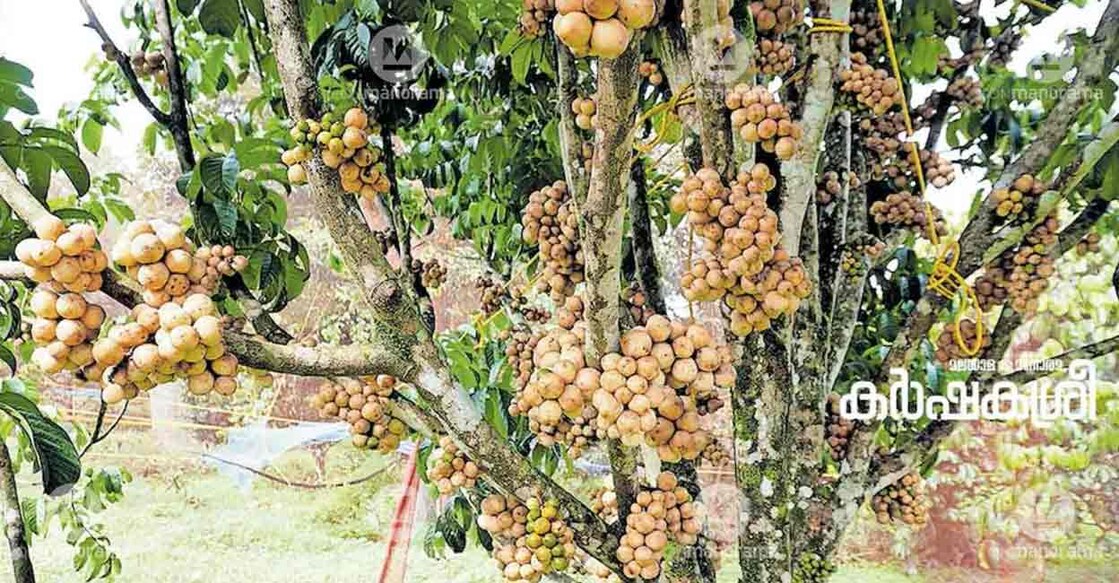
Cultivated widely in Malaysia and Indonesia, dukong is spreading its roots in the farm of brothers Johnson K. Paul and Jilson of Kulappuram near Kaloor in Thodupuzha. The siblings have been farming and harvesting dukong, brought from Malaysia, for the past three years. Bunches of dukong clinging to the branches are a sight to behold.

Dukong is a hybrid of longan, belonging to the same family as the familiar langsat, and an exotic fruit, duku. Though langsat is tasty, its hard shell, sap, and the bitter seed went against it. Longan grows tall and is not too sweet. But, dukong, which grows like bunches of grapes close to the trunk, is sweeter and gives a better yield. Additionally, it could be kept for three to four days after harvesting, which enables long-distance transport. However, care should be taken to avoid moisture to prevent fungal infestation.
Dukong is fleshy with one or two small seeds. Some say that it has a hint of the tanginess of pomelo. When ripened, the outer skin becomes thinner, and the fruit tastes sweeter. Johnson said Malaysia developed the fruit, and very few saplings were exported. Johnson is now producing quintals of the fruit with support from his elder brother Jilson. A marine engineer, he used to experiment with local fruits available at each port of call. After tasting dukong in Malaysia, he brought its saplings to Kerala with the help of a friend.
The saplings should be planted 20 feet apart. However, the brothers could not provide such a distance since they intercropped it with durian. The plant does not need any specific care in the first two years, but in the third year, its branches should be slightly pruned to ensure air circulation.
Still, they need not be pruned annually like rambutan. It normally flowers by the third year, in phases between January and April. The fruits will be ready to be harvested in three months. The fruits are initially green, which turns yellow, and grows larger and darker. Once they turn dark, they could be plucked.
The fertilisers include less urea and more potassium. Johnson said boron and calcium provide better yield. Calcium deficiency often leads to cracks on the fruit. The brothers have not faced any serious pest infestation.
The trees do not run the roots deep, and hence, the chances of them getting uprooted are high.
Though the first lot of saplings bore fruit three years ago, the brothers hid it from society until they were sure that the produce was suitable for our climate and market. Once they were convinced that the crop could be grown in Kerala, they introduced it to other farmers.
However, they have not yet started producing saplings commercially, except for distributing a few grafted saplings among friends. Of the 150 trees on their farm, 100 are bearing fruit.
Johnson debuted fruit farming after slaughtering rubber on five acres. Rambutan was the first crop. Though he wanted to plant dukong and durian, he did not get their saplings. Once he got the saplings, he replaced the rambutan with durian and then dukong. Johnson said the dukong saplings were costly. By 2023, most of the saplings bore fruit. This year, he got 70 to 100 kilograms from each tree.
Phone: 9446208755.
 Add as a preferred source on Google